
7.2 – Circles and Circle Properties and Composite Shapes
Circles are curved shapes with many useful properties. In this topic, we learn how to work with the radius, diameter, circumference, and area of a circle. We also apply these ideas to semicircles, parts of circles, and composite shapes.
The circumference is the distance around a circle, while the area measures the amount of surface inside the circle.
Parts and Properties of a Circle
A circle is a set of points that are all the same distance from a fixed point called the centre.
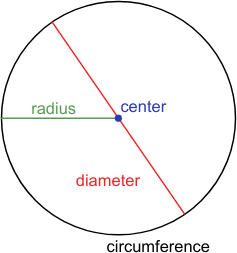
| Term | Meaning |
|---|---|
| Centre | The fixed point at the middle of the circle. |
| Radius | The distance from the centre to the circumference. |
| Diameter | A line segment passing through the centre from one side of the circle to the other. |
| Circumference | The distance around the circle. |
The diameter is always twice the radius:
\(d=2r\)
Therefore:
\(r=\frac{d}{2}\)
💡 Remember:
Diameter goes all the way across the circle through the centre.
Radius goes from the centre to the circumference.
\(\boxed{d=2r}\)
The Number \(\pi\)
The circumference of every circle has a constant relationship with its diameter. This constant is called pi, written as \(\pi\).
\(\pi\approx3.14159265\ldots\)
The decimal continues forever, so in calculations we usually use the \(\pi\) button on a calculator or an appropriate approximation when instructed.
A useful relationship is:
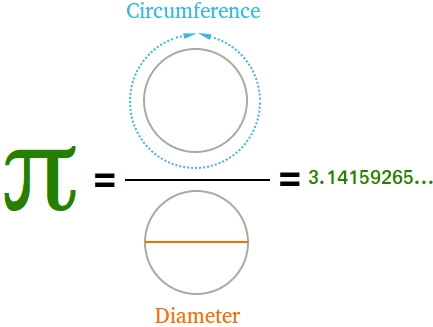
\(\frac{\text{circumference}}{\text{diameter}}=\pi\)
This leads directly to the circumference formula.
Circumference of a Circle
The circumference is the distance around a circle.
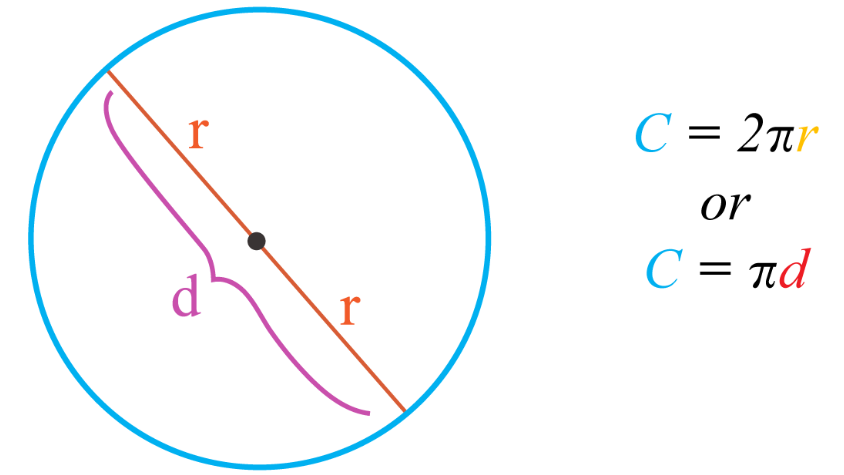
If the diameter \(d\) is known:
\(\boxed{C=\pi d}\)
If the radius \(r\) is known:
\(\boxed{C=2\pi r}\)
Since \(d=2r\), the two formulae are equivalent.
\(C=\pi d\)
\(C=\pi(2r)\)
\(C=2\pi r\)
Example: Find the circumference of a circle with radius \(5\text{ cm}\).
\(C=2\pi r\)
\(C=2\pi(5)\)
\(C=10\pi\)
\(C\approx31.4\text{ cm}\)
Therefore, the circumference is approximately \(31.4\text{ cm}\).
Do not use the radius in \(C=\pi d\).
If you are given the radius, use \(C=2\pi r\), or first find the diameter.
Finding a Missing Radius or Diameter
The circumference formula can also be rearranged to find an unknown radius or diameter.
Starting with:
\(C=2\pi r\)
Divide both sides by \(2\pi\):
\(r=\frac{C}{2\pi}\)
Similarly, from \(C=\pi d\):
\(d=\frac{C}{\pi}\)
For example, if the circumference is \(25.1\text{ cm}\):
\(r=\frac{25.1}{2\pi}\)
\(r\approx4.0\text{ cm}\)
So the radius is approximately \(4.0\text{ cm}\).
Area of a Circle
The area of a circle is the amount of space inside the circle. Area is measured in square units.
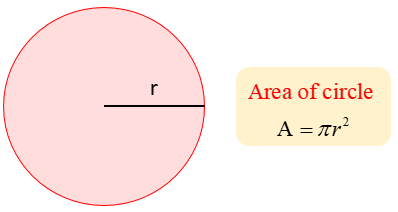
\(\boxed{A=\pi r^2}\)
where \(r\) is the radius.
Notice that the radius is squared. Therefore, the area is not found by simply multiplying the radius by \(\pi\).
Example: Find the area of a circle with radius \(6\text{ cm}\).
\(A=\pi r^2\)
\(A=\pi(6)^2\)
\(A=36\pi\)
\(A\approx113.1\text{ cm}^2\)
Therefore, the area is approximately \(113.1\text{ cm}^2\).
Circumference uses ordinary length units such as cm or m.
Area uses square units such as \(\text{cm}^2\) or \(\text{m}^2\).
Finding Area from the Diameter
The area formula requires the radius. If the diameter is given, first divide it by \(2\).
For example, a circle has diameter \(14\text{ cm}\).
\(r=\frac{14}{2}=7\text{ cm}\)
Then:
\(A=\pi(7)^2\)
\(A=49\pi\)
\(A\approx153.9\text{ cm}^2\)
Always check whether the given measurement is a radius or diameter before using the formula.
Semicircles and Other Parts of Circles
A semicircle is half of a circle.
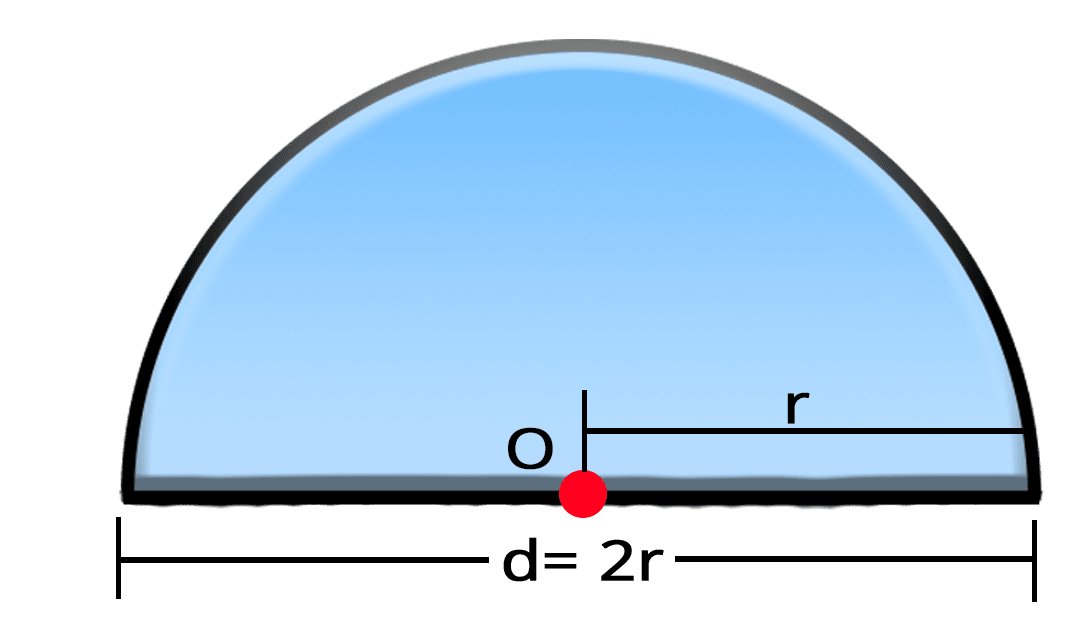
Therefore, the area of a semicircle is half the area of the complete circle:
\(A_{\text{semicircle}}=\frac{1}{2}\pi r^2\)
For a quarter-circle:
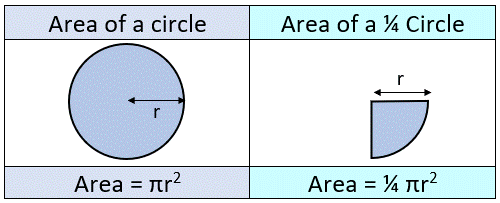
\(A_{\text{quarter-circle}}=\frac{1}{4}\pi r^2\)
| Part of Circle | Fraction of Circle | Area |
|---|---|---|
| Full circle | \(1\) | \(\pi r^2\) |
| Semicircle | \(\frac{1}{2}\) | \(\frac{1}{2}\pi r^2\) |
| Quarter-circle | \(\frac{1}{4}\) | \(\frac{1}{4}\pi r^2\) |
Perimeter of a Semicircle
Be careful when finding the perimeter of a semicircle. The perimeter includes both the curved half and the straight diameter.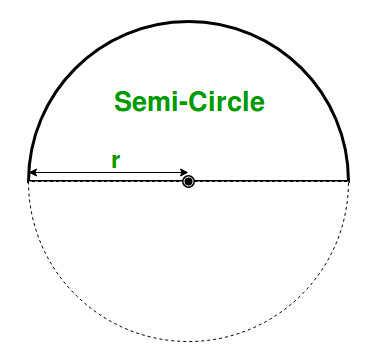
The full circumference is:
\(C=2\pi r\)
Half of the circumference is:
\(\pi r\)
Adding the diameter \(2r\):
\(\boxed{P=\pi r+2r}\)
This is different from the area of a semicircle, which is only the region inside the curve.
For the perimeter of a semicircle, do not forget the straight diameter.
Composite Shapes
A composite shape is a figure made from two or more familiar shapes. These may include rectangles, triangles, circles, semicircles, and other simple figures.
To find the area of a composite shape, we can:
- Divide the shape into familiar shapes and add their areas.
- Subtract a smaller shape from a larger shape.
1. Identify the familiar shapes.
2. Find any missing dimensions.
3. Calculate each individual area.
4. Add or subtract the areas as required.
5. Give the final answer in square units.
For example, if a shape consists of a rectangle and a semicircle, then:
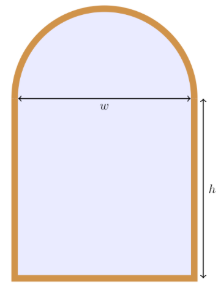
\(\text{Total area}=\text{area of rectangle}+\text{area of semicircle}\)
If a smaller circle is removed from a larger circle:
\(\text{Remaining area}=\text{area of large circle}-\text{area of small circle}\)
Finding Missing Dimensions in Composite Shapes
Sometimes not every dimension is labelled. You may need to use relationships between sides before calculating the area.
For a semicircle attached to a rectangle, the diameter of the semicircle may be equal to the width of the rectangle.
If the diameter is \(10\text{ cm}\), then:
\(r=\frac{10}{2}=5\text{ cm}\)
The radius can then be used in the circle formulae.
Before calculating a composite area, look carefully for dimensions that can be found from other parts of the diagram.
Circle Formula Summary
| Quantity | Formula | Units |
|---|---|---|
| Diameter | \(d=2r\) | Length units |
| Radius | \(r=\frac{d}{2}\) | Length units |
| Circumference | \(C=2\pi r\) or \(C=\pi d\) | Length units |
| Area | \(A=\pi r^2\) | Square units |
| Semicircle area | \(A=\frac{1}{2}\pi r^2\) | Square units |
| Semicircle perimeter | \(P=\pi r+2r\) | Length units |
Example 1:
A circular flower bed has a diameter of \(12\text{ m}\).
a) Find the radius of the flower bed.
b) Find the circumference of the flower bed, correct to 1 decimal place.
c) Find the area of the flower bed, correct to 1 decimal place.
d) The flower bed is changed into a composite design consisting of the original circle with a semicircular section of radius \(3\text{ m}\) attached to it. Find the total area of the new design, correct to 1 decimal place.
▶️ Answer/Explanation
a) Radius
The diameter is twice the radius:
\(r=\frac{12}{2}=6\text{ m}\)
Answer: \(6\text{ m}\)
b) Circumference
Use:
\(C=2\pi r\)
\(C=2\pi(6)\)
\(C=12\pi\)
\(C\approx37.7\text{ m}\)
Answer: \(37.7\text{ m}\)
c) Area of the circle
\(A=\pi r^2\)
\(A=\pi(6)^2\)
\(A=36\pi\)
\(A\approx113.1\text{ m}^2\)
Answer: \(113.1\text{ m}^2\)
d) Total area of the composite design
The new design consists of the original circle and a semicircle.
Area of the semicircle:
\(A=\frac{1}{2}\pi r^2\)
\(A=\frac{1}{2}\pi(3)^2\)
\(A=4.5\pi\)
\(A\approx14.1\text{ m}^2\)
Add the two areas:
\(113.1+14.1=127.2\text{ m}^2\)
Answer: The total area is approximately \(127.2\text{ m}^2\).
Example 2:
A playground has a shape made from a rectangle with a semicircle attached to one of its shorter sides. The rectangle is \(14\text{ m}\) long and \(8\text{ m}\) wide. The diameter of the semicircle is equal to the width of the rectangle.
a) Find the radius of the semicircle.
b) Find the area of the rectangle.
c) Find the area of the semicircle, correct to 1 decimal place.
d) Find the total area of the playground, correct to 1 decimal place.
e) Find the perimeter of the playground, correct to 1 decimal place.
▶️ Answer/Explanation
a) Radius of the semicircle
The diameter is equal to the rectangle’s width:
d=8\text{ m}
Therefore:
\(r=\frac{8}{2}=4\text{ m}\)
Answer: \(4\text{ m}\)
b) Area of rectangle
\(A=lw\)
\(A=14\times8\)
\(A=112\text{ m}^2\)
Answer: \(112\text{ m}^2\)
c) Area of semicircle
\(A=\frac{1}{2}\pi r^2\)
\(A=\frac{1}{2}\pi(4)^2\)
\(A=8\pi\)
\(A\approx25.1\text{ m}^2\)
Answer: \(25.1\text{ m}^2\)
d) Total area
\(\text{Total area}=112+25.1\)
\(\text{Total area}=137.1\text{ m}^2\)
Answer: \(137.1\text{ m}^2\)
e) Perimeter
The perimeter includes:
- The two long sides of the rectangle: \(14+14\)
- The bottom side: \(8\)
- The curved semicircular edge
The curved part is half the circumference of a circle with radius \(4\text{ m}\):
\(\text{Curved length}=\pi r=4\pi\)
\(\text{Curved length}\approx12.6\text{ m}\)
Therefore:
\(P=14+14+8+12.6\)
\(P=48.6\text{ m}\)
Answer: The perimeter is approximately \(48.6\text{ m}\).