
7.3 – Surface Area and Nets of 3D Shapes
Three-dimensional shapes have length, width, and height. Unlike two-dimensional shapes, they have faces, edges, and vertices. In this topic, we learn how to represent 3D shapes using nets and calculate their surface area.
Surface area is useful when we need to find how much material is needed to cover an object, such as paint for a solid, wrapping paper for a box, or metal for a container.
3D Shapes and Their Surfaces
A 3D shape is a solid object that occupies space. Common 3D shapes include cubes, rectangular prisms, triangular prisms, cylinders, and spheres.
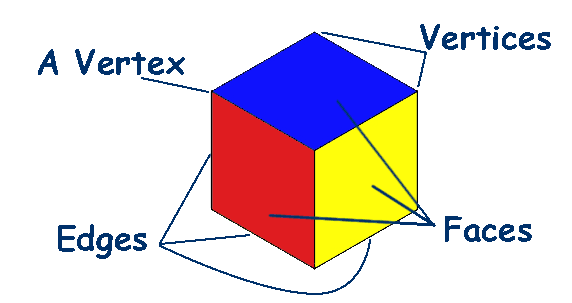
| Feature | Meaning |
|---|---|
| Face | A flat or curved surface of a 3D shape. |
| Edge | A line where two faces meet. |
| Vertex | A point where edges meet. |
What Is a Net?
A net is a two-dimensional arrangement of all the surfaces of a 3D shape. It can be folded to form the original solid.
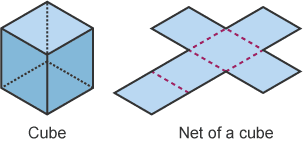
Nets are useful because they allow us to see every surface separately and calculate the total surface area by adding the areas of the individual parts.
📌 Key Idea
Surface area is the total area of all the surfaces of a 3D shape.
\(\text{Surface Area}=\text{sum of the areas of all surfaces}\)
When using a net, make sure that every surface is included exactly once.
Nets of Common 3D Shapes
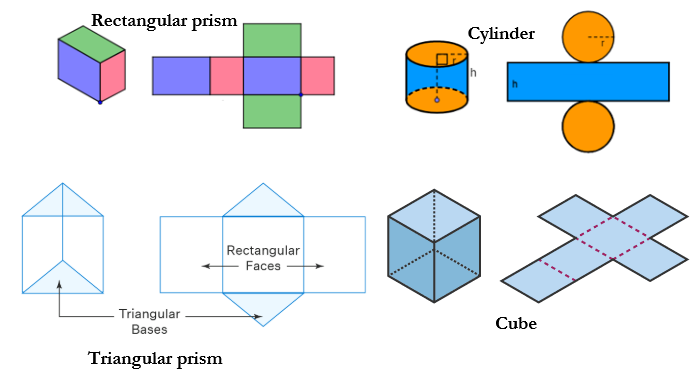
| 3D Shape | Surfaces in a Typical Net |
|---|---|
| Cube | 6 equal squares |
| Rectangular prism | 6 rectangles |
| Triangular prism | 2 triangles and 3 rectangles |
| Cylinder | 1 rectangle and 2 circles |
A sphere does not have a simple flat net made from polygons. Its surface area is found using a formula rather than by adding the areas of flat faces.
Surface Area of a Cube
A cube has six equal square faces. If each side has length \(s\), the area of one face is:

\(A=s^2\)
Since there are six identical faces:
📌 Surface Area of a Cube
\(\boxed{SA=6s^2}\)
Example: A cube has side length \(5\text{ cm}\).
\(SA=6s^2\)
\(SA=6(5)^2\)
\(SA=6(25)\)
\(SA=150\text{ cm}^2\)
Therefore, the surface area is \(150\text{ cm}^2\).
Surface Area of a Rectangular Prism
A rectangular prism has three pairs of equal rectangular faces. If its dimensions are length \(l\), width \(w\), and height \(h\), the three different face areas are:
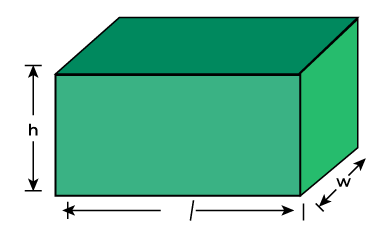
\(lw,\quad lh,\quad wh\)
Each of these occurs twice, so:
📌 Surface Area of a Rectangular Prism
\(\boxed{SA=2lw+2lh+2wh}\)
or
\(\boxed{SA=2(lw+lh+wh)}\)
Example: A rectangular prism has dimensions \(8\text{ cm}\), \(5\text{ cm}\), and \(3\text{ cm}\).
\(SA=2(lw+lh+wh)\)
\(SA=2(8\times5+8\times3+5\times3)\)
\(SA=2(40+24+15)\)
\(SA=2(79)\)
\(SA=158\text{ cm}^2\)
Therefore, the surface area is \(158\text{ cm}^2\).
Surface Area of a Triangular Prism
A triangular prism has:

- 2 identical triangular faces
- 3 rectangular faces
Therefore:
\(\text{Surface Area}=2(\text{area of triangle})+\text{areas of 3 rectangles}\)
If the triangular base has area \(A\), its three side lengths are \(a\), \(b\), and \(c\), and the prism length is \(L\), then:
\(SA=2A+L(a+b+c)\)
The net makes this relationship easier to understand because each of the five faces can be seen separately.
Surface Area of a Cylinder
A cylinder has:

- 2 circular bases
- 1 curved surface
When the curved surface is opened out, it forms a rectangle. The length of this rectangle is the circumference of the circular base.
The rectangle therefore has:
\(\text{length}=2\pi r\)
\(\text{width}=h\)
So the curved surface area is:
\(2\pi rh\)
The two circular bases have total area:
\(2\pi r^2\)
📌 Surface Area of a Closed Cylinder
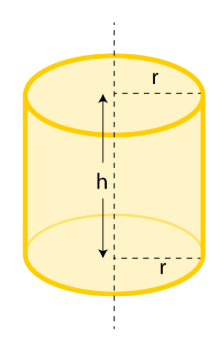
\(\boxed{SA=2\pi r^2+2\pi rh}\) or \(\boxed{SA=2\pi r(r+h)}\)
Important: If a cylinder is open at the top or bottom, the corresponding circular area should not be included.
⚠️ Common Mistake:
The curved surface of a cylinder is not \(\pi r^2\).
\(\pi r^2\) is the area of one circular base.
\(2\pi rh\) is the curved surface area.
Surface Area of a Sphere
A sphere has a completely curved surface and no flat faces. Its surface area is found using a formula.

📌 Surface Area of a Sphere
\(\boxed{SA=4\pi r^2}\)
If the diameter is given, first find the radius:
\(r=\frac{d}{2}\)
Then substitute the radius into the surface-area formula.
Surface Area Using a Net
A net can often be used instead of memorising a formula. The basic process is:
- Identify every face in the net.
- Find the area of each face.
- Identify equal or repeated faces.
- Add all the surface areas.
- Write the answer in square units.
🎯 Exam Strategy
When a net is provided, do not try to calculate the surface area from the 3D picture alone. Use the net to identify every individual surface and calculate their areas.
Surface Area Formula Summary
| Shape | Surface Area |
|---|---|
| Cube | \(SA=6s^2\) |
| Rectangular prism | \(SA=2(lw+lh+wh)\) |
| Triangular prism | \(SA=2A+L(a+b+c)\) |
| Closed cylinder | \(SA=2\pi r^2+2\pi rh\) |
| Sphere | \(SA=4\pi r^2\) |
Surface area is always measured in square units.
Examples include: \(\text{mm}^2\), \(\text{cm}^2\), \(\text{m}^2\), and \(\text{km}^2\).
Example 1:
A rectangular storage box has length \(12\text{ cm}\), width \(7\text{ cm}\), and height \(5\text{ cm}\).
a) State the dimensions of the three different types of rectangular faces in its net.
b) Find the area of each type of face.
c) Find the total surface area of the box.
d) The box is to be completely covered with decorative paper. If \(1\text{ m}^2\) of paper covers \(10\,000\text{ cm}^2\), explain whether \(0.02\text{ m}^2\) of paper is enough.
▶️ Answer/Explanation
a) Dimensions of the faces
A rectangular prism has three pairs of equal faces:
12\text{ cm}\times7\text{ cm}
12\text{ cm}\times5\text{ cm}
7\text{ cm}\times5\text{ cm}
Answer: The three face dimensions are \(12\times7\), \(12\times5\), and \(7\times5\) cm.
b) Areas of the faces
12\times7=84\text{ cm}^2
12\times5=60\text{ cm}^2
7\times5=35\text{ cm}^2
Answer: The three different face areas are \(84\text{ cm}^2\), \(60\text{ cm}^2\), and \(35\text{ cm}^2\).
c) Total surface area
SA=2(84+60+35)
SA=2(179)
SA=358\text{ cm}^2
Answer: \(358\text{ cm}^2\)
d) Is \(0.02\text{ m}^2\) enough?
Convert \(0.02\text{ m}^2\) to square centimetres:
1\text{ m}^2=10\,000\text{ cm}^2
0.02\times10\,000=200\text{ cm}^2
The box requires \(358\text{ cm}^2\), but only \(200\text{ cm}^2\) is available.
Answer: No. \(0.02\text{ m}^2\) is not enough paper.
Example 2:
A triangular prism has a right-angled triangular cross-section with side lengths \(6\text{ cm}\), \(8\text{ cm}\), and \(10\text{ cm}\). The length of the prism is \(15\text{ cm}\).
a) Find the area of one triangular end.
b) Find the areas of the three rectangular faces.
c) Find the total surface area of the prism.
d) Explain why the answer must be given in \(\text{cm}^2\), not \(\text{cm}^3\).
▶️ Answer/Explanation
a) Area of one triangular end
The triangle is right-angled, so use the two perpendicular sides \(6\text{ cm}\) and \(8\text{ cm}\).
A=\frac{1}{2}bh
A=\frac{1}{2}(6)(8)
A=24\text{ cm}^2
Answer: \(24\text{ cm}^2\)
b) Areas of the rectangular faces
Each rectangle has length \(15\text{ cm}\).
6\times15=90\text{ cm}^2
8\times15=120\text{ cm}^2
10\times15=150\text{ cm}^2
Answer: The rectangular faces have areas \(90\text{ cm}^2\), \(120\text{ cm}^2\), and \(150\text{ cm}^2\).
c) Total surface area
There are two triangular ends:
2\times24=48\text{ cm}^2
Add the three rectangular faces:
90+120+150=360\text{ cm}^2
Therefore:
SA=48+360
SA=408\text{ cm}^2
Answer: \(408\text{ cm}^2\)
d) Why \(\text{cm}^2\)?
Surface area measures the amount of two-dimensional surface covering the solid. Therefore, it is measured in square units.
Answer: The correct unit is \(\text{cm}^2\), not \(\text{cm}^3\). Cubic units are used for volume.