
7.4 – Volume of Prisms, Cylinders, Cones and Spheres
What Is Volume?
Volume is the amount of space occupied by a three-dimensional object. Unlike surface area, which measures the outside surface of a solid, volume measures the space inside it.
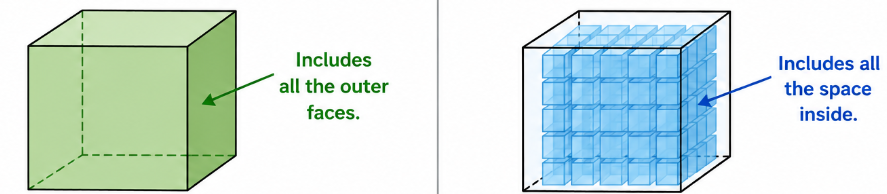
Volume is measured in cubic units, such as \(\text{mm}^3\), \(\text{cm}^3\), \(\text{m}^3\), and \(\text{km}^3\).
Volume is always expressed using cubic units.
The General Volume Rule
Many solids can be understood by looking at their cross-section. If a solid has the same cross-section throughout its length, it is called a solid of uniform cross-section.
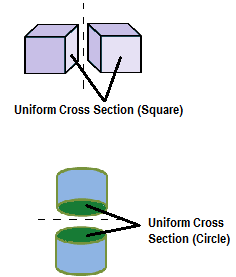
For such solids:
\(\boxed{V=\text{area of cross-section}\times\text{length}}\)
This idea leads directly to the volume formulas for prisms and cylinders.
Volume of a Rectangular Prism
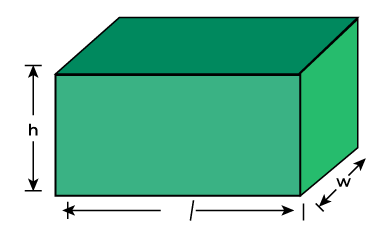
A rectangular prism has a rectangular cross-section. Its volume is found by multiplying its three dimensions.
\(\boxed{V=lwh}\)
where \(l\) = length, \(w\) = width, and \(h\) = height.
Example: A rectangular prism has length \(8\text{ cm}\), width \(5\text{ cm}\), and height \(3\text{ cm}\).
\(V=lwh\)
\(V=8\times5\times3\)
\(V=120\text{ cm}^3\)
Therefore, the volume is \(120\text{ cm}^3\).
Volume of a Prism
A prism has two identical, parallel end faces and a uniform cross-section between them.
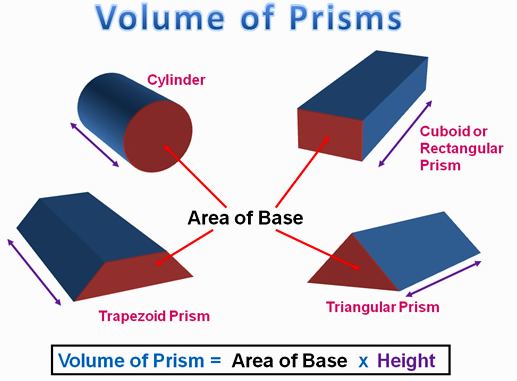
The cross-section does not have to be a rectangle. It can be a triangle, for example.
\(\boxed{V=A\times L}\)
where \(A\) = area of the cross-section and \(L\) = length of the prism.
For a triangular prism: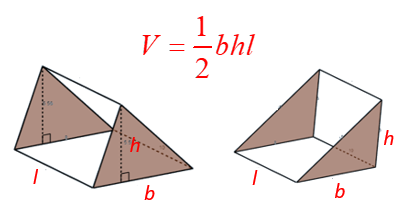
\(A=\frac{1}{2}bh\)
Therefore:
\(V=\frac{1}{2}bhL\)
Example: A triangular prism has a triangular cross-section with base \(6\text{ cm}\) and perpendicular height \(4\text{ cm}\). The prism is \(10\text{ cm}\) long.
A=\frac{1}{2}(6)(4)=12\text{ cm}^2
V=A\times L
V=12\times10
V=120\text{ cm}^3
Therefore, the volume is \(120\text{ cm}^3\).
Volume of a Cylinder
A cylinder is a solid with a circular cross-section that remains the same size throughout its height.
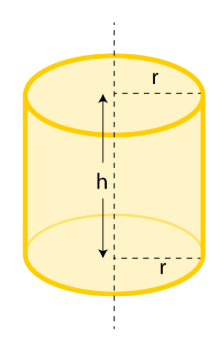
The area of the circular cross-section is:
\(A=\pi r^2\)
Using the prism idea:
\(\boxed{V=\pi r^2h}\)
where \(r\) = radius and \(h\) = height.
Example: A cylinder has radius \(4\text{ cm}\) and height \(10\text{ cm}\). Find its volume.
\(V=\pi r^2h\)
\(V=\pi(4)^2(10)\)
\(V=160\pi\text{ cm}^3\)
Using \(\pi\approx3.142\):
\(V\approx502.7\text{ cm}^3\)
Therefore, the volume is approximately \(502.7\text{ cm}^3\).
The cylinder formula uses the radius, not the diameter.
If the diameter \(d\) is given:
\(r=\frac{d}{2}\)
Volume of a Cone
A cone has a circular base and tapers to a single point called the apex.
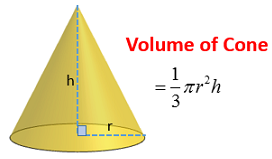
A cone with the same base radius and height as a cylinder has one-third of the cylinder’s volume.
\(\boxed{V=\frac{1}{3}\pi r^2h}\)
where \(r\) = radius of the circular base and \(h\) = perpendicular height.
Example: A cone has radius \(6\text{ cm}\) and perpendicular height \(8\text{ cm}\). Find its volume.
\(V=\frac{1}{3}\pi r^2h\)
\(V=\frac{1}{3}\pi(6)^2(8)\)
\(V=\frac{1}{3}\pi(36)(8)\)
\(V=96\pi\text{ cm}^3\)
Therefore, the exact volume is \(96\pi\text{ cm}^3\).
Cylinder: \(V=\pi r^2h\)
Cone: \(V=\frac{1}{3}\pi r^2h\)
So, a cone is exactly one-third of the volume of a cylinder with the same radius and height.
Volume of a Sphere
A sphere is a perfectly round 3D shape in which every point on the surface is the same distance from the centre.

This distance is called the radius.
\(\boxed{V=\frac{4}{3}\pi r^3}\)
Notice that the radius is cubed. This is because volume is measured in cubic units.
Example: A sphere has radius \(3\text{ cm}\). Find its volume.
\(V=\frac{4}{3}\pi r^3\)
\(V=\frac{4}{3}\pi(3)^3\)
\(V=\frac{4}{3}\pi(27)\)
\(V=36\pi\text{ cm}^3\)
Therefore, the exact volume is \(36\pi\text{ cm}^3\).
If the diameter of a sphere is given, first divide it by \(2\).
\(r=\frac{d}{2}\)
Choosing the Correct Formula
| Solid | Formula | Important Information |
|---|---|---|
| Rectangular prism | \(V=lwh\) | Multiply the three dimensions |
| Prism | \(V=A\times L\) | Area of cross-section × length |
| Cylinder | \(V=\pi r^2h\) | Circular cross-section |
| Cone | \(V=\frac{1}{3}\pi r^2h\) | One-third of corresponding cylinder |
| Sphere | \(V=\frac{4}{3}\pi r^3\) | Radius is cubed |
Converting Volume Units
When converting volume units, remember that the conversion factor must be cubed.
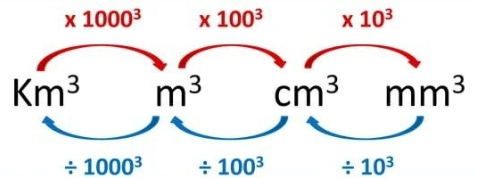
For example:
\(1\text{ m}=100\text{ cm}\)
\(1\text{ m}^3=(100)^3\text{ cm}^3\)
\(1\text{ m}^3=1\,000\,000\text{ cm}^3\)
Do not use \(1\text{ m}=100\text{ cm}\) directly when converting \(\text{m}^3\) to \(\text{cm}^3\).
The conversion factor must be cubed:
\(100^3=1\,000\,000\)
MYP 3 Problem-Solving Strategy
- Identify the 3D shape.
- Write the appropriate volume formula.
- Check whether the dimensions use the same unit.
- If necessary, convert the radius or diameter.
- Substitute the values carefully.
- Calculate the volume.
- Give the answer in cubic units.
- Check whether the answer is reasonable.
Example 1:
A cylinder, cone, and sphere all have radius \(5\text{ cm}\). The cylinder and cone each have a height of \(12\text{ cm}\).
a) Find the volume of the cylinder.
b) Find the volume of the cone.
c) Find the volume of the sphere.
d) Compare the volume of the cone with the volume of the cylinder.
▶️ Answer/Explanation
a) Volume of the cylinder
\(V=\pi r^2h\)
\(V=\pi(5)^2(12)\)
\(V=300\pi\text{ cm}^3\)
Answer: \(300\pi\text{ cm}^3\), approximately \(942.5\text{ cm}^3\).
b) Volume of the cone
\(V=\frac{1}{3}\pi r^2h\)
\(V=\frac{1}{3}\pi(5)^2(12)\)
\(V=100\pi\text{ cm}^3\)
Answer: \(100\pi\text{ cm}^3\), approximately \(314.2\text{ cm}^3\).
c) Volume of the sphere
\(V=\frac{4}{3}\pi r^3\)
\(V=\frac{4}{3}\pi(5)^3\)
\(V=\frac{500}{3}\pi\text{ cm}^3\)
\(V\approx523.6\text{ cm}^3\)
Answer: \(\frac{500}{3}\pi\text{ cm}^3\), approximately \(523.6\text{ cm}^3\).
d) Comparing the cone and cylinder
The cone and cylinder have the same radius and height.
\(\frac{100\pi}{300\pi}=\frac{1}{3}\)
Answer: The cone has exactly one-third of the volume of the cylinder.
Example 2:
A cylindrical water tank has a radius of \(0.75\text{ m}\) and a height of \(2\text{ m}\).
a) Find the volume of the tank in \(\text{m}^3\).
b) Convert the volume into litres.
c) The tank is filled to \(80\%\) of its capacity. Find the amount of water in the tank in litres.
▶️ Answer/Explanation
a) Volume of the cylinder
\(V=\pi r^2h\)
\(V=\pi(0.75)^2(2)\)
\(V=1.125\pi\text{ m}^3\)
\(V\approx3.534\text{ m}^3\)
Answer: The volume is approximately \(3.534\text{ m}^3\).
b) Convert to litres
Use:
\(1\text{ m}^3=1000\text{ L}\)
\(3.534\times1000=3534\text{ L}\)
Answer: The tank holds approximately \(3534\text{ L}\) when completely full.
c) Amount of water at \(80\%\)
\(80\%\text{ of }3534=0.8(3534)\)
\(=2827.2\text{ L}\)
Answer: The tank contains approximately \(2827.2\text{ L}\) of water.