
7.5 – Capacity, Volume and Measurement Problems
Volume and Capacity
Volume measures the amount of three-dimensional space occupied by an object. Capacity measures how much a container can hold, usually a liquid.
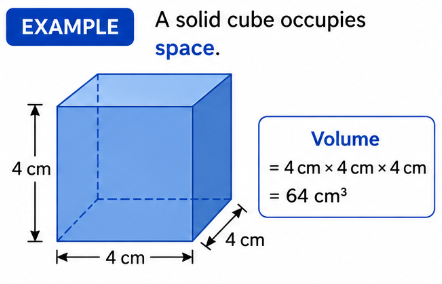
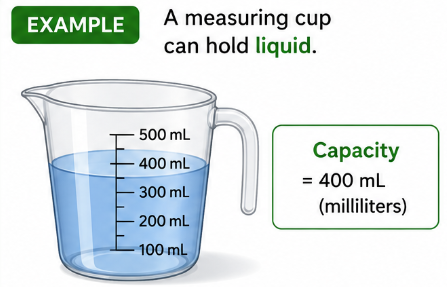
Volume is normally measured in cubic units, such as \(\text{cm}^3\) and \(\text{m}^3\), while capacity is commonly measured in millilitres and litres.
| Measurement | Common Units | Used For |
|---|---|---|
| Volume | \(\text{mm}^3,\text{ cm}^3,\text{ m}^3\) | Space occupied by a solid |
| Capacity | mL, L | Amount a container can hold |
Connecting Volume and Capacity
There is a direct relationship between cubic centimetres and millilitres:
📌 Important Conversions
\(1\text{ cm}^3=1\text{ mL}\)
\(1000\text{ cm}^3=1000\text{ mL}=1\text{ L}\)
Therefore:
\(\boxed{1\text{ L}=1000\text{ cm}^3}\)
Another important relationship is:
\(1\text{ m}^3=1000\text{ L}\)
This means that a container with a volume of \(2.5\text{ m}^3\) has a capacity of:
\(2.5\times1000=2500\text{ L}\)
💡 Remember:
\(\text{cm}^3\leftrightarrow\text{mL}\)
\(1\text{ cm}^3=1\text{ mL}\)
\(\text{L}\leftrightarrow\text{cm}^3\)
\(1\text{ L}=1000\text{ cm}^3\)
\(\text{m}^3\leftrightarrow\text{L}\)
\(1\text{ m}^3=1000\text{ L}\)
Converting Between Capacity Units
Remember:
\(1\text{ L}=1000\text{ mL}\)
Therefore, to convert:
| Conversion | Operation |
|---|---|
| L → mL | Multiply by \(1000\) |
| mL → L | Divide by \(1000\) |
Example: Convert \(3.75\text{ L}\) to millilitres.
\(3.75\times1000=3750\text{ mL}\)
Therefore, \(3.75\text{ L}=3750\text{ mL}\).
Example: Convert \(4250\text{ mL}\) to litres.
\(4250\div1000=4.25\text{ L}\)
Therefore, \(4250\text{ mL}=4.25\text{ L}\).
Choosing Suitable Units
The unit you choose should match the size of the object being measured.
| Object | Suitable Unit |
|---|---|
| Medicine bottle | mL |
| Water bottle | mL or L |
| Swimming pool | \(\text{m}^3\) or L |
| Small box | \(\text{cm}^3\) |
| Large building | \(\text{m}^3\) |
Finding Capacity from Volume
If the volume of a container is known in \(\text{cm}^3\), it can be converted directly into millilitres.
For example, a container has a volume of \(850\text{ cm}^3\).
\(850\text{ cm}^3=850\text{ mL}\)
In litres:
\(850\div1000=0.85\text{ L}\)
Therefore, the container has a capacity of \(850\text{ mL}\), or \(0.85\text{ L}\).
Finding Volume from Capacity
The process also works in reverse.
If a bottle has a capacity of \(2.4\text{ L}\), then:
\(2.4\times1000=2400\text{ mL}\)
\(2400\text{ mL}=2400\text{ cm}^3\)
Therefore, the container has a volume of \(2400\text{ cm}^3\).
Measurement Problems with Volume
Many real-life problems require several steps. You may need to:
- Identify the shape.
- Find the appropriate volume formula.
- Calculate the volume.
- Convert the volume into an appropriate capacity unit.
- Compare the capacity with the amount available.
- Interpret the answer in the context of the problem.
🎯 Problem-Solving Tip
Do not start calculating immediately. First identify:
What is being measured?
What shape is involved?
Which formula is needed?
What units should the final answer use?
Comparing Capacity with an Available Amount
Sometimes a problem gives the capacity of a container and asks whether a certain quantity will fit inside it.
The two quantities must first be expressed in the same units.
For example, suppose a container has capacity \(2.8\text{ L}\), and you have \(2500\text{ mL}\) of liquid.
\(2.8\text{ L}=2800\text{ mL}\)
Since:
\(2500<2800\)
the liquid will fit inside the container.
The unused capacity is:
\(2800-2500=300\text{ mL}\)
Therefore, \(300\text{ mL}\) of space remains.
Finding an Unknown Dimension from Volume
Sometimes the volume is known, but one of the dimensions is missing. In this situation, use the volume formula and rearrange it.
For a rectangular prism:
\(V=lwh\)
If the height is unknown:
\(h=\frac{V}{lw}\)
For example, a rectangular container has volume \(360\text{ cm}^3\), length \(10\text{ cm}\), and width \(6\text{ cm}\).
\(h=\frac{360}{10\times6}\)
\(h=6\text{ cm}\)
Therefore, the height is \(6\text{ cm}\).
Mixed Units in Measurement Problems
Before calculating volume, all dimensions must be expressed using compatible units.
For example, if a rectangular prism has length \(2\text{ m}\), width \(50\text{ cm}\), and height \(40\text{ cm}\), do not multiply these values immediately.
Convert the dimensions to the same unit first:
\(2\text{ m}=200\text{ cm}\)
Then:
\(V=200\times50\times40\)
\(V=400\,000\text{ cm}^3\)
Since \(1000\text{ cm}^3=1\text{ L}\):
\(400\,000\div1000=400\text{ L}\)
⚠️ Common Mistake:
Never multiply measurements such as metres and centimetres without first converting them to the same unit.
Volume and Capacity Summary
| Relationship | Conversion |
|---|---|
| Cubic centimetres and millilitres | \(1\text{ cm}^3=1\text{ mL}\) |
| Litres and millilitres | \(1\text{ L}=1000\text{ mL}\) |
| Litres and cubic centimetres | \(1\text{ L}=1000\text{ cm}^3\) |
| Cubic metres and litres | \(1\text{ m}^3=1000\text{ L}\) |
Example 1:
A cylindrical water container has radius \(20\text{ cm}\) and height \(50\text{ cm}\).
a) Find the volume of the container in \(\text{cm}^3\), giving your answer to the nearest cubic centimetre.
b) Convert the volume into litres.
c) The container currently contains \(25\text{ L}\) of water. How many more litres can it hold?
d) If water is added at a rate of \(2.5\text{ L}\) per minute, approximately how many minutes will it take to fill the remaining space?
▶️ Answer/Explanation
a) Volume of the cylinder
\(V=\pi r^2h\)
\(V=\pi(20)^2(50)\)
\(V=20\,000\pi\text{ cm}^3\)
\(V\approx62\,832\text{ cm}^3\)
Answer: Approximately \(62\,832\text{ cm}^3\).
b) Convert to litres
Since \(1000\text{ cm}^3=1\text{ L}\):
\(62\,832\div1000=62.832\text{ L}\)
Answer: Approximately \(62.832\text{ L}\).
c) Remaining capacity
\(62.832-25=37.832\text{ L}\)
Answer: Approximately \(37.832\text{ L}\) can still be added.
d) Time required to fill the remaining space
\(\text{Time}=\frac{\text{amount of water}}{\text{rate}}\)
\(\text{Time}=\frac{37.832}{2.5}\)
\(\text{Time}\approx15.13\text{ minutes}\)
Answer: Approximately \(15.1\) minutes.
Example 2:
A rectangular water tank is \(2.5\text{ m}\) long, \(80\text{ cm}\) wide, and \(60\text{ cm}\) high.
a) Convert the length to centimetres.
b) Find the volume of the tank in \(\text{cm}^3\).
c) Convert the volume to litres.
d) The tank is filled to \(75\%\) of its capacity. How many litres of water are in the tank?
e) If \(120\text{ L}\) of water is removed, what percentage of the tank’s capacity remains?
▶️ Answer/Explanation
a) Convert the length
\(2.5\text{ m}=250\text{ cm}\)
Answer: \(250\text{ cm}\)
b) Volume of the tank
All dimensions are now in centimetres.
\(V=lwh\)
\(V=250\times80\times60\)
\(V=1\,200\,000\text{ cm}^3\)
Answer: \(1\,200\,000\text{ cm}^3\)
c) Convert to litres
\(1\,200\,000\div1000=1200\text{ L}\)
Answer: The capacity is \(1200\text{ L}\).
d) \(75\%\) of the capacity
\(0.75\times1200=900\text{ L}\)
Answer: There are \(900\text{ L}\) of water in the tank.
e) Percentage remaining after removing \(120\text{ L}\)
First find the amount remaining:
\(900-120=780\text{ L}\)
Now compare this with the full capacity:
\(\frac{780}{1200}\times100=65\%\)
Answer: \(65\%\) of the tank’s capacity remains.