
7.6 – Time, Time Calculations and Time Zones
Time is used to measure when events happen, how long they last, and the order in which events occur. We use time calculations in timetables, travel, sports, school schedules, appointments and everyday planning.
In this topic, you will learn how to convert between units of time, calculate durations, use the 24-hour clock, work with timetables, and calculate differences between time zones.
Units of Time
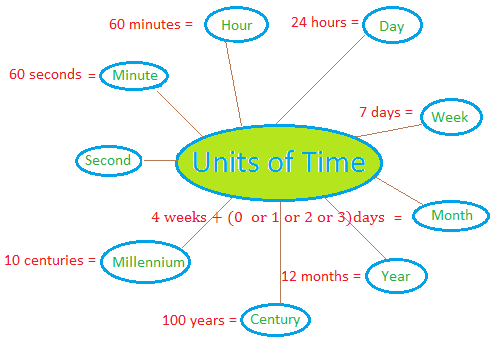
The main units of time used in everyday mathematics are seconds, minutes, hours, days, weeks, months and years.
| Unit | Equivalent |
|---|---|
| 1 minute | \(60\) seconds |
| 1 hour | \(60\) minutes \(=3600\) seconds |
| 1 day | \(24\) hours |
| 1 week | \(7\) days |
| 1 year | Approximately \(365\) days |
📌 Important Conversion Rule
Moving to a smaller unit means multiplying.
\(1\text{ h}=60\text{ min}\)
\(1\text{ min}=60\text{ s}\)
Moving to a larger unit means dividing.
\(60\text{ min}=1\text{ h}\)
\(60\text{ s}=1\text{ min}\)
Converting Time
To convert hours into minutes, multiply by \(60\).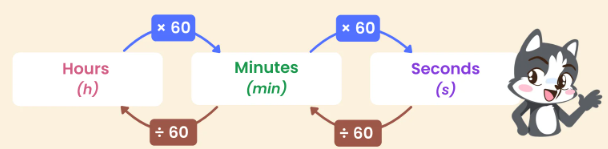
\(4\text{ h}=4\times60=240\text{ min}\)
To convert minutes into hours and minutes, divide by \(60\) and use the remainder as the number of minutes.
\(157\div60=2\text{ remainder }37\)
\(157\text{ min}=2\text{ h }37\text{ min}\)
Similarly:
\(367\text{ s}=6\text{ min }7\text{ s}\)
because:
\(367\div60=6\text{ remainder }7\)
Calculating with Time
When adding or subtracting time, remember that \(60\) minutes make \(1\) hour and \(60\) seconds make \(1\) minute.
For example:
\(2\text{ h }45\text{ min}+1\text{ h }35\text{ min}\)
\(=3\text{ h }80\text{ min}\)
\(=4\text{ h }20\text{ min}\)
We regroup \(60\) minutes as \(1\) hour.
When subtracting time, borrowing may be necessary.
For example:
\(5\text{ h }10\text{ min}-2\text{ h }35\text{ min}\)
\(=4\text{ h }70\text{ min}-2\text{ h }35\text{ min}\)
\(=2\text{ h }35\text{ min}\)
Finding a Time After or Before Another Time
To find a time after an event, add the duration to the starting time. To find a time before an event, subtract the duration from the given time.
Example: A lesson begins at \(9{:}35\) am and lasts \(2\) hours \(45\) minutes.
\(9{:}35\text{ am}+2\text{ h}=11{:}35\text{ am}\)
\(11{:}35\text{ am}+45\text{ min}=12{:}20\text{ pm}\)
Therefore, the lesson finishes at \(12{:}20\) pm.
Finding the Duration of an Event
The duration of an event is the amount of time between its starting time and finishing time.
A useful method is to break the calculation into simple intervals.
For example, find the time from \(8{:}45\) am to \(2{:}30\) pm.
\(8{:}45\text{ am}\rightarrow1{:}45\text{ pm}=5\text{ h}\)
\(1{:}45\text{ pm}\rightarrow2{:}30\text{ pm}=45\text{ min}\)
\(\therefore\text{ Duration}=5\text{ h }45\text{ min}\)
💡 Tip for Long Time Differences
If the event crosses noon, midnight, or the next day, split the calculation into smaller intervals instead of trying to subtract everything at once.
Time Calculations Across Midnight
When an event continues past midnight, the date changes.
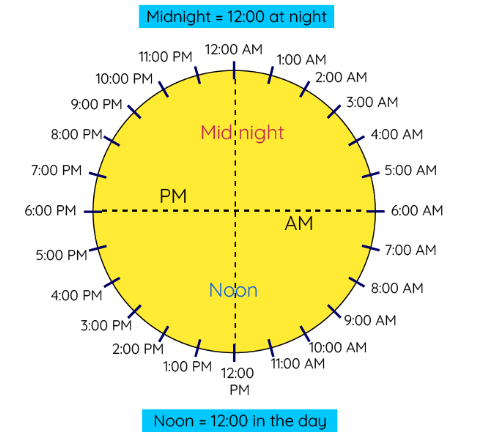
For example, a person sleeps from \(9{:}40\) pm to \(6{:}15\) am the next morning.
\(9{:}40\text{ pm}\rightarrow12{:}00\text{ midnight}=2\text{ h }20\text{ min}\)
\(12{:}00\text{ midnight}\rightarrow6{:}15\text{ am}=6\text{ h }15\text{ min}\)
\(2\text{ h }20\text{ min}+6\text{ h }15\text{ min}=8\text{ h }35\text{ min}\)
Therefore, the person slept for \(8\) hours \(35\) minutes.
Large Units of Time
| Unit | Equivalent |
|---|---|
| Decade | \(10\) years |
| Century | \(100\) years |
| Millennium | \(1000\) years |
For example:
\(6\text{ decades}=6\times10=60\text{ years}\)
\(4\text{ centuries}=4\times100=400\text{ years}\)
\(3\text{ millennia}=3\times1000=3000\text{ years}\)
24-Hour Time
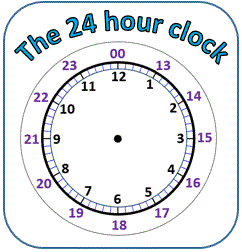
The 24-hour clock represents the hours of a day using numbers from \(00{:}00\) to \(23{:}59\). It avoids the need to use am and pm.
| 12-Hour Time | 24-Hour Time |
|---|---|
| 12:00 midnight | 00:00 |
| 7:25 am | 07:25 |
| 12:00 noon | 12:00 |
| 3:48 pm | 15:48 |
| 9:30 pm | 21:30 |
| 11:59 pm | 23:59 |
Converting am to 24-hour time:
\(8{:}35\text{ am}=08{:}35\)
For pm times from \(1{:}00\) pm to \(11{:}59\) pm, add \(12\) to the hour.
\(7{:}20\text{ pm}\rightarrow7+12=19\)
\(7{:}20\text{ pm}=19{:}20\)
Converting 24-hour time to 12-hour time:
For times from \(13{:}00\) to \(23{:}59\), subtract \(12\) from the hour.
\(18{:}45-12\text{ h}=6{:}45\text{ pm}\)
⚠️ Remember:
Midnight is written as \(00{:}00\), not \(24{:}00\).
\(00{:}00\) to \(11{:}59\) represents the morning.
\(12{:}00\) to \(23{:}59\) represents the afternoon and evening.
Time Zones
Different places on Earth experience different times of day because the Earth rotates. Therefore, the world is divided into time zones.
Time zones are described using an offset from a reference time. A location may be ahead of or behind the reference time.
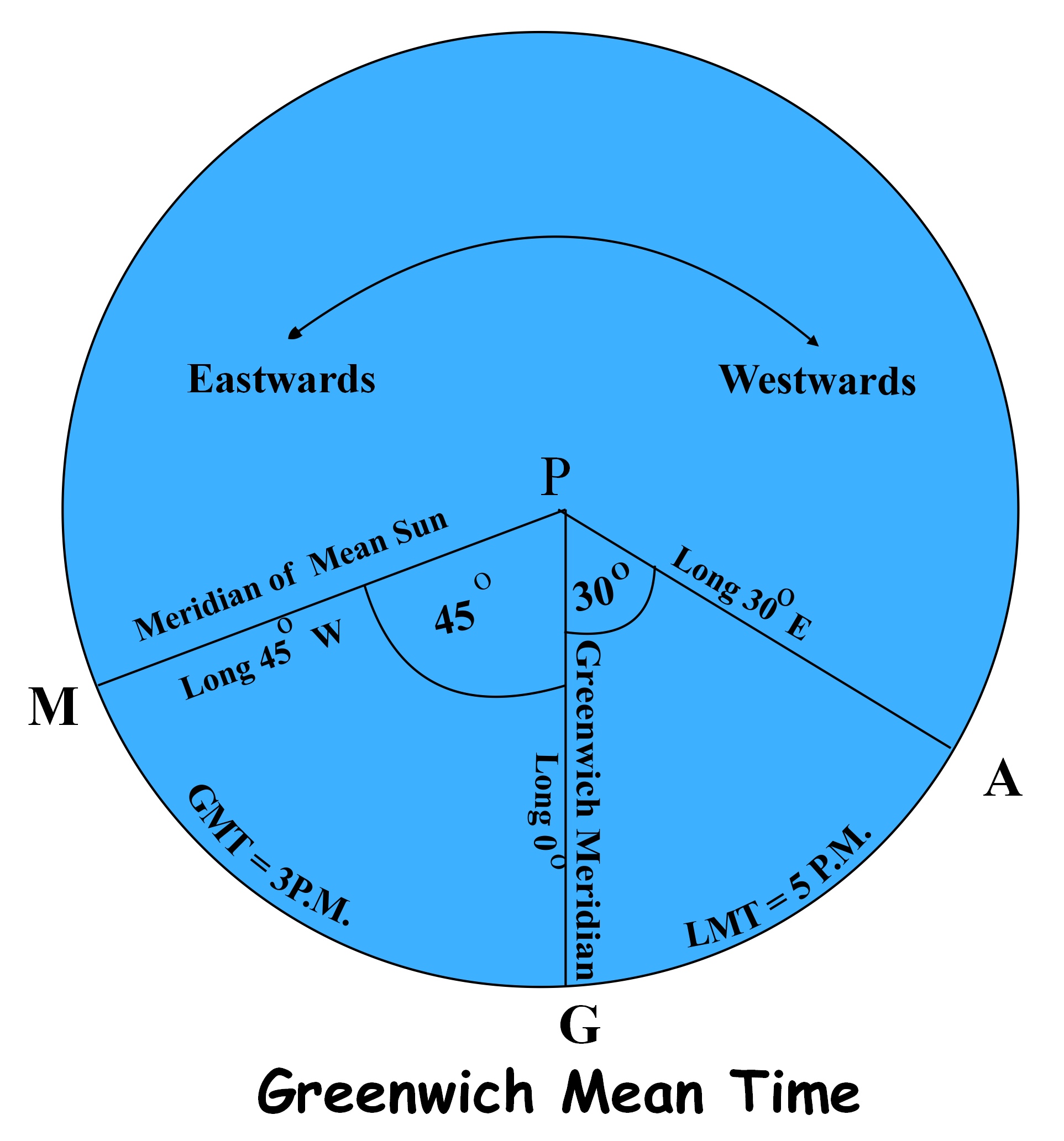
The Prime Meridian is at longitude \(0^\circ\) and passes through Greenwich. Greenwich Mean Time (GMT) has traditionally been used as a reference for time-zone calculations.
In modern notation, time zones are commonly expressed as offsets from UTC (Coordinated Universal Time).
| Position Relative to Reference | What to Do |
|---|---|
| Ahead | Add the time difference |
| Behind | Subtract the time difference |
For example, if Location A is \(+5\) hours from UTC and Location B is \(-4\) hours from UTC, then Location A is:
\(5-(-4)=9\text{ hours}\)
ahead of Location B.
Calculating Time Between Two Time Zones
A reliable method is:
- Write the UTC offset for each location.
- Find the difference between the offsets.
- Move forward if the destination is ahead.
- Move backward if the destination is behind.
- Check whether the date changes.
For example, suppose Location A is UTC \(+5\) and Location B is UTC \(+2\). Location A is:
\(5-2=3\text{ hours}\)
ahead of Location B.
Therefore, if it is \(10{:}00\) am in Location B:
\(10{:}00\text{ am}+3\text{ h}=1{:}00\text{ pm}\)
The local time in Location A is \(1{:}00\) pm.
Time Zones and Travel
Travel problems involving time zones require two separate calculations:
- Calculate the time the journey finishes in the departure location’s time.
- Convert that finishing time to the destination’s local time.
This prevents the flight duration from being confused with the time-zone difference.
✈️ Travel Problem Strategy
Step 1: Add the journey duration to the departure time.
Step 2: Find the time-zone difference.
Step 3: Adjust the arrival time for the destination time zone.
Step 4: Check whether the arrival is on the same day or the next day.
Crossing Midnight and Changing Dates
A time-zone calculation can cause the date to change.
For example, if a location is \(5\) hours ahead and the calculated time is \(22{:}30\), then:
\(22{:}30+5\text{ h}=27{:}30\)
Since a day has \(24\) hours:
\(27{:}30-24{:}00=03{:}30\)
Therefore, the correct time is \(03{:}30\) on the next day.
Example 1:
A school sports event begins at \(08{:}45\) and finishes at \(15{:}20\). The students have a \(35\)-minute lunch break during the event.
a) How long does the event last altogether?
b) How long are the students actually participating in activities, excluding the lunch break?
c) Write the starting and finishing times in 12-hour notation.
d) Another activity begins \(1\) hour \(45\) minutes after the event finishes. At what time does it begin?
▶️ Answer/Explanation
a) Total duration
\(15{:}20-08{:}45\)
\(08{:}45\rightarrow14{:}45=6\text{ h}\)
\(14{:}45\rightarrow15{:}20=35\text{ min}\)
\(\therefore 6\text{ h }35\text{ min}\)
Answer: \(6\) hours \(35\) minutes.
b) Actual participation time
\(6\text{ h }35\text{ min}-35\text{ min}=6\text{ h}\)
Answer: \(6\) hours.
c) Convert to 12-hour time
\(08{:}45=8{:}45\text{ am}\)
\(15{:}20=3{:}20\text{ pm}\)
Answer: Start: \(8{:}45\) am; Finish: \(3{:}20\) pm.
d) Time of the next activity
\(15{:}20+1\text{ h }45\text{ min}\)
\(15{:}20+1\text{ h}=16{:}20\)
\(16{:}20+45\text{ min}=17{:}05\)
Answer: \(17{:}05\), or \(5{:}05\) pm.
Example 2:
A flight leaves City A at \(21{:}40\) on Monday. City A is in the UTC \(+5\) time zone. City B is in the UTC \(+1\) time zone. The flight takes \(7\) hours \(30\) minutes.
a) What time is it in City A when the flight arrives?
b) What is the time-zone difference between City A and City B?
c) What is the local arrival time in City B?
d) On which day does the flight arrive?
▶️ Answer/Explanation
a) Arrival time in City A’s time zone
\(21{:}40+7\text{ h}=04{:}40\text{ next day}\)
\(04{:}40+30\text{ min}=05{:}10\)
Answer: \(05{:}10\) Tuesday in City A time.
b) Time-zone difference
\(+5-(+1)=4\text{ hours}\)
City B is \(4\) hours behind City A.
Answer: \(4\) hours.
c) Local arrival time in City B
\(05{:}10-4\text{ h}=01{:}10\)
Answer: \(01{:}10\) Tuesday in City B.
d) Day of arrival
The arrival time is after midnight, so the flight arrives on Tuesday.
Answer: Tuesday.