
7.7 – Rates, Speed, Density and Unit Conversions
A rate compares two quantities of different kinds. Rates are used to describe how quickly something changes or how much of one quantity corresponds to another. Examples include speed, heart rate, rate of pay, fuel consumption, population density, growth rate and flow rate.
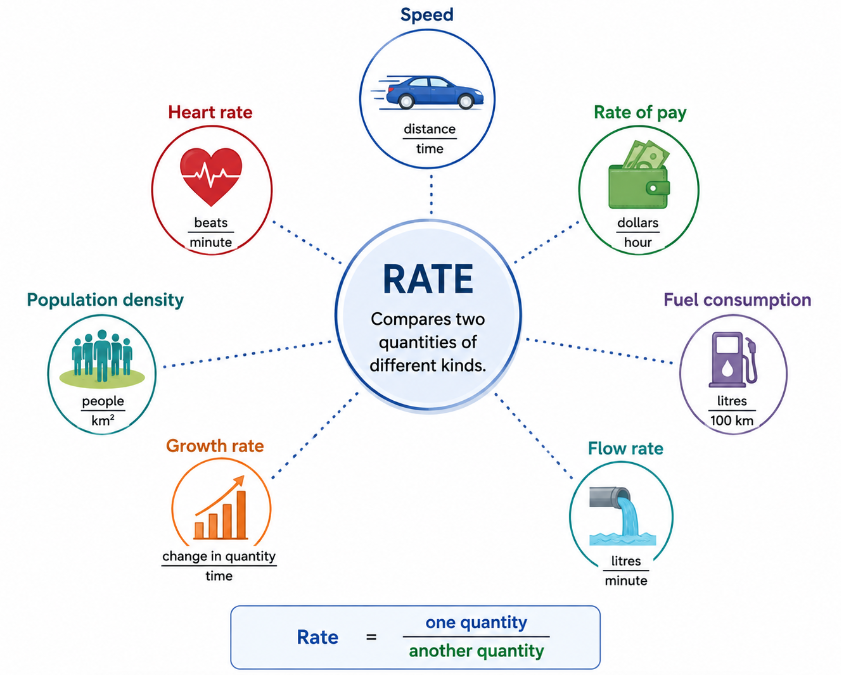
Unlike a ratio, which compares quantities of the same kind, a rate compares quantities with different units. Therefore, units are essential when writing a rate. The word per means “for every”, and a slash \(/\) can also be used.
Rate
\(\text{Rate}=\frac{\text{quantity}}{\text{corresponding quantity}}\)
For example:
\(65\text{ beats per minute}=65\text{ beats/min}\)
This means \(65\) beats occur for every \(1\) minute.
Common Rates
| Situation | Possible Rate |
|---|---|
| Heart rate | beats/min |
| Rate of pay | $/hour |
| Typing speed | words/min |
| Fuel consumption | km/L or L/100 km |
| Water flow | L/min |
| Population density | people/km² |
| Growth rate | m/year, cm/year, etc. |
Finding a Rate
To find a rate, divide the change in the quantity by the amount of the corresponding quantity.
Formula Box
\(\text{Rate}=\frac{\text{change in quantity}}{\text{change in corresponding quantity}}\)
Example: A baby weighs \(12.5\) kg and three weeks later weighs \(13.1\) kg. Find the rate of weight gain in grams per week.
\(\text{Weight gain}=13.1-12.5=0.6\text{ kg}\)
\(0.6\text{ kg}=600\text{ g}\)
\(\text{Rate}=\frac{600}{3}=200\text{ g/week}\)
Therefore, the baby’s rate of weight gain is \(200\text{ g/week}\).
Using a Rate to Find a Quantity
Once a rate is known, it can be used to find the amount produced, travelled, earned or consumed over a particular time.
\(\text{Quantity}=\text{Rate}\times\text{Time}\)
Example: An elephant eats \(240\) peanuts every \(3\) minutes.
\(\text{Rate}=\frac{240}{3}=80\text{ peanuts/min}\)
In \(10\) minutes:
\(80\times10=800\text{ peanuts}\)
Therefore, the elephant eats \(800\) peanuts in \(10\) minutes.
Speed
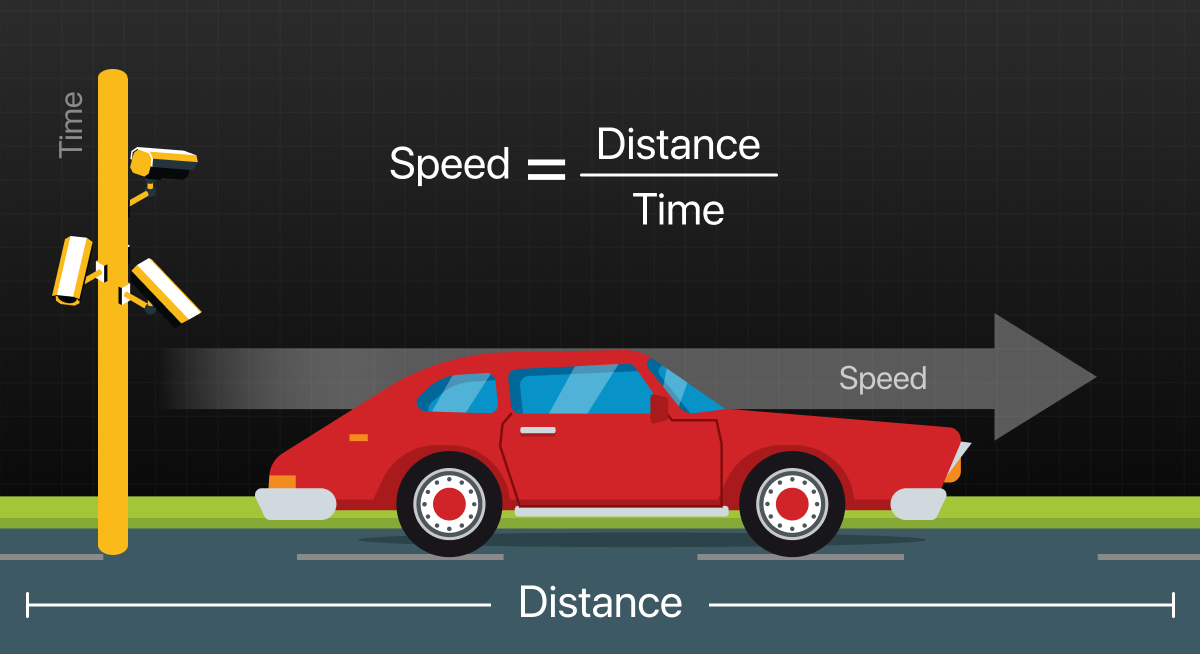
Speed is a rate that compares the distance travelled with the time taken.
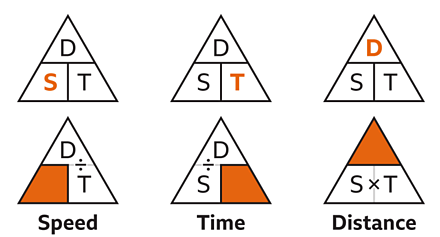
Formula Box: Speed–Distance–Time
\(\text{Speed}=\frac{\text{Distance}}{\text{Time}}\)
\(\text{Distance}=\text{Speed}\times\text{Time}\)
\(\text{Time}=\frac{\text{Distance}}{\text{Speed}}\)
The formula triangle can be remembered as:
Units of speed commonly include:
- kilometres per hour: km/h
- metres per second: m/s
- kilometres per minute: km/min
⚡ Instantaneous Speed and Average Speed
Instantaneous speed is the speed of an object at a particular moment. For example, a car’s speedometer may show an instantaneous speed of \(50\text{ km/h}\).
Average speed considers the entire journey.
\(\text{Average speed}=\frac{\text{total distance travelled}}{\text{total time taken}}\)
⚠️ Important:
Average speed uses the total distance and the total time for the entire journey.
Do not simply average two different speeds unless the time intervals are equal.
Example: Erica cycles \(80\) km in \(2\) hours. Find her average speed.
\(\text{Average speed}=\frac{80}{2}=40\text{ km/h}\)
Therefore, Erica’s average speed is \(40\text{ km/h}\).
If she continues at this rate, the time required to travel \(180\) km is:
\(T=\frac{180}{40}=4.5\text{ h}\)
\(4.5\text{ h}=4\text{ h }30\text{ min}\)
Therefore, the journey would take \(4\) hours \(30\) minutes.
Choosing the Correct Speed Formula
| You know… | Use… |
|---|---|
| Distance and time | \(S=\frac{D}{T}\) |
| Speed and time | \(D=ST\) |
| Distance and speed | \(T=\frac{D}{S}\) |
Speed Problems with Different Units
Before calculating speed, make sure the distance and time units are compatible.
For example, if a person travels \(750\) km in \(50\) minutes, first convert \(50\) minutes into hours:
\(50\text{ min}=\frac{50}{60}\text{ h}=\frac{5}{6}\text{ h}\)
Then:
\(\text{Speed}=\frac{750}{5/6}=900\text{ km/h}\)
The key is to make the units consistent before applying the formula.
Density
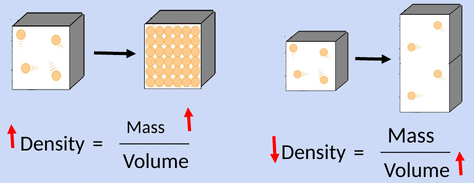
Density is a rate that compares the mass of an object with its volume.
Formula Box: Density
\(\text{Density}=\frac{\text{Mass}}{\text{Volume}}\)
\(\rho=\frac{m}{V}\)
Rearranging:
\(m=\rho V\)
\(V=\frac{m}{\rho}\)
Density is commonly measured in:
\(\text{g/cm}^3\)
Other units are possible, such as \(\text{kg/m}^3\).
For example, the density of pure gold is approximately \(19.30\text{ g/cm}^3\). This means that every \(1\text{ cm}^3\) of pure gold has a mass of \(19.30\) g.
Density of Water and Floating
The density of pure water is approximately:
\(1\text{ g/cm}^3\)
Therefore:
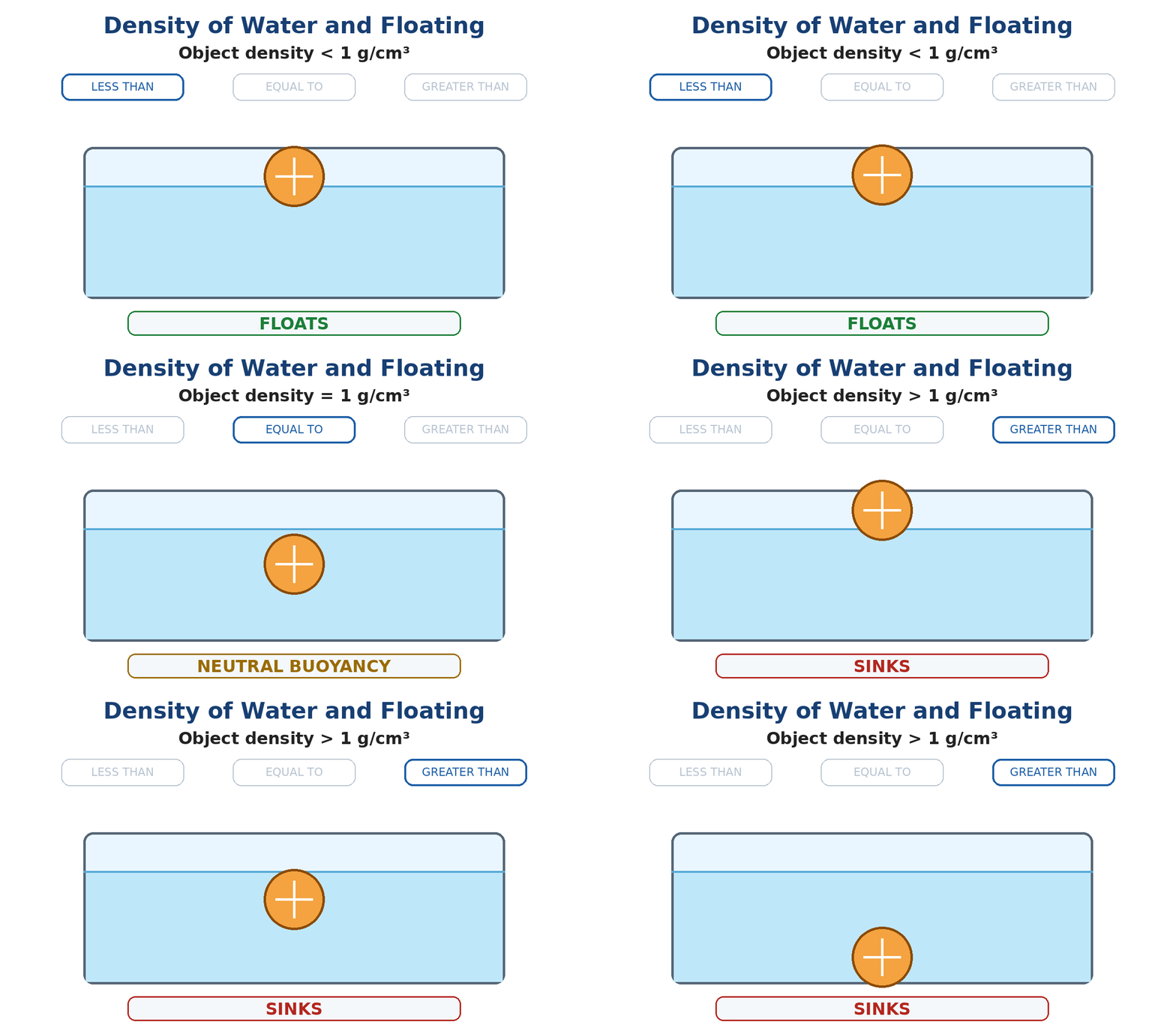
| Object Density | Result in Water |
|---|---|
| Less than \(1\text{ g/cm}^3\) | Floats |
| Equal to \(1\text{ g/cm}^3\) | Neutral buoyancy |
| Greater than \(1\text{ g/cm}^3\) | Sinks |
Example: A piece of timber measures \(60\text{ cm}\times10\text{ cm}\times3\text{ cm}\) and has a mass of \(1.62\) kg. Find its density.
First convert the mass to grams:
\(1.62\text{ kg}=1620\text{ g}\)
Find the volume:
\(V=60\times10\times3=1800\text{ cm}^3\)
Now calculate the density:
\(\rho=\frac{1620}{1800}=0.9\text{ g/cm}^3\)
Since \(0.9<1\), the timber would float in water.
Converting Rates
A rate can often be expressed in different units. The units should be chosen to make the rate useful for the situation.
For example, a petrol pump may operate at \(600\text{ L/hour}\). To convert this to litres per minute, divide by \(60\), because there are \(60\) minutes in an hour.
\(\frac{600}{60}=10\)
600 L/hour \(=10\text{ L/min}\)
📌 Rate Conversion Strategy
When converting a rate:
1. Write the original rate.
2. Convert the numerator unit if necessary.
3. Convert the denominator unit if necessary.
4. Keep the units attached to every step.
5. Check that the final unit is exactly what the question asks for.
Converting m/s and km/h
The most important speed conversion in this topic is between metres per second and kilometres per hour.
Speed Conversion Rules
\(\text{m/s}\rightarrow\text{km/h}:\quad \times3.6\)
\(\text{km/h}\rightarrow\text{m/s}:\quad \div3.6\)
This works because:
\(1\text{ km}=1000\text{ m}\)
\(1\text{ h}=3600\text{ s}\)
Therefore:
\(1\text{ m/s}=3.6\text{ km/h}\)
Example: Convert \(11\text{ m/s}\) to km/h.
\(11\times3.6=39.6\)
Therefore:
\(11\text{ m/s}=39.6\text{ km/h}\)
Example: Convert \(900\text{ km/h}\) to m/s.
\(900\div3.6=250\)
Therefore:
\(900\text{ km/h}=250\text{ m/s}\)
Converting Other Rates
The same idea applies to other rates. Convert the units carefully while keeping the quantity represented by the rate unchanged.
Example: A fire hose discharges \(180\) litres per minute. Convert this to litres per hour.
\(180\times60=10800\)
\(180\text{ L/min}=10800\text{ L/h}\)
Example: A plant grows \(18\) m in \(60\) days. Its growth rate in metres per day is:
\(\frac{18}{60}=0.3\text{ m/day}\)
To express this in millimetres per day:
\(0.3\text{ m/day}=300\text{ mm/day}\)
Converting Density Units
Density units must account for the fact that volume is a cubic measurement.
Since:
\(1\text{ m}=100\text{ cm}\)
then:
\(1\text{ m}^3=100^3\text{ cm}^3=1\,000\,000\text{ cm}^3\)
Also:
\(1\text{ kg}=1000\text{ g}\)
Therefore:
\(1\text{ g/cm}^3=1000\text{ kg/m}^3\)
Example: Convert \(6.8\text{ g/cm}^3\) to kg/m³.
\(6.8\times1000=6800\)
\(6.8\text{ g/cm}^3=6800\text{ kg/m}^3\)
⚠️ Common Mistake: Cubic Units
Do not convert \(\text{cm}^3\) to \(\text{m}^3\) using \(100\).
Because volume is cubic:
\(100^3=1\,000\,000\)
Always remember that changes in length units must be cubed when converting volume units.
Rates in Real-Life Problems
Many real-life questions give a rate and ask you to find an unknown quantity. The key is to identify the two quantities being compared.
| Given Rate | Useful Relationship |
|---|---|
| $20/hour | Earnings = rate × hours |
| 80 peanuts/min | Peanuts = rate × minutes |
| 40 km/h | Distance = speed × time |
| 6 L/min | Volume = flow rate × time |
| 0.8 g/cm³ | Mass = density × volume |
1. Forgetting the units in the final answer.
2. Mixing units, such as using kilometres with seconds without converting.
3. Using the wrong speed formula.
4. Averaging speeds instead of using total distance divided by total time.
5. Forgetting to convert kilograms to grams when the density is required in g/cm³.
6. Forgetting that volume units are cubic when converting density units.
7. Using \(\times3.6\) in the wrong direction.
Remember: \(\text{m/s}\rightarrow\text{km/h}\) means \(\times3.6\), while \(\text{km/h}\rightarrow\text{m/s}\) means \(\div3.6\).
Example 1:
Judy earns $86.40 for working \(4\) hours. a) Find her rate of pay. b) How much will she earn if she works \(19\) hours at the same rate?
▶️ Answer/Explanation
a) Rate of pay
\(\text{Rate}=\frac{86.40}{4}=21.60\)
Answer: $\(21.60\)/hour.
b) Earnings for 19 hours
\(21.60\times19=410.40\)
Answer: $\(410.40\).
Example 2:
A car travels \(210\) km in \(2\) hours. a) Find its average speed. b) At this speed, how long would it take to travel \(325\) km?
▶️ Answer/Explanation
a) Average speed
\(S=\frac{D}{T}=\frac{210}{2}=105\text{ km/h}\)
Answer: \(105\text{ km/h}\).
b) Time
\(T=\frac{D}{S}=\frac{325}{105}\)
\(T\approx3.10\text{ h}\)
\(0.10\) hours is approximately \(6\) minutes.
Answer: Approximately \(3\) hours \(6\) minutes.
Example 3:
A metal object has a mass of \(420\) g and a volume of \(150\text{ cm}^3\). Find its density and determine whether it would float or sink in water.
▶️ Answer/Explanation
Step 1: Use the density formula
\(\rho=\frac{m}{V}\)
\(\rho=\frac{420}{150}=2.8\text{ g/cm}^3\)
Step 2: Compare with water
\(2.8>1\)
The object is denser than water.
Answer: Density \(=2.8\text{ g/cm}^3\), so the object sinks.
Example 4:
A car travels \(518\) km using \(28\) L of petrol. a) Find its fuel consumption in km/L. b) How much petrol would be needed for a \(1480\) km journey if the same rate is maintained?
▶️ Answer/Explanation
a) Fuel consumption
\(\text{Fuel consumption}=\frac{518}{28}\)
\(\approx18.5\text{ km/L}\)
Answer: Approximately \(18.5\text{ km/L}\).
b) Petrol required
\(\text{Petrol}=\frac{1480}{18.5}\)
=\(80\text{ L}\)
Answer: \(80\) L of petrol.
Line Graphs
A line graph can be used to show the relationship between two quantities. We graph one quantity against another to see how one variable changes as the other variable changes.
The key idea is to decide which variable depends on the other.
Independent and Dependent Variables
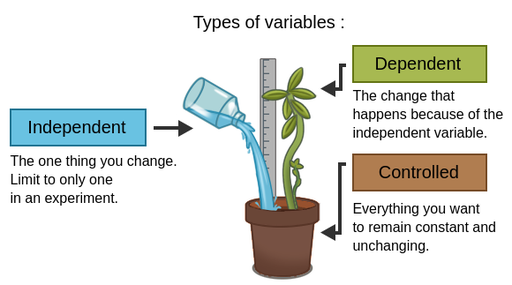
The independent variable is the variable that is changed or controlled.
The dependent variable is the variable whose value depends on the independent variable.
Graphing rule:
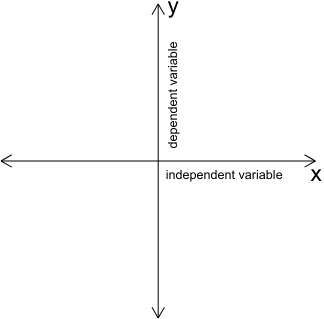
- Independent variable → horizontal axis (\(x\)-axis)
- Dependent variable → vertical axis (\(y\)-axis)
For example, in a journey, the distance travelled depends on the time that has passed. Therefore:
- \(\text{Time}=\text{independent variable}\)
- \(\text{Distance}=\text{dependent variable}\)
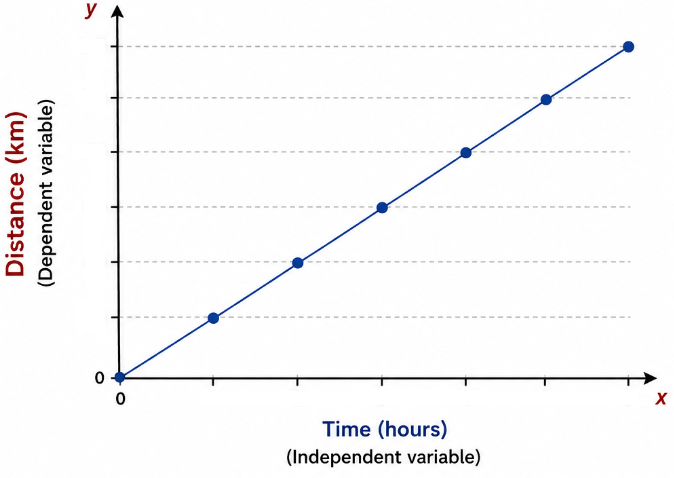
So time is placed on the horizontal axis and distance is placed on the vertical axis. This is exactly how the textbook introduces its travel graphs.
How to Identify the Variables
| Situation | Independent Variable | Dependent Variable |
|---|---|---|
| A car journey | Time | Distance |
| Petrol filling a tank | Time | Amount of petrol |
| Buying fabric | Length of fabric | Cost |
| Student studying | Time spent studying | Test score |
| Water given to a plant | Amount of water | Amount of growth |
Constructing a Line Graph
When constructing a line graph:
- Identify the independent and dependent variables.
- Place the independent variable on the horizontal axis.
- Place the dependent variable on the vertical axis.
- Label both axes with the variable and its units.
- Choose a suitable scale for each axis.
- Plot each ordered pair accurately.
- Join the points appropriately with straight line segments when the relationship is continuous.
⚠️ Graph Checklist
Before finishing a line graph, check:
✓ Correct variable on each axis
✓ Axis labels include units
✓ Scale increases evenly
✓ Points are plotted accurately
✓ Graph has an appropriate title
✓ Points are joined correctly
Example: Petrol Tank
Max has \(10\) litres of petrol in his tank. Petrol is pumped into the tank at \(15\) litres per minute. The tank can hold \(70\) litres.
The amount of petrol depends on the time that the tank has been filling. Therefore:
- \(\text{Independent variable}=\text{time}\)
- \(\text{Dependent variable}=\text{amount of petrol}\)
Since the tank gains \(15\) litres every minute, the table is:
| Time (min) | 0 | 1 | 2 | 3 | 4 |
|---|---|---|---|---|---|
| Amount (L) | 10 | 25 | 40 | 55 | 70 |
The points to plot are:
\((0,10),\ (1,25),\ (2,40),\ (3,55),\ (4,70)\)
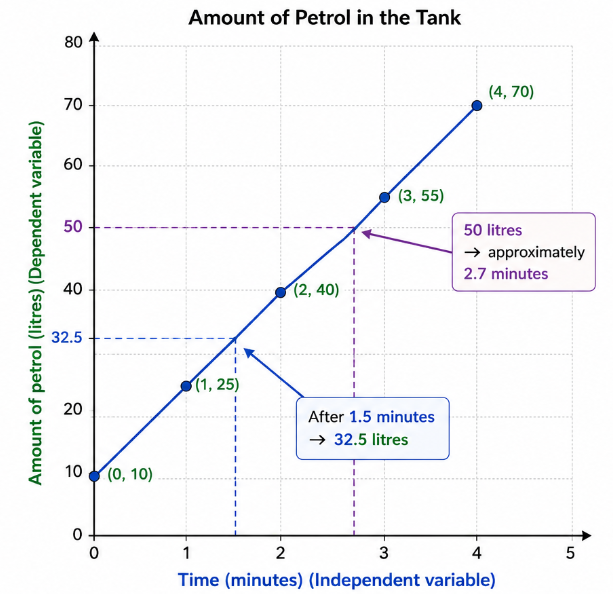
After plotting the points, join them to form the line graph. The textbook uses this example to show how a graph can then be used to estimate values between the plotted points.
Reading from the graph:
After \(1.5\) minutes → \(32.5\) litres
\(50\) litres → approximately \(2.7\) minutes
These values are obtained by reading across from one axis and then down/up to the other variable.
Travel Graphs
A travel graph shows how the distance travelled changes with time.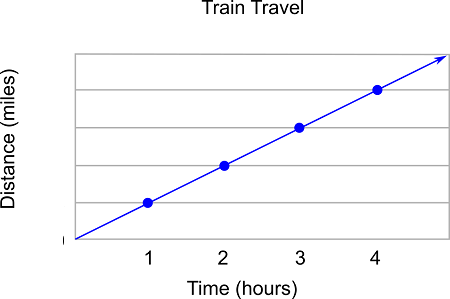
\(\text{Horizontal axis}=\text{time}\)
\(\text{Vertical axis}=\text{distance}\)
The graph can be used to determine:
- distance travelled at a particular time
- time taken to travel a particular distance
- speed during a section of the journey
- average speed for the entire journey
Example: A train travels \(180\) km in the first \(3\) hours and then travels another \(30\) km during the final hour.
From the graph:
\(\text{Distance after 3 h}=180\text{ km}\)
Therefore, its speed during the first \(3\) hours is:
\(\text{Speed}=\frac{180}{3}=60\text{ km/h}\)
During the final hour:
\(\text{Speed}=\frac{30}{1}=30\text{ km/h}\)
The total distance is \(210\) km and the total time is \(4\) hours. Therefore:
\(\text{Average speed}=\frac{210}{4}=52.5\text{ km/h}\)
This is the textbook’s worked travel-graph example.
📌 Reading a Travel Graph
The gradient of a distance-time graph represents speed.
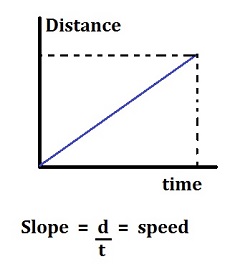
\(\text{Gradient}=\frac{\text{change in distance}}{\text{change in time}}\)
Therefore:
\(\text{Gradient}=\text{Speed}\)
What Does a Straight Line Mean?
If a distance-time graph is a straight line, its gradient is constant. Therefore, the object is travelling at a constant speed.
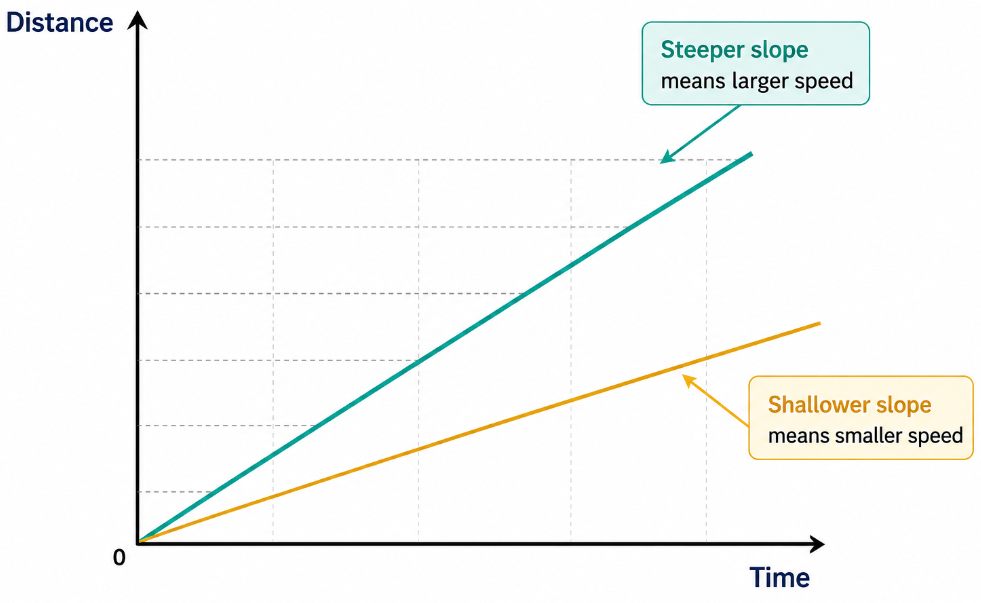
A steeper line means a greater speed because the distance is increasing more quickly for the same amount of time.
| Graph Shape | Meaning |
|---|---|
| Straight upward line | Constant positive speed |
| Steeper upward line | Faster speed |
| Horizontal line | Distance is not changing; object is stationary |
| Changing gradient | Speed is changing |
Example:
A cargo ship travels at a constant speed of \(40\text{ km/h}\).
a) Complete the table for times from \(0\) to \(5\) hours.
b) Identify the independent and dependent variables.
c) Find the distance travelled after \(2.5\) hours.
d) Find the time required to travel \(150\) km.
e) Explain the meaning of the gradient.
▶️ Answer/Explanation
a) Table
| Time (h) | 0 | 1 | 2 | 3 | 4 | 5 |
|---|---|---|---|---|---|---|
| Distance (km) | 0 | 40 | 80 | 120 | 160 | 200 |
b) Variables
\(\text{Independent variable}=\text{time}\)
\(\text{Dependent variable}=\text{distance}\)
c) Distance after \(2.5\) hours
\(D=ST\)
\(D=40\times2.5=100\text{ km}\)
Answer: \(100\) km.
d) Time to travel \(150\) km
\(T=\frac{150}{40}=3.75\text{ h}\)
\(0.75\text{ h}=45\text{ min}\)
Answer: \(3\) hours \(45\) minutes.
e) Gradient
\(\text{Gradient}=\frac{\text{change in distance}}{\text{change in time}} =40\text{ km/h}\)
Therefore, the gradient represents the ship’s constant speed.
Example:
A travel graph shows a car travelling from town A to town C, passing through town B. The graph shows:
A: \((0,0)\)
B: \((2,100)\)
C: \((3,200)\)
Find the speed between A and B and the speed between B and C.
▶️ Answer/Explanation
Speed from A to B:
\(\text{Speed}=\frac{100-0}{2-0}=50\text{ km/h}\)
Speed from B to C:
\(\text{Speed}=\frac{200-100}{3-2}=100\text{ km/h}\)
Therefore, the car travels faster between B and C because that section has the steeper gradient.