
8.1 – Translations, Rotations and Reflections
Transformations are movements or changes made to a shape. A transformation changes the position, orientation, or size of a figure according to a specific rule.
In this topic, we study three important transformations:
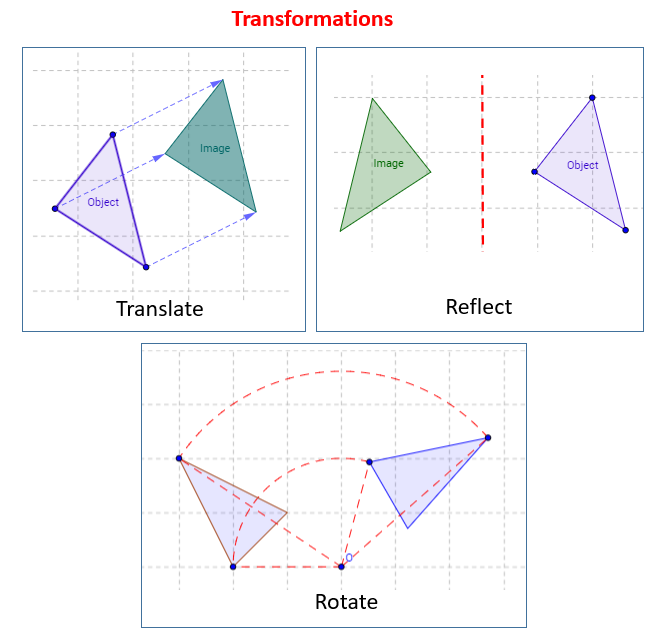
- Translation – slides a shape
- Rotation – turns a shape around a fixed point
- Reflection – flips a shape across a mirror line
Translations, rotations and reflections are rigid transformations.
They do not change the size or shape of the original figure.
Therefore, corresponding:
• side lengths remain equal
• angle measures remain equal
• perimeter remains unchanged
• area remains unchanged
The transformed figure is called the image, while the original figure is called the pre-image.
\(\text{Pre-image} \longrightarrow \text{Transformation} \longrightarrow \text{Image}\)
Corresponding points are usually labelled using prime notation. For example, \(A\) may move to \(A’\), \(B\) to \(B’\), and so on.
Translation
A translation moves every point of a figure the same distance in the same direction.
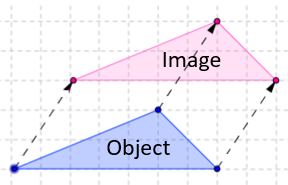
A translation is often described using a translation vector.
Translation Vector
A translation vector is written as:
\(\begin{pmatrix} a \\ b \end{pmatrix}\)
where:
\(a\) represents the horizontal movement.
\(b\) represents the vertical movement.
Positive \(a\) → move right
Negative \(a\) → move left
Positive \(b\) → move up
Negative \(b\) → move down
For example, the vector
\(\begin{pmatrix} 4 \\ 2 \end{pmatrix}\)
means move the figure \(4\) units to the right and \(2\) units upwards.
The vector
\(\begin{pmatrix} -3 \\ -5 \end{pmatrix}\)
means move the figure \(3\) units to the left and \(5\) units downwards.
Example of a coordinate translation:
If \(A(2,3)\) is translated by
\(\begin{pmatrix} 4 \\ -2 \end{pmatrix}\)
then:
\(x: 2+4=6\)
\(y: 3-2=1\)
\(A'(6,1)\)
During a translation, every point moves the same distance in the same direction. The orientation of the shape does not change.
Rotation
A rotation turns a figure around a fixed point called the centre of rotation.
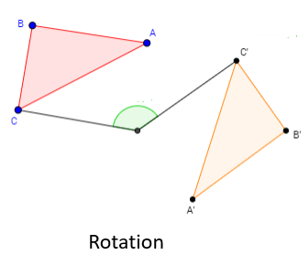
A rotation is described by three pieces of information:
- The centre of rotation
- The angle of rotation
- The direction of rotation
The two main directions are:
| Direction | Meaning |
|---|---|
| Clockwise | Turns in the same direction as the hands of a clock |
| Anticlockwise | Turns in the opposite direction to the hands of a clock |
Common angles of rotation include:
| Rotation | Equivalent Rotation |
|---|---|
| \(90^\circ\) clockwise | \(270^\circ\) anticlockwise |
| \(90^\circ\) anticlockwise | \(270^\circ\) clockwise |
| \(180^\circ\) | Same in either direction |
| \(360^\circ\) | Returns to the original position |
When rotating a shape, each point stays the same distance from the centre of rotation.
📌 Important Properties of Rotation
• The shape does not change size.
• The shape does not change its shape.
• Corresponding side lengths remain equal.
• Corresponding angles remain equal.
• Every point rotates through the same angle.
• The distance of each point from the centre of rotation remains unchanged.
Reflection
A reflection flips a figure over a line called the line of reflection.
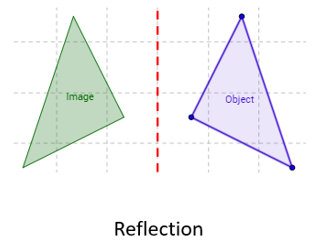
The line of reflection acts like a mirror. Each point and its image are the same perpendicular distance from the mirror line.
📌 Properties of Reflection
• The size of the figure stays the same.
• The shape stays the same.
• Corresponding side lengths remain equal.
• Corresponding angles remain equal.
• The orientation of the figure is reversed.
• Corresponding points are equally far from the line of reflection.
Common lines of reflection on a coordinate plane include the:
- \(x\)-axis
- \(y\)-axis
- line \(y=x\)
- line \(y=-x\)
For example, reflecting a point across the \(x\)-axis keeps its \(x\)-coordinate unchanged but changes the sign of its \(y\)-coordinate.
\((x,y)\rightarrow(x,-y)\)
Reflecting a point across the \(y\)-axis changes the sign of its \(x\)-coordinate while keeping the \(y\)-coordinate unchanged.
\((x,y)\rightarrow(-x,y)\)
| Transformation | Main Idea | What Happens to the Shape? |
|---|---|---|
| Translation | Slide | Moves the same distance and direction |
| Rotation | Turn | Turns around a fixed centre |
| Reflection | Flip | Flips across a mirror line |
Comparing the Three Transformations
| Feature | Translation | Rotation | Reflection |
|---|---|---|---|
| Changes size? | No | No | No |
| Changes shape? | No | No | No |
| Direction/orientation changes? | No | Yes | Yes |
| Special information needed | Translation vector | Centre, angle and direction | Line of reflection |
How to Describe a Transformation
When asked to describe how one shape has changed into another, give enough information to identify the transformation completely.
| Transformation | What to State |
|---|---|
| Translation | The translation vector |
| Rotation | Centre, angle and direction |
| Reflection | The line of reflection |
Example 1:
Triangle \(ABC\) has vertices \(A(1,2)\), \(B(4,2)\) and \(C(2,5)\). The triangle is translated by
\(\begin{pmatrix} 3 \\ -4 \end{pmatrix}\)
Find the coordinates of \(A’\), \(B’\) and \(C’\).
▶️ Answer/Explanation
Translation: \(3\) units right and \(4\) units down.
Point \(A\):
\(A(1,2)\rightarrow A'(1+3,2-4)\)
\(A'(4,-2)\)
Point \(B\):
\(B(4,2)\rightarrow B'(4+3,2-4)\)
\(B'(7,-2)\)
Point \(C\):
\(C(2,5)\rightarrow C'(2+3,5-4)\)
\(C'(5,1)\)
Final Answer:
\(A'(4,-2),\ B'(7,-2),\ C'(5,1)\)
Example 2:
Point \(P(3,1)\) is transformed in two different ways.
a) Rotate \(P\) \(90^\circ\) anticlockwise about the origin.
b) Reflect the original point \(P\) in the \(x\)-axis.
▶️ Answer/Explanation
a) \(90^\circ\) anticlockwise rotation
For a \(90^\circ\) anticlockwise rotation about the origin:
\((x,y)\rightarrow(-y,x)\)
\(P(3,1)\rightarrow P'(-1,3)\)
Answer: \(P'(-1,3)\)
b) Reflection in the \(x\)-axis
For a reflection in the \(x\)-axis:
\((x,y)\rightarrow(x,-y)\)
\(P(3,1)\rightarrow P'(3,-1)\)
Answer: \(P'(3,-1)\)
Notice that both transformations preserve the distance from the origin, but they move the point in different ways.