
8.2 – Dilations and Enlargements
A dilation is a transformation that changes the size of a figure while keeping its shape the same. A dilation is described by a centre of dilation and a scale factor.
A dilation can make a figure larger or smaller. The resulting figure has the same shape as the original figure, so the two figures are similar.
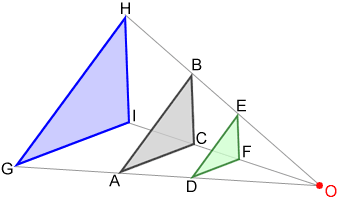
A dilation changes the size of a figure by multiplying its lengths by a scale factor.
Unlike translations, rotations and reflections, a dilation generally does change the size of the figure.
The shape and angle measures remain unchanged.
Centre of Dilation
The centre of dilation is the fixed point from which the figure is enlarged or reduced.
For a dilation with a positive scale factor, each point of the original figure and its corresponding image point lie on the same straight line passing through the centre of dilation.
The distance from the centre to each image point is found by multiplying the original distance by the scale factor.
\(\text{New distance from centre}=\text{Scale factor}\times\text{Original distance from centre}\)
💡 Visualising a Dilation
Imagine the centre of dilation as a fixed point.
• Draw a line from the centre through each vertex of the original figure.
• Move each vertex along its line.
• Multiply its distance from the centre by the scale factor.
• Join the new vertices to form the image.
Scale Factor
The scale factor tells us how many times larger or smaller the image is compared with the original figure.
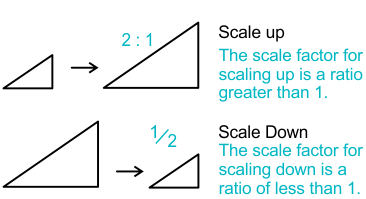
\(\text{Scale factor}=\frac{\text{corresponding length in image}}{\text{corresponding length in original}}\)
| Scale Factor | Type | Effect |
|---|---|---|
| \(k>1\) | Enlargement | Figure becomes larger |
| \(0<k<1\) | Reduction | Figure becomes smaller |
| \(k=1\) | No change | Figure stays the same size |
For example, a scale factor of \(3\) means every length becomes \(3\) times as long.
\(5\text{ cm}\times3=15\text{ cm}\)
A scale factor of \(\frac{1}{2}\) means every length becomes half as long.
\(10\text{ cm}\times\frac{1}{2}=5\text{ cm}\)
Finding Missing Lengths
When two figures are related by a dilation, all corresponding lengths are multiplied by the same scale factor.
If the original side is \(8\) cm and the scale factor is \(2.5\):
\(\text{Image length}=8\times2.5=20\text{ cm}\)
If the image side is \(24\) cm and the original side is \(8\) cm:
\(\text{Scale factor}=\frac{24}{8}=3\)
Therefore, the image is an enlargement by a factor of \(3\).
Perimeter Under a Dilation
Since every length is multiplied by the scale factor, the perimeter is also multiplied by the scale factor.
\(\text{New perimeter}=k\times\text{Original perimeter}\)
For example, if a triangle has perimeter \(12\) cm and is enlarged by a scale factor of \(2\):
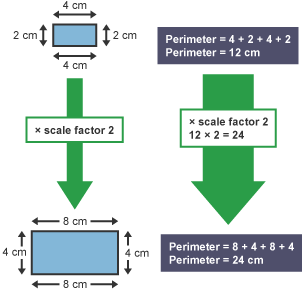
\(12\times2=24\text{ cm}\)
So the new perimeter is \(24\) cm.
Area Under a Dilation
Area changes differently from length. If every length is multiplied by \(k\), the area is multiplied by \(k^2\).
Area Scale Factor
\(\text{Area scale factor}=k^2\)
\(\text{New area}=k^2\times\text{Original area}\)
For example, if a rectangle has an area of \(8\text{ cm}^2\) and is enlarged by a scale factor of \(2\):
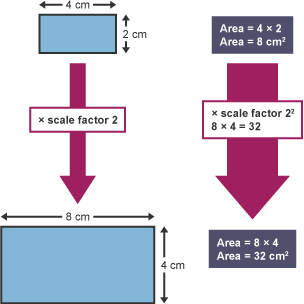
\(k^2=2^2=4\)
\(4\times8=32\text{ cm}^2\)
Therefore, the new area is \(32\text{ cm}^2\).
⚠️ Important Difference
If the scale factor is \(3\):
Lengths become \(3\) times as large.
Perimeter becomes \(3\) times as large.
Area becomes \(3^2=9\) times as large.
Do not multiply area by \(3\). Area uses the square of the scale factor.
Dilations on the Cartesian Plane
When the centre of dilation is the origin \((0,0)\), a dilation can be performed directly on the coordinates.
Coordinate Rule for a Dilation About the Origin
\((x,y)\rightarrow(kx,ky)\)
This means that both coordinates are multiplied by the scale factor.
Example: Enlarge the point \(A(2,4)\) by a scale factor of \(3\) about the origin.
\(A(2,4)\rightarrow A'(3\times2,3\times4)\)
\(A'(6,12)\)
Therefore, the image of \(A\) is \(A'(6,12)\).
Example with a reduction: Reduce \(B(8,6)\) by a scale factor of \(\frac{1}{2}\) about the origin.
\(B(8,6)\rightarrow B’\left(\frac{1}{2}\times8,\frac{1}{2}\times6\right)\)
\(B'(4,3)\)
Dilation When the Centre Is Not the Origin
If the centre of dilation is not the origin, the coordinate rule \((x,y)\rightarrow(kx,ky)\) cannot be used directly.
Instead, each point moves along the line connecting it to the centre of dilation. Its distance from the centre is multiplied by the scale factor.
For an enlargement with \(k>1\), the image point is farther from the centre. For a reduction with \(0<k<1\), the image point is closer to the centre.
🧠 Three Things to Check
1. Where is the centre of dilation?
2. What is the scale factor?
3. Is the figure becoming larger or smaller?
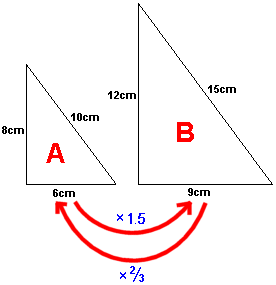
Finding the Scale Factor from a Diagram
If the original and image figures are shown, choose a pair of corresponding sides and divide the image length by the original length.
\(k=\frac{\text{image length}}{\text{original length}}\)
Properties of Figures Under Dilation
| Property | What Happens? |
|---|---|
| Shape | Remains the same |
| Angles | Remain equal |
| Side lengths | Multiply by \(k\) |
| Perimeter | Multiplies by \(k\) |
| Area | Multiplies by \(k^2\) |
| Orientation | Remains unchanged for positive \(k\) |
Working Backwards from an Enlargement
Sometimes the image is known and the original figure must be found. In this case, divide by the scale factor.
If the image side is \(30\) cm and the scale factor is \(2.5\):
\(\text{Original length}=\frac{30}{2.5}=12\text{ cm}\)
Therefore, the original corresponding side was \(12\) cm.
🚨 Common Mistakes
1. Using the scale factor in the wrong direction.
Always use: \(\displaystyle k=\frac{\text{image}}{\text{original}}\).
2. Multiplying area by \(k\) instead of \(k^2\).
3. Forgetting the centre of dilation when working with a diagram.
4. Using \((x,y)\rightarrow(kx,ky)\) when the centre is not the origin.
5. Thinking that an enlargement changes the shape.
The figure becomes larger or smaller, but its shape and corresponding angles remain the same.
Example 1:
Triangle \(ABC\) has side lengths \(6\) cm, \(8\) cm and \(10\) cm. It is enlarged by a scale factor of \(2.5\).
a) Find the three side lengths of the enlarged triangle.
b) Find the perimeter of the enlarged triangle.
c) If the original triangle has an area of \(24\text{ cm}^2\), find the area of the enlarged triangle.
d) Explain what happens to the angles of the triangle.
▶️ Answer/Explanation
a) Side lengths
\(6\times2.5=15\text{ cm}\)
\(8\times2.5=20\text{ cm}\)
\(10\times2.5=25\text{ cm}\)
Answer: \(15\) cm, \(20\) cm and \(25\) cm.
b) Perimeter
\(\text{Original perimeter}=6+8+10=24\text{ cm}\)
\(\text{New perimeter}=24\times2.5=60\text{ cm}\)
Answer: \(60\) cm.
c) Area
\(k^2=(2.5)^2=6.25\)
\(\text{New area}=24\times6.25=150\text{ cm}^2\)
Answer: \(150\text{ cm}^2\).
d) Angles
A dilation does not change angle measures. Therefore, all corresponding angles remain equal.
Answer: The angles remain unchanged.
Example 2:
Triangle \(PQR\) has coordinates
\(P(2,1),\quad Q(5,1),\quad R(2,4)\)
The triangle is enlarged by a scale factor of \(2\) about the origin.
a) Find the coordinates of \(P’\), \(Q’\) and \(R’\).
b) Find the original and enlarged perimeters.
c) If the original area is \(4.5\text{ square units}\), find the enlarged area.
▶️ Answer/Explanation
a) Coordinates
Since the centre is the origin, use:
\((x,y)\rightarrow(2x,2y)\)
For \(P(2,1)\):
\(P'(4,2)\)
For \(Q(5,1)\):
\(Q'(10,2)\)
For \(R(2,4)\):
\(R'(4,8)\)
Answer: \(P'(4,2),\ Q'(10,2),\ R'(4,8)\)
b) Perimeter
The original triangle has side lengths \(3\), \(3\), and \(3\sqrt{2}\).
\(\text{Original perimeter}=6+3\sqrt{2}\)
The scale factor is \(2\), so the perimeter also doubles:
\(\text{New perimeter}=2(6+3\sqrt{2})\)
\(=12+6\sqrt{2}\)
Answer: Original perimeter \(=6+3\sqrt{2}\) units; enlarged perimeter \(=12+6\sqrt{2}\) units.
c) Area
The area scale factor is:
\(2^2=4\)
\(4.5\times4=18\text{ square units}\)
Answer: \(18\text{ square units}\).