
8.3 – Transformations on the Cartesian Plane
Transformations can be performed on shapes drawn on the Cartesian plane. Instead of moving a shape by eye, we can use coordinate rules to determine the exact position of each image point.
In this topic, we apply the four main transformations to coordinates:
- Translation – slides a figure
- Rotation – turns a figure around a centre
- Reflection – flips a figure across a line
- Dilation – enlarges or reduces a figure
If \(A(x,y)\) is transformed, its new position is written as \(A'(x’,y’)\).
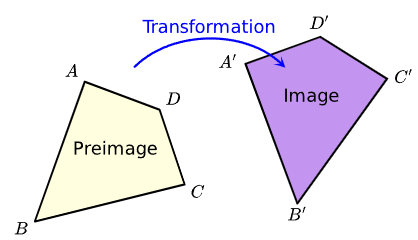
The original figure is called the pre-image, and the transformed figure is called the image.
The Cartesian Plane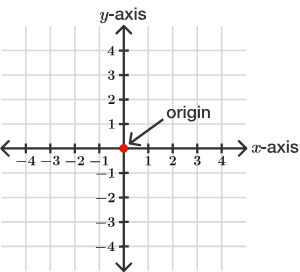
The Cartesian plane is formed by two perpendicular number lines:
- The horizontal axis is the \(x\)-axis.
- The vertical axis is the \(y\)-axis.
- The point where the axes meet is the origin, \((0,0)\).
A point is written as an ordered pair:
\((x,y)\)
The \(x\)-coordinate is written first, followed by the \(y\)-coordinate.
Always remember:
\(x\) comes first → horizontal movement
\(y\) comes second → vertical movement
Translation Rules
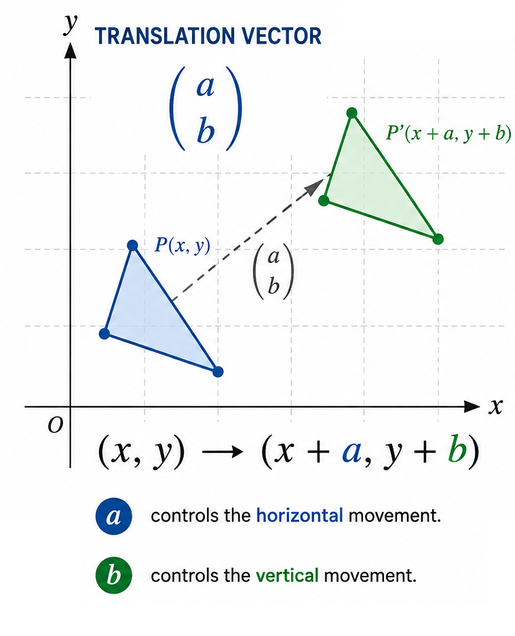
A translation moves every point the same distance in the same direction.
A translation can be represented by a vector:
\(\begin{pmatrix} a \\ b \end{pmatrix}\)
The coordinate rule is:
| Vector | Movement |
|---|---|
| \(\begin{pmatrix} 4 \\ 2 \end{pmatrix}\) | 4 right, 2 up |
| \(\begin{pmatrix} -4 \\ 2 \end{pmatrix}\) | 4 left, 2 up |
| \(\begin{pmatrix} 4 \\ -2 \end{pmatrix}\) | 4 right, 2 down |
| \(\begin{pmatrix} -4 \\ -2 \end{pmatrix}\) | 4 left, 2 down |
Example: Translate \(A(3,-2)\) by
\(\begin{pmatrix} -5 \\ 4 \end{pmatrix}\)
\((x,y)\rightarrow(x-5,y+4)\)
\(A'(3-5,-2+4)\)
\(A'(-2,2)\)
Rotation Rules About the Origin
Rotations on the Cartesian plane can be performed using coordinate rules when the centre of rotation is the origin.
| Rotation | Coordinate Rule |
|---|---|
\(90^\circ\) | \((x,y)\rightarrow(-y,x)\) |
\(180^\circ\) | \((x,y)\rightarrow(-x,-y)\) |
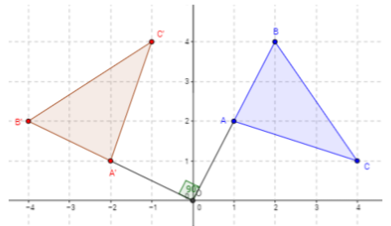
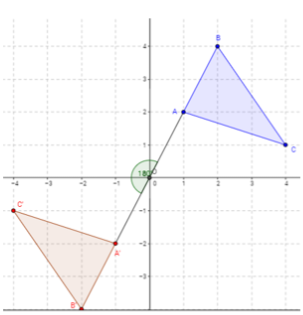
For \(90^\circ\) anticlockwise:
Swap the coordinates, then change the sign of the original \(y\).
\((x,y)\rightarrow(-y,x)\)
For \(90^\circ\) clockwise:
Swap the coordinates, then change the sign of the original \(x\).
\((x,y)\rightarrow(y,-x)\)
Example: Rotate \(P(4,2)\) \(90^\circ\) anticlockwise about the origin.
\((x,y)\rightarrow(-y,x)\)
\(P(4,2)\rightarrow P'(-2,4)\)
Therefore, \(P'(-2,4)\).
Reflection Rules
Reflections can also be described using coordinate rules. The rule depends on the line of reflection.
| Line of Reflection | Coordinate Rule |
|---|---|
| \(x\)-axis | \((x,y)\rightarrow(x,-y)\) |
| \(y\)-axis | \((x,y)\rightarrow(-x,y)\) |
| \(y=x\) | \((x,y)\rightarrow(y,x)\) |
| \(y=-x\) | \((x,y)\rightarrow(-y,-x)\) |
Example: Reflect \(A(-3,5)\) in the \(x\)-axis.
\((x,y)\rightarrow(x,-y)\)
\(A(-3,5)\rightarrow A'(-3,-5)\)
Therefore, \(A'(-3,-5)\).
Dilation Rules About the Origin
A dilation with centre at the origin changes the distance of every point from the origin by the scale factor \(k\).
\((x,y)\rightarrow(kx,ky)\)
where \(k\) is the scale factor.
If \(k>1\), the figure is enlarged.
If \(0<k<1\), the figure is reduced.
Example: Dilate \(B(-2,4)\) by a scale factor of \(3\) about the origin.
\((x,y)\rightarrow(3x,3y)\)
\(B(-2,4)\rightarrow B'(-6,12)\)
Therefore, \(B'(-6,12)\).
Transformation Rules Summary
| Transformation | Rule |
|---|---|
| Translation | \((x,y)\rightarrow(x+a,y+b)\) |
| \(90^\circ\) anticlockwise rotation | \((x,y)\rightarrow(-y,x)\) |
| \(90^\circ\) clockwise rotation | \((x,y)\rightarrow(y,-x)\) |
| \(180^\circ\) rotation | \((x,y)\rightarrow(-x,-y)\) |
| Reflection in \(x\)-axis | \((x,y)\rightarrow(x,-y)\) |
| Reflection in \(y\)-axis | \((x,y)\rightarrow(-x,y)\) |
| Reflection in \(y=x\) | \((x,y)\rightarrow(y,x)\) |
| Reflection in \(y=-x\) | \((x,y)\rightarrow(-y,-x)\) |
| Dilation about origin | \((x,y)\rightarrow(kx,ky)\) |
Identifying a Transformation from Coordinates
Sometimes you are given the coordinates of a pre-image and an image and must determine which transformation has been used.
Look for the pattern between the original and new coordinates.
| What you notice | Possible Transformation |
|---|---|
| Same change added to every \(x\) and \(y\) | Translation |
| \(x\) changes sign only | Reflection in \(y\)-axis |
| \(y\) changes sign only | Reflection in \(x\)-axis |
| Coordinates swap with one sign change | \(90^\circ\) rotation |
| Both coordinates change sign | \(180^\circ\) rotation |
| Both coordinates are multiplied by the same number | Dilation about origin |
Transformations of Whole Figures
When transforming a polygon, apply the same transformation rule to every vertex.
For example, suppose triangle \(ABC\) has vertices: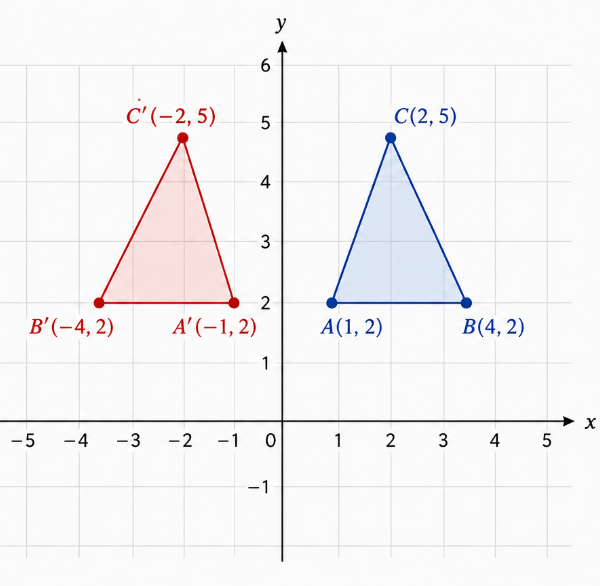
\(A(1,2),\quad B(4,2),\quad C(2,5)\)
To reflect the triangle in the \(y\)-axis, use:
\((x,y)\rightarrow(-x,y)\)
\(A(1,2)\rightarrow A'(-1,2)\)
\(B(4,2)\rightarrow B'(-4,2)\)
\(C(2,5)\rightarrow C'(-2,5)\)
The new triangle is formed by joining \(A’\), \(B’\) and \(C’\).
Step 1: Write down the coordinates of every vertex.
Step 2: Identify the transformation and its rule.
Step 3: Apply the rule to each vertex.
Step 4: Write the new coordinates using prime notation.
Step 5: Plot the image points and join them in the same order.
If a point is first reflected and then translated, the result may be different from first translating and then reflecting.
Always complete the transformations in the order given.
Quadrants and Transformations
Remember the signs of coordinates in each quadrant:
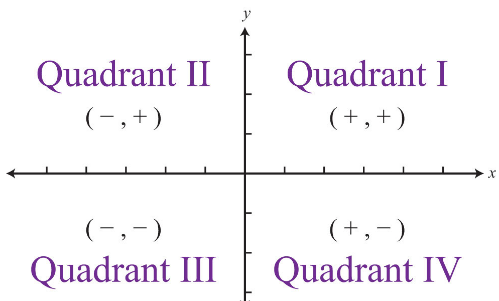
| Quadrant | Sign of \(x\) | Sign of \(y\) |
|---|---|---|
| I | Positive | Positive |
| II | Negative | Positive |
| III | Negative | Negative |
| IV | Positive | Negative |
Understanding the signs helps you check whether your transformed coordinates are reasonable.
Example 1:
Triangle \(ABC\) has vertices
\(A(2,1),\quad B(5,1),\quad C(3,4)\)
a) Reflect the triangle in the \(x\)-axis.
b) Translate the original triangle by
\(\begin{pmatrix}-2\\3\end{pmatrix}\)
c) Rotate the original triangle \(180^\circ\) about the origin.
▶️ Answer/Explanation
a) Reflection in the \(x\)-axis
\((x,y)\rightarrow(x,-y)\)
\(A(2,1)\rightarrow A'(2,-1)\)
\(B(5,1)\rightarrow B'(5,-1)\)
\(C(3,4)\rightarrow C'(3,-4)\)
Answer: \(A'(2,-1),\ B'(5,-1),\ C'(3,-4)\)
b) Translation
\((x,y)\rightarrow(x-2,y+3)\)
\(A(2,1)\rightarrow A'(0,4)\)
\(B(5,1)\rightarrow B'(3,4)\)
\(C(3,4)\rightarrow C'(1,7)\)
Answer: \(A'(0,4),\ B'(3,4),\ C'(1,7)\)
c) \(180^\circ\) rotation
\((x,y)\rightarrow(-x,-y)\)
\(A(2,1)\rightarrow A'(-2,-1)\)
\(B(5,1)\rightarrow B'(-5,-1)\)
\(C(3,4)\rightarrow C'(-3,-4)\)
Answer: \(A'(-2,-1),\ B'(-5,-1),\ C'(-3,-4)\)
Example 2:
Point \(P(3,-2)\) is transformed in two steps:
Step 1: Reflect \(P\) in the \(y\)-axis.
Step 2: Translate the resulting point by
\(\begin{pmatrix}4\\5\end{pmatrix}\)
Find the final coordinates of \(P”\).
▶️ Answer/Explanation
Step 1: Reflect in the \(y\)-axis
\((x,y)\rightarrow(-x,y)\)
\(P(3,-2)\rightarrow P'(-3,-2)\)
Step 2: Translate by
\(\begin{pmatrix}4\\5\end{pmatrix}\)
\((x,y)\rightarrow(x+4,y+5)\)
\(P'(-3,-2)\rightarrow P”(-3+4,-2+5)\)
\(P”(1,3)\)
Final Answer: \(P”(1,3)\)
The order matters because the translation was performed after the reflection.