
8.4 – Congruence and Similarity Using Transformations
Transformations provide a useful way to understand when two figures are congruent or similar. Congruence means that figures have exactly the same size and shape, while similarity means that they have the same shape but may have different sizes.
On the Cartesian plane, we can use translations, rotations, reflections and dilations to determine the relationship between two figures.
Congruent figures: same shape and same size.
Similar figures: same shape, but the size may be different. Corresponding lengths are proportional and corresponding angles are equal.
What Does Congruent Mean?
Two figures are congruent if one can be transformed into the other using transformations that do not change the size or shape of the figure.
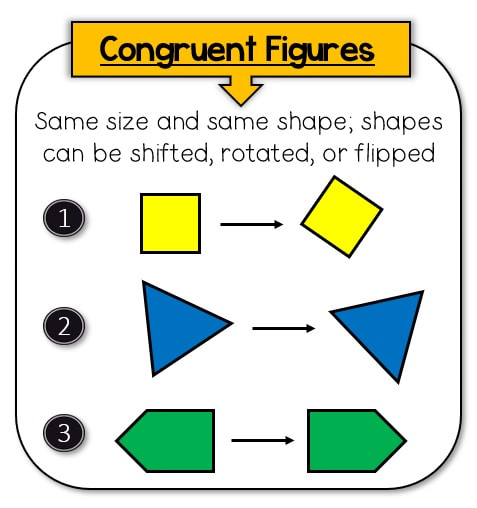
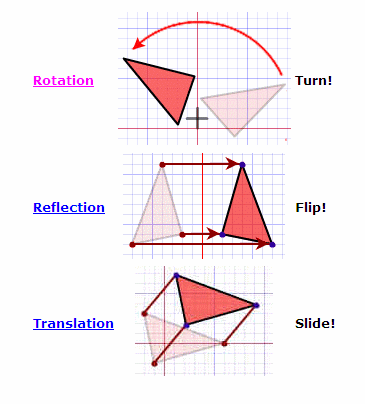
The main transformations that preserve size and shape are:
- Translation
- Rotation
- Reflection
These are called rigid transformations because they do not stretch, shrink or distort a figure.
Rigid Transformations
Translation, rotation and reflection preserve:
• side lengths
• angle measures
• shape
• perimeter
Therefore, a figure and its image after a rigid transformation are congruent.
For example, if triangle \(ABC\) is translated to triangle \(A’B’C’\), every side length and angle remains unchanged.
\(AB=A’B’\)
\(BC=B’C’\)
\(AC=A’C’\)
Therefore, the two triangles are congruent.
Congruence on the Cartesian Plane
On a coordinate plane, two figures are congruent if one can be mapped onto the other using only translations, rotations and/or reflections.
The coordinates may change, but the distances between corresponding points remain the same.
| Transformation | Changes Size? | Preserves Shape? | Can Produce a Congruent Figure? |
|---|---|---|---|
| Translation | No | Yes | Yes |
| Rotation | No | Yes | Yes |
| Reflection | No | Yes | Yes |
| Dilation | Usually | Yes | Only when \(k=1\) |
How to Show Two Figures Are Congruent
To show that two figures are congruent using transformations:
Step 1: Identify the corresponding vertices.
Step 2: Compare the coordinates or side lengths.
Step 3: Look for a translation, rotation or reflection that maps one figure exactly onto the other.
Step 4: Check that corresponding side lengths and angles remain equal.
Step 5: Conclude that the figures are congruent.
What Does Similar Mean?
Two figures are similar if they have the same shape but not necessarily the same size.
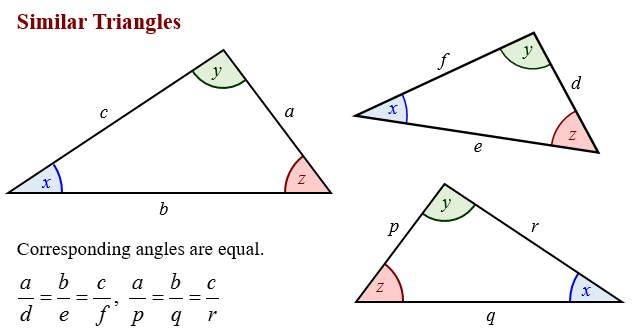
Similar figures have:
- equal corresponding angles;
- corresponding sides in the same ratio;
- the same overall shape.
A dilation changes the size of a figure while preserving its shape. Therefore, dilations are central to understanding similarity.
Similarity Using Transformations
Two figures are similar if one can be transformed into the other using a dilation together with rigid transformations such as translations, rotations and reflections.
The dilation changes the size, while the rigid transformations change the position or orientation.
For example, a triangle can first be enlarged by a scale factor of \(2\), then rotated and finally translated. The final triangle will have the same shape as the original but will be twice as large.
Scale Factor
The scale factor tells us how much the lengths of a figure have been multiplied or divided.
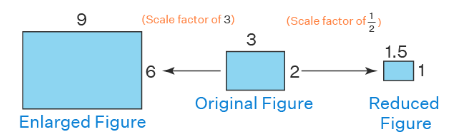
\(\text{Scale factor}=\frac{\text{corresponding length in image}}{\text{corresponding length in original}}\)
| Scale Factor | Result |
|---|---|
| \(k>1\) | Enlargement |
| \(0<k<1\) | Reduction |
| \(k=1\) | Same size |
Example: A side of a triangle is \(5\) cm long. Its corresponding side in a similar triangle is \(15\) cm long.
\(\text{Scale factor}=\frac{15}{5}=3\)
Therefore, the second triangle is an enlargement by scale factor \(3\).
Corresponding Sides and Angles
When comparing two similar figures, it is important to match corresponding parts correctly.
If triangle \(ABC\) is similar to triangle \(DEF\), the corresponding vertices are:
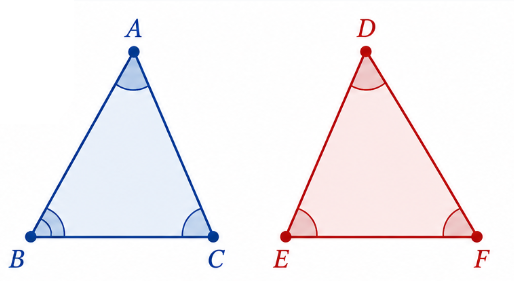
\(A\leftrightarrow D,\quad B\leftrightarrow E,\quad C\leftrightarrow F\)
Therefore:
\(AB\leftrightarrow DE\)
\(BC\leftrightarrow EF\)
\(AC\leftrightarrow DF\)
The corresponding angles are equal:
\(\angle A=\angle D,\quad \angle B=\angle E,\quad \angle C=\angle F\)
The corresponding side lengths have the same ratio:
\(\frac{DE}{AB}=\frac{EF}{BC}=\frac{DF}{AC}\)
This common ratio is the scale factor.
Congruence vs Similarity
| Feature | Congruent | Similar |
|---|---|---|
| Same shape | Yes | Yes |
| Same size | Yes | Not necessarily |
| Corresponding angles | Equal | Equal |
| Corresponding sides | Equal | Proportional |
| Dilation required? | No | Usually |
🧠 Easy Way to Remember
Congruent = identical size and shape.
Think: “exactly the same.”
Similar = same shape, possibly different size.
Think: “same shape, scaled.”
Transformation Path
A transformation path shows how one figure can be changed into another.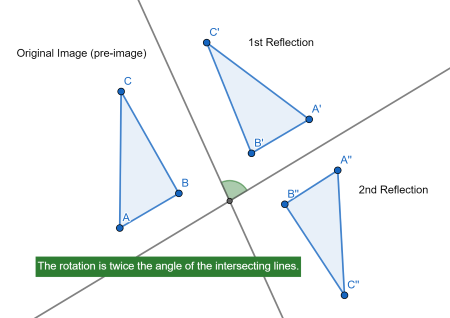
For congruent figures, the transformation path can contain only rigid transformations:
\(\text{Translation}\rightarrow\text{Rotation}\rightarrow\text{Reflection}\)
The exact order may vary.
For similar figures, a dilation can also be included:
\(\text{Dilation}\rightarrow\text{Rotation}\rightarrow\text{Translation}\)
The dilation changes the size, while the other transformations change position or orientation without changing the size.
Congruence on Coordinates
Consider two triangles:
\(A(1,1),\quad B(4,1),\quad C(1,3)\)
and
\(A'(5,2),\quad B'(8,2),\quad C'(5,4)\)
Each corresponding point has been translated by the same vector:
\(\begin{pmatrix}4\\1\end{pmatrix}\)
Since the transformation is a translation, the triangles are congruent.
Similarity on Coordinates
Suppose a triangle has vertices:
\(A(1,1),\quad B(3,1),\quad C(1,2)\)
Dilating about the origin by scale factor \(2\) gives:
\(A'(2,2),\quad B'(6,2),\quad C'(2,4)\)
The new triangle has exactly the same shape but is twice as large. Therefore, the two triangles are similar.
🔑 Important Connection
Rigid transformations → Congruence
Translation, rotation and reflection preserve lengths.
Dilation + rigid transformations → Similarity
Dilation changes lengths by a common scale factor but preserves the shape.
Example 1:
Triangle \(ABC\) has coordinates
\(A(1,2),\quad B(4,2),\quad C(1,5)\)
Triangle \(A’B’C’\) has coordinates
\(A'(-2,1),\quad B'(-2,4),\quad C'(-5,1)\)
a) Describe a transformation that maps triangle \(ABC\) onto triangle \(A’B’C’\).
b) State whether the two triangles are congruent or similar.
c) Explain why your answer is correct.
▶️ Answer/Explanation
a) Identify the transformation
A \(90^\circ\) anticlockwise rotation about the origin follows:
\((x,y)\rightarrow(-y,x)\)
\(A(1,2)\rightarrow(-2,1)=A’\)
\(B(4,2)\rightarrow(-2,4)=B’\)
\(C(1,5)\rightarrow(-5,1)=C’\)
Therefore, triangle \(ABC\) is mapped onto triangle \(A’B’C’\) by a \(90^\circ\) anticlockwise rotation about the origin.
b) Classification
The triangles are congruent.
c) Explanation
A rotation is a rigid transformation. It does not change the lengths of sides or the sizes of angles.
Therefore, the two triangles have exactly the same size and shape.
Final Answer: The triangles are congruent because one is the image of the other under a rigid transformation.
Example 2:
Triangle \(ABC\) has coordinates
\(A(1,1),\quad B(4,1),\quad C(1,3)\)
First, the triangle is dilated about the origin by scale factor \(2\). It is then translated by
\(\begin{pmatrix}3\\-2\end{pmatrix}\)
a) Find the coordinates after the dilation.
b) Find the final coordinates after the translation.
c) Determine whether the original and final triangles are congruent or similar.
d) State the scale factor relating the two triangles.
▶️ Answer/Explanation
a) Apply the dilation
A dilation about the origin by scale factor \(2\) uses:
\((x,y)\rightarrow(2x,2y)\)
\(A(1,1)\rightarrow A'(2,2)\)
\(B(4,1)\rightarrow B'(8,2)\)
\(C(1,3)\rightarrow C'(2,6)\)
Therefore, after the dilation:
\(A'(2,2),\quad B'(8,2),\quad C'(2,6)\)
b) Apply the translation
\((x,y)\rightarrow(x+3,y-2)\)
\(A'(2,2)\rightarrow A”(5,0)\)
\(B'(8,2)\rightarrow B”(11,0)\)
\(C'(2,6)\rightarrow C”(5,4)\)
Therefore, the final triangle has coordinates:
\(A”(5,0),\quad B”(11,0),\quad C”(5,4)\)
c) Classification
The triangles are similar, not congruent.
The dilation changes the size of the triangle but preserves its shape. The translation then changes only its position.
d) Scale factor
\(k=2\)
Every corresponding side in the final triangle is twice the length of the corresponding side in the original triangle.
Final Answer: The triangles are similar with scale factor \(2\).