
9.5 – Probability, Outcomes and Sample Spaces
Probability is used to describe how likely an event is to happen. Before finding a probability, we need to understand all the possible results of an experiment.
The complete collection of possible results is called the sample space.
Experiments and Outcomes
A probability experiment is an activity or process that produces one result from a set of possible results.
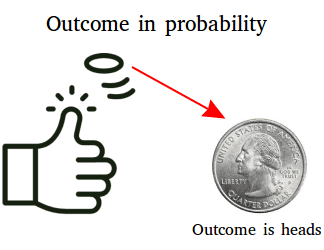
An outcome is one possible result of an experiment.
| Experiment | Possible Outcomes |
|---|---|
| Tossing a coin | Head, Tail |
| Rolling a six-sided die | \(1,2,3,4,5,6\) |
| Spinning a spinner labelled \(A,B,C\) | \(A,B,C\) |
| Choosing a season | Spring, Summer, Autumn, Winter |
Sample Space
The sample space is the set of all possible outcomes of an experiment.
We usually represent a sample space using set notation with curly brackets \(\{\ \}\).
For example, when a fair six-sided die is rolled:
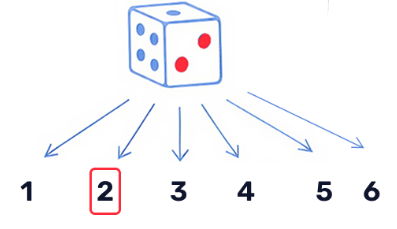
Therefore, there are 6 possible outcomes.
The sample space must include every possible outcome of the experiment, without leaving any possible result out.
Equally Likely Outcomes
Outcomes are equally likely when each outcome has the same chance of occurring.
For example, when a fair six-sided die is rolled, each number from \(1\) to \(6\) has the same probability:
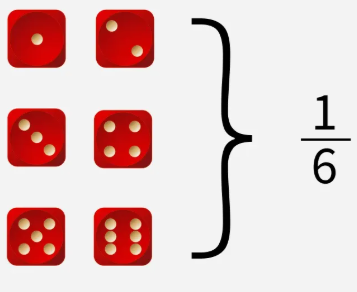
However, outcomes are not always equally likely. For example, a spinner with unequal-sized sectors may give some outcomes a greater chance than others.
Theoretical Probability
When all possible outcomes are equally likely, the probability of an event can be calculated using:
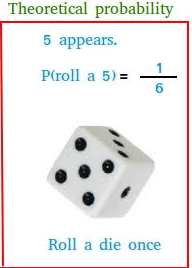
📌 Formula: Theoretical Probability
where \(E\) represents the event being considered.
For example, when a fair die is rolled, the probability of obtaining an even number is found from the favourable outcomes \(2,4,6\):
Events
An event is a collection of one or more outcomes from the sample space.
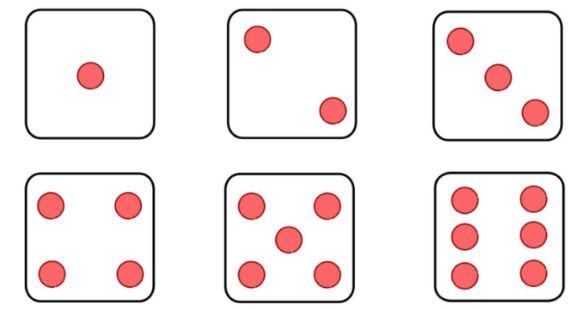
For a six-sided die:
- Event \(A\): rolling an even number
\(A=\{2,4,6\}\) - Event \(B\): rolling a number greater than \(4\)
\(B=\{5,6\}\) - Event \(C\): rolling a prime number
\(C=\{2,3,5\}\)
Notice that an event can contain several outcomes.
Certain, Impossible and Possible Events
| Type | Meaning | Probability | Example |
|---|---|---|---|
| Impossible | Cannot happen | \(0\) | Rolling a \(7\) on a standard die |
| Possible | May happen | Between \(0\) and \(1\) | Rolling a \(4\) |
| Certain | Must happen | \(1\) | Rolling a number from \(1\) to \(6\) |
Probability Scale
Probability always lies between \(0\) and \(1\):
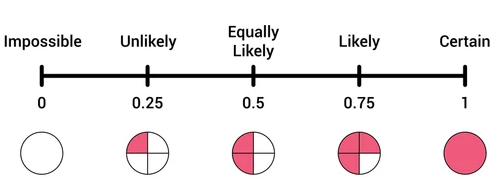
Probability can also be expressed as a fraction, decimal, or percentage.
| Probability | Meaning |
|---|---|
| \(0\) | Impossible |
| \(0.25=25\%\) | Unlikely |
| \(0.5=50\%\) | Equally likely to happen or not happen |
| \(0.75=75\%\) | Likely |
| \(1\) | Certain |
Complementary Events
The complement of an event consists of all outcomes in the sample space that are not in the event.
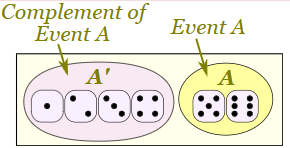
If \(A\) is the event “rolling an even number” on a standard die:
Its complement \(A’\) is:
The probabilities of an event and its complement add to \(1\):
📌 Complement Rule
Sample Spaces for Two-Operation Experiments
When an experiment involves two operations, such as tossing a coin and rolling a die, listing the outcomes in a two-dimensional grid can make the sample space easier to see.
Suppose a coin is tossed and a six-sided die is rolled.
The possible outcomes are:
There are:
possible outcomes.
| Coin \ Die | 1 | 2 | 3 | 4 | 5 | 6 |
|---|---|---|---|---|---|---|
| H | (H,1) | (H,2) | (H,3) | (H,4) | (H,5) | (H,6) |
| T | (T,1) | (T,2) | (T,3) | (T,4) | (T,5) | (T,6) |
Each cell represents one possible outcome.
Counting Outcomes
If one operation has \(m\) possible outcomes and a second operation has \(n\) possible outcomes, the total number of combinations is:
For example, a coin has \(2\) outcomes and a die has \(6\) outcomes:
So there are \(12\) possible combined outcomes.
Understanding “And” and “Or”
Probability questions often use words such as and, or, and not. Read these words carefully because they describe different events.
| Word | Meaning | Example |
|---|---|---|
| and | Both conditions happen | Head and an even number |
| or | At least one of the conditions happens | Head or a \(6\) |
| not | The event does not happen | Not rolling a \(6\) |
🔍 Sample Space Checklist
- Identify the experiment.
- List every possible outcome.
- Check that no outcome has been missed.
- Check that no outcome has been repeated.
- Count the total number of possible outcomes.
- Identify the favourable outcomes for the event.
- Calculate the probability if the outcomes are equally likely.
Common Mistakes
| Mistake | Correct Approach |
|---|---|
| Forgetting an outcome | List the complete sample space before calculating probability. |
| Counting the same outcome twice | Use a systematic list or grid. |
| Using the wrong denominator | The denominator is the total number of possible outcomes when outcomes are equally likely. |
| Confusing “and” with “or” | And requires both conditions; or includes outcomes satisfying at least one condition. |
| Assuming every outcome is equally likely | Check whether the experiment is fair or whether outcomes have equal chances. |
Example 1:
A fair six-sided die is rolled once.
a) Write the sample space.
b) State the number of possible outcomes.
c) Find the probability of rolling:
i) an even number
ii) a prime number
iii) a number greater than \(4\)
d) Find the probability of not rolling a \(6\).
▶️ Answer/Explanation
Answer
a) Sample space
b) Number of possible outcomes
There are 6 possible outcomes.
c) Probabilities
i) Even number
The favourable outcomes are \(2,4,6\).
Answer: \(\frac{1}{2}\)
ii) Prime number
The prime outcomes are \(2,3,5\).
Answer: \(\frac{1}{2}\)
iii) Number greater than \(4\)
The favourable outcomes are \(5,6\).
Answer: \(\frac{1}{3}\)
d) Not rolling a \(6\)
First find the probability of rolling a \(6\):
Therefore:
Answer: \(\frac{5}{6}\)
Example 2:
A fair coin is tossed and a fair six-sided die is rolled.
a) Use a two-dimensional grid or systematic listing to show the sample space.
b) How many possible outcomes are there?
c) Find the probability of getting:
i) a head and an even number
ii) a tail and a prime number
iii) a head or a \(5\)
▶️ Answer/Explanation
Answer
a) Sample space
The outcomes can be represented as ordered pairs:
b) Number of possible outcomes
Answer: \(12\) outcomes
c) Probabilities
i) Head and an even number
The favourable outcomes are:
There are \(3\) favourable outcomes out of \(12\).
Answer: \(\frac{1}{4}\)
ii) Tail and a prime number
The prime numbers are \(2,3,5\).
Answer: \(\frac{1}{4}\)
iii) Head or a \(5\)
The outcomes with a head are:
The additional outcome with a \(5\) is \((T,5)\). Therefore, there are \(7\) favourable outcomes.
Answer: \(\frac{7}{12}\)