
9.6 – Theoretical and Experimental Probability
Probability can be found in two main ways. When the possible outcomes and their probabilities can be determined mathematically, we use theoretical probability. When we estimate probability by carrying out an experiment and collecting data, we use experimental probability.
Theoretical Probability
Theoretical probability is the probability calculated from the possible outcomes of an experiment, without actually performing the experiment.
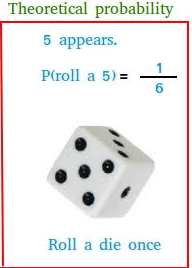
When all possible outcomes are equally likely, the theoretical probability of an event can be calculated by comparing the number of favourable outcomes with the total number of possible outcomes.
Formula: Theoretical Probability
where \(E\) is the event being considered.
A favourable outcome is an outcome that satisfies the condition of the event.
For example, when a fair six-sided die is rolled, there are six equally likely outcomes:
If the event is rolling an even number, the favourable outcomes are \(2,4,6\). Therefore:
The theoretical probability assumes that the possible outcomes are equally likely. A fair die, a fair coin, and a spinner divided into equal sections are common examples.
Equally Likely Outcomes
Outcomes are equally likely when each outcome has the same chance of occurring.

| Experiment | Equally Likely? | Reason |
|---|---|---|
| Fair coin | Yes | Head and tail have equal chances. |
| Fair six-sided die | Yes | Each number has the same chance. |
| Spinner with 4 equal sections | Yes | Each section has the same size. |
| Unequal spinner sections | No | Larger sections have a greater chance. |
Using a Sample Space to Find Theoretical Probability
A sample space lists all possible outcomes. Once the sample space is known, we can count the favourable outcomes and use the theoretical probability formula.
For example, consider the sample space for rolling a die:
Suppose the event is rolling a number greater than 4. The favourable outcomes are \(5\) and \(6\).
Therefore, the theoretical probability is approximately \(0.333\), or \(33.3\%\).
Experimental Probability
Sometimes it is difficult or impossible to calculate a theoretical probability. In such situations, we can perform the experiment several times and use the results to estimate the probability.
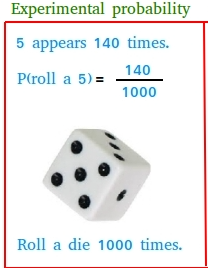
This estimated probability is called experimental probability.
Experimental probability is based on what actually happens when an experiment is performed.
Frequency and Relative Frequency
The frequency of an event is the number of times that event occurs.
The relative frequency compares the frequency of an event with the total number of trials.
📌 Formula: Experimental Probability
The symbol \(\approx\) is used because experimental probability is an estimate.
Experimental probability is often written as a decimal, although it can also be expressed as a fraction or percentage.
Worked Example: Experimental Probability
A student tosses a small object \(200\) times. It lands on its side \(132\) times and on its base \(68\) times.
The experimental probability of landing on its side is:
Therefore, the experimental probability of landing on its side is \(0.66\), or \(66\%\).
Similarly:
Notice that:
Number of Trials and Accuracy
An experimental probability is an estimate, so it may not be exactly equal to the theoretical probability.
Generally, increasing the number of trials makes the experimental probability more reliable and often causes it to move closer to the theoretical probability.
| Number of Trials | Typical Reliability |
|---|---|
| Small number of trials | Results can vary considerably. |
| Moderate number of trials | Results are usually more stable. |
| Large number of trials | The estimate is generally more reliable. |
More trials do not guarantee that the experimental probability will be exactly equal to the theoretical probability. They simply make the estimate generally more reliable.
Theoretical vs Experimental Probability
| Feature | Theoretical Probability | Experimental Probability |
|---|---|---|
| Based on | Mathematical reasoning | Observed results |
| Requires trials? | No | Yes |
| Uses | Possible and favourable outcomes | Frequency and total trials |
| Nature of result | Calculated probability | Estimated probability |
Comparing Experimental and Theoretical Results
Suppose a fair coin has a theoretical probability of getting a head of:
If the coin is tossed \(20\) times, we might obtain \(13\) heads. The experimental probability would then be:
The result \(0.65\) is different from \(0.5\), but this does not mean the coin must be unfair. Random variation can cause experimental results to differ from theoretical probability.
If the coin is tossed many more times, the experimental probability will generally become more stable and tend towards the theoretical probability of \(0.5\).
When Experimental Probability is Useful
Some real-world events do not have a simple mathematical model. For example, we may want to estimate the probability that:
- a particular type of product is purchased;
- a machine produces a faulty item;
- a certain type of weather occurs;
- a randomly tossed object lands in a particular position;
- a customer chooses a particular option.
In these situations, collecting data from many trials can provide a useful estimate of the probability.
Common Mistakes
| Mistake | Correct Approach |
|---|---|
| Using frequency as the probability. | Divide the frequency by the total number of trials. |
| Using theoretical probability when the outcomes are not equally likely. | Check whether the outcomes are equally likely before using the simple formula. |
| Assuming experimental probability must equal theoretical probability. | Experimental results can differ because of random variation. |
| Thinking a small number of trials gives a highly reliable estimate. | More trials generally produce a more reliable estimate. |
| Forgetting that experimental probability is an estimate. | Use \(\approx\) when presenting an experimental probability as an estimate. |
Example 1:
A fair six-sided die is rolled once.
a) Find the theoretical probability of rolling a prime number.
b) Find the theoretical probability of rolling a number less than \(5\).
c) Find the theoretical probability of rolling a number that is not a multiple of \(3\).
▶️ Answer/Explanation
Answer
The sample space is:
a) Prime number
The prime numbers are \(2,3,5\). There are \(3\) favourable outcomes out of \(6\).
Therefore, the probability is \(0.5\) or \(50\%\).
b) Number less than \(5\)
The favourable outcomes are \(1,2,3,4\).
Therefore, the probability is approximately \(66.7\%\).
c) Not a multiple of \(3\)
The multiples of \(3\) are \(3\) and \(6\). Therefore, the numbers that are not multiples of \(3\) are \(1,2,4,5\).
Therefore, the probability is \(\frac{2}{3}\), or approximately \(66.7\%\).
Example 2:
A fair six-sided die is rolled \(120\) times. The results are recorded below.
| Number | Frequency |
|---|---|
| 1 | 18 |
| 2 | 21 |
| 3 | 17 |
| 4 | 22 |
| 5 | 19 |
| 6 | 23 |
a) Find the experimental probability of rolling a \(6\).
b) Find the theoretical probability of rolling a \(6\).
c) Compare the two probabilities.
▶️ Answer/Explanation
Answer
a) Experimental probability
The number \(6\) occurred \(23\) times in \(120\) trials.
Therefore, the experimental probability is approximately \(0.192\), or \(19.2\%\).
b) Theoretical probability
A fair die has \(6\) equally likely outcomes, and only one outcome is a \(6\).
Therefore, the theoretical probability is approximately \(0.167\), or \(16.7\%\).
c) Comparison
The experimental probability, approximately \(0.192\), is slightly greater than the theoretical probability, approximately \(0.167\).
This difference is due to random variation in the \(120\) rolls. With a much larger number of trials, the experimental probability would generally be expected to become closer to the theoretical probability.