
9.7 – Independent Events and Combined Probability
Some probability experiments involve more than one event. For example, a coin may be tossed while a die is rolled, or two players may each take a shot at a target. In these situations, we may need to find the probability that both events occur.
To solve these problems, it is important to understand the difference between independent and dependent events.
Independent Events
Two events are independent if the occurrence of one event does not affect the probability of the other event.
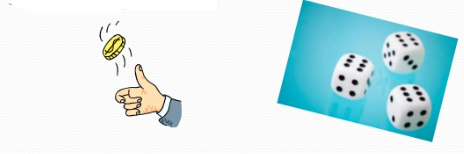
If one event happening does not change the probability of another event, the events are independent.
Common examples of independent events include:
- Tossing a coin and rolling a die.
- Spinning one spinner and then spinning a different spinner.
- Two people independently taking shots at a target.
- Rolling a die twice, provided the first roll does not affect the second roll.
Multiplication Rule for Independent Events
When two events \(A\) and \(B\) are independent, the probability that both events occur is found by multiplying their probabilities.
📌 Formula: Independent Events
The word “and” is an important clue that multiplication may be required.
Suppose a fair coin is tossed and a fair six-sided die is rolled.
Find the probability of getting a head and a 6.
The two events are independent because the result of the coin toss does not affect the result of the die roll.
Therefore:
So the probability is \(\frac{1}{12}\).
Recognising “And” Probability Questions
In probability questions, the word “and” often means that both conditions must happen together.
| Question | Meaning |
|---|---|
| A head and a 4 | Both events must occur. |
| Both players score | Player A scores and Player B scores. |
| A red and a green | Both outcomes occur. |
Finding the Probability of Both Events Not Happening
Sometimes a question asks for the probability that both events fail. First find the probability of each event not occurring.
📌 Complement Rule:
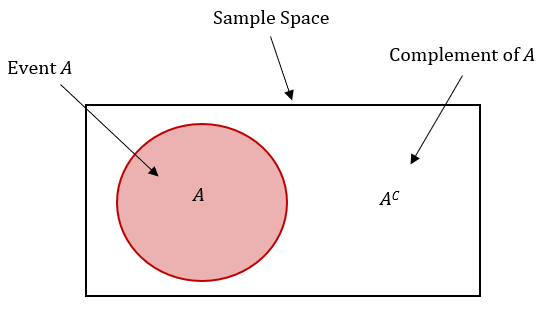
This second formula applies when the events are independent.
Independent Events in Real-Life Situations
Independent events do not have to involve coins or dice. They can also describe separate people or real-world events.
Suppose Maya has a probability of \(\frac{2}{3}\) of scoring a goal, while Noah has a probability of \(\frac{3}{5}\) of scoring a goal. If their attempts are independent, then:
Therefore, the probability that both score is \(\frac{2}{5}\).
To find the probability that both players miss, use the complementary probabilities.
Therefore:
Dependent Events
Two events are dependent if the occurrence of one event changes the probability of the other event.
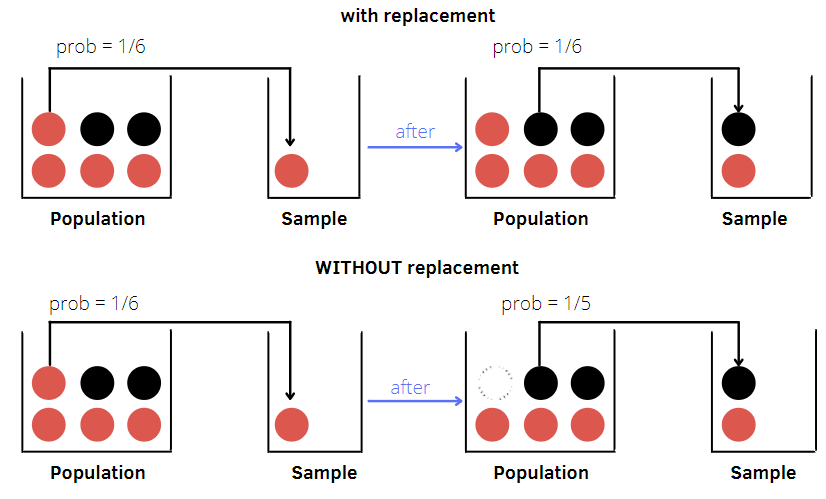
A common example is selecting objects without replacement. After the first object is removed, the number of objects remaining changes, so the probability for the second selection may change.
Do not automatically multiply the original probability twice. First decide whether the first event changes the probability of the second event.
With Replacement vs Without Replacement
| Situation | Effect | Usually |
|---|---|---|
| Replace the object after selecting it | The contents return to the original state. | Events are independent. |
| Do not replace the object | The contents change after the first selection. | Events are dependent. |
For example, a bag contains \(5\) red counters and \(3\) blue counters. One counter is selected and not replaced.
The probability of selecting a red counter first is:
If the first counter is red, only \(4\) red counters remain out of \(7\) counters. Therefore:
The second probability changed from \(\frac{5}{8}\) to \(\frac{4}{7}\). Therefore, the events are dependent.
For MYP 3 problems, the key skill is to recognise that the first selection changes the situation for the second selection.
More Than Two Independent Events
The multiplication idea can be extended when several events are independent. Multiply the probability of each event.
For example, if three independent events have probabilities \(\frac{1}{2}\), \(\frac{1}{3}\), and \(\frac{1}{4}\), then:
How to Decide Which Method to Use
| Step | Question to Ask |
|---|---|
| 1 | What are the events? |
| 2 | Does one event affect the probability of the other? |
| 3 | If not, the events are independent. |
| 4 | If independent and both events must occur, multiply the probabilities. |
| 5 | If the first event changes the second probability, recognise that the events are dependent. |
Common Mistakes
| Mistake | Correct Approach |
|---|---|
| Adding probabilities when the question asks for both events. | For independent “and” events, multiply the probabilities. |
| Assuming all events are independent. | Check whether the first event changes the probability of the second. |
| Ignoring “without replacement”. | Recalculate the probability after the first object is removed. |
| Using the original probability for the second selection without checking. | Check how many favourable outcomes and total outcomes remain. |
MYP 3 Exam Tips
- “And” usually means both events must occur.
- For independent events: \(P(A\text{ and }B)=P(A)\times P(B)\).
- Ask whether the first event changes the probability of the second event.
- With replacement usually keeps the probabilities unchanged.
- Without replacement usually changes the probabilities.
- For “both miss”, first find the probability of each event not occurring, then multiply if the events are independent.
- Always show the probability of each individual event before multiplying. This makes your method clear and reduces calculation errors.
Example 1:
A fair coin is tossed and a fair six-sided die is rolled.
Find the probability of:
a) getting a head and an even number
b) getting a tail and a number greater than \(4\)
c) getting a tail and an odd number
▶️ Answer/Explanation
Answer
The coin toss and die roll are independent because the result of one does not affect the result of the other.
a) Head and even number
The probability of a head is:
The even numbers on a die are \(2,4,6\), so:
Therefore:
Answer: \(\frac{1}{4}\)
b) Tail and number greater than \(4\)
The numbers greater than \(4\) are \(5\) and \(6\).
Answer: \(\frac{1}{6}\)
c) Tail and odd number
The odd numbers are \(1,3,5\).
Answer: \(\frac{1}{4}\)
Example 2:
A box contains \(4\) red balls and \(6\) blue balls. Two balls are selected one after another.
Case A: The first ball is replaced before the second ball is selected.
Find the probability that both balls are red.
Case B: The first ball is not replaced.
Find the probability that both balls are red.
▶️ Answer/Explanation
Answer
Case A: With replacement
There are \(4\) red balls out of \(10\) balls.
Because the first ball is replaced, there are still \(4\) red balls out of \(10\) balls.
The events are independent.
Case A answer: \(\frac{4}{25}\)
Case B: Without replacement
The probability of selecting red first is still:
If the first ball is red, there are now \(3\) red balls and \(9\) balls in total.
The probability changed, so the events are dependent.
Case B answer: \(\frac{2}{15}\)
Therefore, replacing the first ball changes the probability of the second selection and changes the final answer.