
9.9 – Expected Outcomes and Probability Problem Solving
Probability can be used not only to find the chance of a single event, but also to predict how many times an event is likely to occur when an experiment is repeated many times.
This predicted number is called the expected number of occurrences.
Expected Outcomes
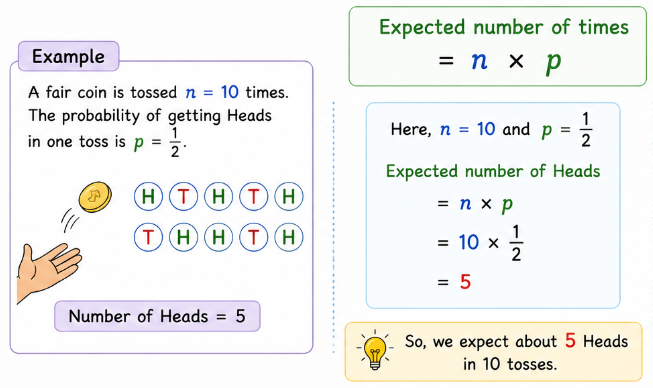
Suppose an event has probability \(p\) of occurring in one trial, and the experiment is repeated \(n\) times.
The expected number of times the event will occur is found by multiplying the number of trials by the probability of the event.
📌 Formula: Expected Number
where:
- \(E\) = expected number of occurrences
- \(n\) = number of trials
- \(p\) = probability of the event occurring in one trial
Expected Does Not Mean Guaranteed
An expected number is a prediction, not a guaranteed result.
For example, if a fair coin is tossed \(10\) times:
We expect \(5\) heads, but the actual result could be \(3\), \(6\), \(8\), or even \(10\) heads.
Expected number = what we predict on average over many repetitions. It does not tell us exactly what will happen in one experiment.
Expected Outcomes from Different Probabilities
The probability does not have to be \(\frac{1}{2}\) or an equally likely fraction. We can use any probability between \(0\) and \(1\).
| Probability | Number of Trials | Expected Number |
|---|---|---|
| \(\frac{1}{2}\) | 100 | \(100\times\frac{1}{2}=50\) |
| \(\frac{1}{4}\) | 80 | \(80\times\frac{1}{4}=20\) |
| \(0.2\) | 150 | \(150\times0.2=30\) |
| \(0.08\) | 500 | \(500\times0.08=40\) |
What If the Expected Number Is a Decimal?
An expected number does not always have to be a whole number.
For example, suppose the probability of an event is \(0.17\) and there are \(50\) trials.
The expected number is \(8.5\).
This does not mean that exactly \(8.5\) events will occur. It means that over many repetitions, the average number of occurrences would be around \(8.5\) per \(50\) trials.
Expected Outcomes from a Sample Space
Sometimes we first need to find the probability of an event from a sample space and then use the expected number formula.
For example, when a fair six-sided die is rolled, the probability of obtaining a prime number is:
The prime numbers are \(2,3,5\), so there are \(3\) favourable outcomes out of \(6\).
If the die is rolled \(600\) times:
Therefore, we would expect approximately 300 prime-number results.
Probability Problem-Solving Strategy
Probability problems can involve several steps. A useful strategy is to identify what information is given before choosing a formula.
📋 Step-by-Step Method
- Identify the experiment. Determine what is being selected, rolled, spun, or repeated.
- Identify the event. Determine exactly what outcome the question is asking about.
- Find the probability. Use the sample space, table, Venn diagram, or another appropriate method.
- Check whether the question asks for an expected number. If the experiment is repeated \(n\) times, use \(E=np\).
- Interpret the answer. State what the probability or expected number means in the context.
Expected Outcomes from Percentages
A probability may be given as a percentage. Convert the percentage to a decimal before using \(E=np\).
For example, if \(35\%\) of students are expected to choose a particular option and \(200\) students are surveyed:
So we would expect approximately 70 students to choose that option.
Expected Outcomes and Repeated Trials
Expected outcomes become more useful when an experiment is repeated many times. The actual number of occurrences can vary from the expected number in a particular set of trials.
For example, a fair die has:
If the die is rolled \(60\) times:
We expect about \(10\) sixes, but the actual number might be \(7\), \(11\), \(14\), or another value.
Working Backwards with Expected Outcomes
Sometimes the expected number and the number of trials are given, and the probability must be found.
Since:
divide both sides by \(n\):
For example, if \(24\) occurrences are expected in \(120\) trials:
Therefore, the probability is \(0.2\), or \(20\%\).
Common Probability Problem Types
| Question Type | Useful Method |
|---|---|
| Find probability from equally likely outcomes | \(\frac{\text{favourable outcomes}}{\text{total outcomes}}\) |
| Find probability from experimental data | Relative frequency |
| Find probability from a table | Identify the correct frequency and total |
| Find probability from a Venn diagram | Identify the required region(s) |
| Find probability of independent “and” events | Multiply the probabilities |
| Find expected number | \(E=np\) |
Expected Number vs Actual Number
| Expected Number | Actual Number |
|---|---|
| Calculated using probability. | Obtained from the actual experiment. |
| A prediction. | An observed result. |
| May be a decimal. | Must be a whole number of occurrences. |
Common Mistakes
| Mistake | Correct Approach |
|---|---|
| Adding \(n\) and \(p\). | Multiply them: \(E=np\). |
| Treating the expected number as an exact result. | Remember that expectation is a prediction. |
| Using a percentage such as \(25\%\) directly as \(25\). | Convert \(25\%\) to \(0.25\). |
| Forgetting to find the probability first. | Identify the event and calculate \(p\) before using \(E=np\). |
| Rounding too early. | Keep exact values until the final answer whenever possible. |
MYP 3 Exam Tips
- Look for phrases such as “how many would you expect” or “expected number”.
- Use \(E=np\) when an event with probability \(p\) is repeated \(n\) times.
- If the probability is given as a percentage, convert it to a decimal first.
- If the probability is not given, find it before calculating the expected number.
- An expected number is not necessarily the exact number that will occur.
- Show the probability calculation and then the expectation calculation.
- Always interpret the final answer in the context of the question.
Example 1:
A fair six-sided die is rolled \(600\) times.
Find the expected number of times the result will be:
a) \(6\)
b) an even number
c) a prime number
d) a composite number
▶️ Answer/Explanation
Answer
a) Rolling a \(6\)
There is one \(6\) out of six possible outcomes.
Answer: \(100\) sixes
b) Rolling an even number
The even numbers are \(2,4,6\).
Answer: \(300\) even numbers
c) Rolling a prime number
The prime numbers are \(2,3,5\).
Answer: \(300\) prime numbers
d) Rolling a composite number
The composite numbers are \(4\) and \(6\).
Answer: \(200\) composite numbers
Example 2:
A school canteen sells \(540\) bottles of a drink during a month. Each bottle has a probability of \(0.08\) of containing a prize.
a) Find the expected number of prize-winning bottles.
b) Explain what your answer means.
c) Would you expect exactly this number of prizes to be won? Explain your answer.
▶️ Answer/Explanation
Answer
a) Expected number of prizes
The number of trials is \(540\), and the probability of winning a prize is \(0.08\).
Therefore, the expected number of prize-winning bottles is approximately \(43\).
Answer: Approximately \(43\) prizes
b) Interpretation
We would expect about \(43\) of the \(540\) bottles to contain a prize.
c) Is exactly \(43\) guaranteed?
No. An expected number is a prediction based on probability. The actual number of prize-winning bottles could be higher or lower than \(43\).
Answer: No. The expected value describes what we would predict over many similar repetitions, not the exact result of one month.