
Question : Genetic Material and Cell Division – Topic: Genetics and Cell Division [12 marks]
This question explores genetic storage and cell division processes (Genetics and Cell Division), building on material exchange (Question 1) and linking to biological reproduction.
Question 2 Introduction
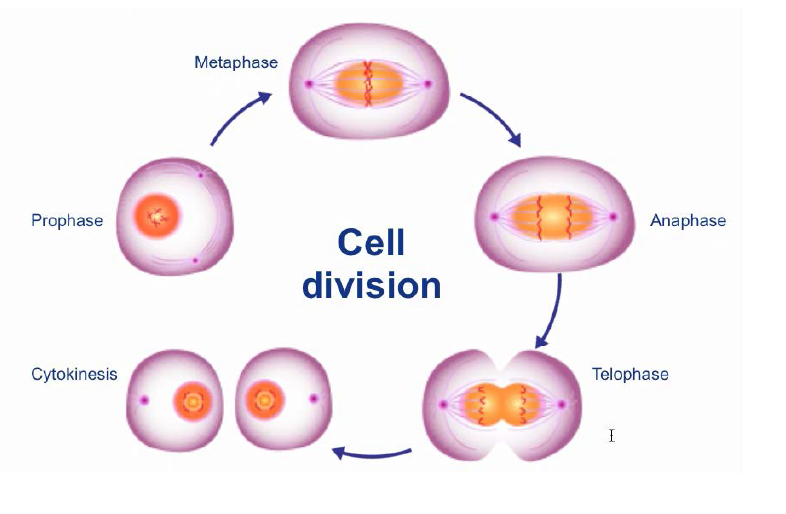
The following diagram shows the phases of mitosis.
Question (a) [1 mark] – Genetic Molecule (Topic: Genetics and Cell Division)
Question a (1 mark)
State the name of the molecule that stores genetic information in living organisms.
▶️ Answer/Explanation
Answer:
DNA (Deoxyribonucleic acid)
Detailed Explanation:
Genetic storage:
- DNA: A double-helix polymer in cell nuclei (e.g., 3 billion base pairs in humans) encodes genetic instructions for protein synthesis and heredity.
- Function: Stores information via nucleotide sequences (A, T, C, G), replicated and passed to daughter cells during division (e.g., mitosis, meiosis).
- Contrast: Distinct from RNA, which translates DNA into proteins but doesn’t store genetic info long-term.
Mark: 1 for “DNA” or “deoxyribonucleic acid.”
Question (b) [3 marks] – Anaphase Role (Topic: Genetics and Cell Division)
Question b (3 marks)
Outline how the events in anaphase are crucial for the formation of two identical cells.
▶️ Answer/Explanation
Answer:
In anaphase, spindle fibers attached to centromeres pull sister chromatids apart to opposite poles of the cell. This ensures each daughter cell receives an identical set of chromosomes, crucial for forming two genetically identical cells.
Detailed Explanation:
Anaphase mechanics:
- Spindle Fibers: Microtubules from centrioles (image: anaphase) shorten (e.g., by 5 μm/s), exerting force on kinetochores at centromeres.
- Chromatid Separation: Sister chromatids (e.g., 46 in humans) are pulled apart (e.g., 23 to each pole), ensuring equal DNA distribution post-cytokinesis.
- Outcome: Without this precise separation, daughter cells could lack genes (e.g., losing chromosome 21) or gain extras, disrupting identicality essential for growth/repair.
Marks: 1 for spindle fibers, 1 for chromatid separation, 1 for identicality link, totaling 3.
Question (c) [3 marks] – Mitosis vs. Meiosis (Topic: Genetics and Cell Division)
Question c (3 marks)
Mitosis is the process that leads to growth and repair whereas meiosis is required for sexual reproduction. Outline three differences between the products of mitosis and meiosis.
▶️ Answer/Explanation
Answer:
1. Mitosis produces two genetically identical daughter cells, while meiosis produces four genetically varied cells.
2. Mitosis results in diploid cells (e.g., 46 chromosomes), whereas meiosis produces haploid cells (e.g., 23 chromosomes).
3. Mitosis occurs in somatic cells for growth, while meiosis occurs in gametes for reproduction.
Detailed Explanation:
Product differences:
- Genetic Variation: Mitosis (image) duplicates DNA exactly (e.g., 100% match to parent cell), while meiosis introduces variation via crossing over (e.g., 50% parental DNA shuffled).
- Chromosome Number: Mitosis maintains diploidy (2n=46) for tissue repair, whereas meiosis halves it to haploid (n=23) for gamete formation, ensuring proper fertilization (2n restored).
- Cell Type: Mitosis affects body cells (e.g., skin, 10 trillion in humans), while meiosis targets reproductive cells (e.g., sperm/eggs, millions produced daily in males).
Marks: 1 for each difference (variation, ploidy, cell type), totaling 3.
Question (d) [2 marks] – Genetic Problem (Topic: Genetics and Cell Division)
Question d (2 marks)
Describe one problem that can occur to the genetic molecule during meiosis.
▶️ Answer/Explanation
Answer:
A mutation, such as a deletion, can occur in DNA during meiosis, removing a gene segment and potentially causing genetic disorders in offspring.
Detailed Explanation:
Genetic issue:
- Mutation: During meiosis (e.g., prophase I), DNA (2a) may undergo deletion (e.g., loss of 1000 base pairs on chromosome 7), due to replication errors or crossing over faults.
- Impact: This alters gene function (e.g., CFTR gene deletion linked to cystic fibrosis), producing a faulty protein or none, expressed in gametes and offspring.
- Examples: Insertion or substitution also possible, but deletion exemplifies a clear structural loss.
Marks: 1 for “mutation” (problem), 1 for description (deletion/effect), totaling 2.
Question (e) [3 marks] – Genetic Variation (Topic: Genetics and Cell Division)
Question e (3 marks)
Explain how one process that occurs in meiosis can lead to genetic differences in children.
▶️ Answer/Explanation
Answer:
Crossing over during meiosis swaps genetic material between homologous chromosomes, creating unique gametes. When these combine in fertilization, children inherit diverse DNA combinations, differing from parents and siblings.
Detailed Explanation:
Variation process:
- Crossing Over: In prophase I of meiosis, homologous chromosomes (e.g., 23 pairs) exchange segments at chiasmata (e.g., 50-100 crossovers/genome), shuffling alleles (e.g., eye color gene swapped).
- Gamete Diversity: This produces 4 haploid cells (n=23) with unique DNA (e.g., 8.4 million combinations from independent assortment plus crossing over), unlike mitosis’s identical output (2c).
- Child Variation: Fertilization (e.g., 1 of 10⁶ sperm × 1 of 10⁶ eggs) yields a diploid zygote (2n=46) with a novel genotype, ensuring siblings differ (e.g., 70 trillion possible combos).
Marks: 1 for process (crossing over), 1 for gamete effect, 1 for child variation, totaling 3.