
Question : Astrophysics and Exoplanets [8 marks]
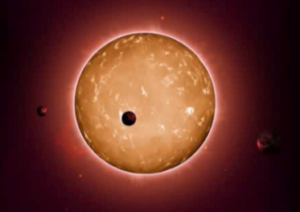
In 2009, NASA launched the Kepler space observatory to discover “Earth-like” planets orbiting other stars. The equipment carried by Kepler was a simple photometer used to measure the brightness of stars. The mission detected planets when they moved between the star and the observatory.
Explanation space:
▶️Answer/Explanation
Mark scheme answers:
- Planets are opaque or would block some of the light
- This means that there would be a reduction in the brightness that was measured
Detailed Explanation:
When an exoplanet transits (passes in front of) its host star from our viewpoint, it blocks a small fraction of the star’s light. The amount of dimming depends on the planet’s size relative to the star (typically 0.01%-1% for Earth-Jupiter sized planets). Kepler detected this periodic dimming, with light curves showing characteristic U-shaped dips. The depth indicates planet size, while duration reveals orbital period. Multiple transits confirm planetary nature versus other dimming causes.
Explanation space:
▶️Answer/Explanation
Mark scheme answers:
- Planets are non-luminous objects so they cannot be seen directly
- They can only be detected if they are illuminated by the light from a star or if they block the light from a star
Detailed Explanation:
Direct imaging is extremely challenging because: (1) Planets don’t emit their own visible light, only reflecting faint starlight (10⁶-10¹⁰ times fainter than their stars). (2) The small angular separation (e.g., Earth at 1AU from a star 10 light-years away appears just 0.1 arcseconds apart). (3) Atmospheric distortion limits ground-based resolution. Even Hubble struggles – only about 20 exoplanets have been directly imaged, all gas giants far from their stars.
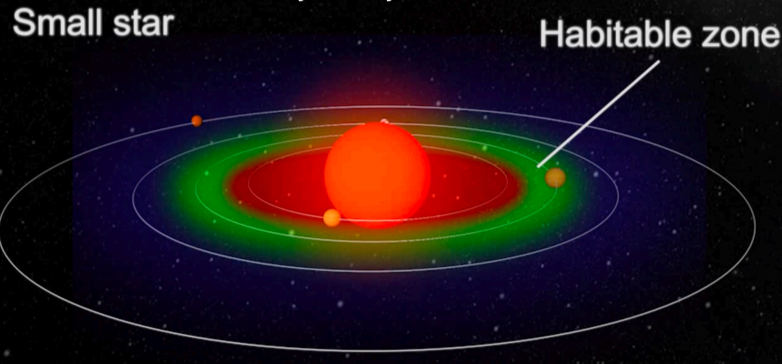
[Diagram showing habitable zones around small, medium, and large stars would appear here]
Red zone = too close to star; Green zone = habitable; Outer zone = too far
Explanation space:
▶️Answer/Explanation
Mark scheme answers:
- It would be too hot
- The water would evaporate or become vapour or boil away
Detailed Explanation:
The red zone represents regions where stellar flux is too intense, causing: (1) Surface temperatures exceeding water’s boiling point (100°C at 1 atm). (2) Photodissociation of water molecules by UV radiation. (3) Possible runaway greenhouse effect like Venus (surface temp ~465°C). Even if water exists initially, thermal escape would cause it to be lost to space over astronomical timescales. The exact inner habitable zone boundary depends on atmospheric composition and pressure.
Explanation space:
▶️Answer/Explanation
Mark scheme answers:
- The hotter the star, the further away the habitable zone
- (Because) the energy received by the planet is related to distance or (because) the surface temperature of the planet is related to distance
Detailed Explanation:
The habitable zone (HZ) position follows the inverse-square law: L ∝ T⁴ (Stefan-Boltzmann law), so hotter stars (O/B/A types) have HZs at 10-100s AU, while cooler stars (K/M types) have HZs at 0.1-0.5AU. For example: Sun’s HZ ≈ 0.95-1.4AU, while an M-dwarf’s HZ might be 0.1-0.2AU. The HZ moves outward because hotter stars emit more total radiation (L = 4πR²σT⁴), requiring planets to be farther to receive Earth-like flux (F = L/4πd²).
Syllabus Reference
Astrophysics
- Exoplanet detection methods
- Habitable zones
Heat
- Thermal equilibrium
- Phase changes of water
Light
- Luminosity and apparent brightness
- Inverse square law
Assessment Criteria: A (Knowledge), B (Investigating), C (Communicating)