
Real Numbers:
The set of real numbers includes all numbers that can be found on the number line. They are divided into two major groups: rational and irrational numbers.
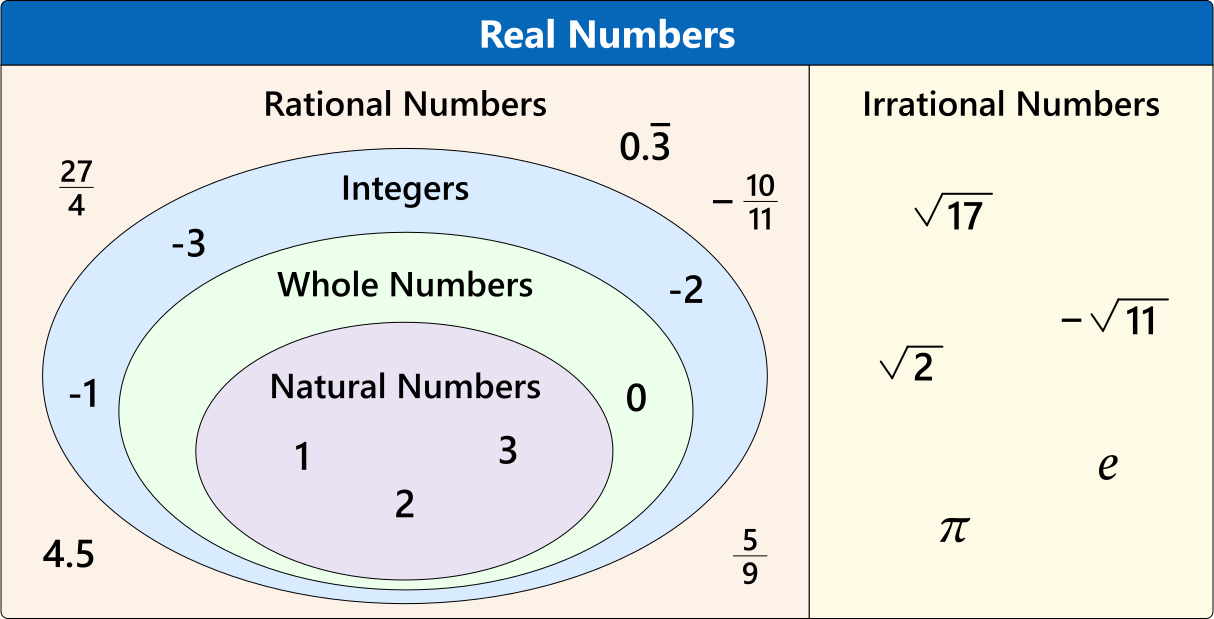
1. Rational Numbers: Numbers that can be written as fractions or ratios of two integers. This includes:
- Terminating decimals: \( 4.5,\ 0.3 \)
- Repeating decimals: \( 0.\overline{3},\ \frac{10}{11} \)
- Integers: \( -3,\ -2,\ 0,\ 1,\ 2 \)
- Fractions: \( \frac{27}{4},\ \frac{5}{9} \)
Subsets within Rational Numbers:
- Integers: Whole numbers and their negatives (e.g. \( -3,\ -1,\ 0,\ 2 \))
- Whole Numbers: Non-negative integers (e.g. \( 0,\ 1,\ 2,\ 3 \))
- Natural Numbers: Counting numbers (e.g. \( 1,\ 2,\ 3 \))
2. Irrational Numbers: Numbers that cannot be written as fractions and have non-terminating, non-repeating decimal expansions:
- Square roots of non-perfect squares: \( \sqrt{2},\ \sqrt{17},\ -\sqrt{11} \)
- Famous constants: \( \pi,\ e \)
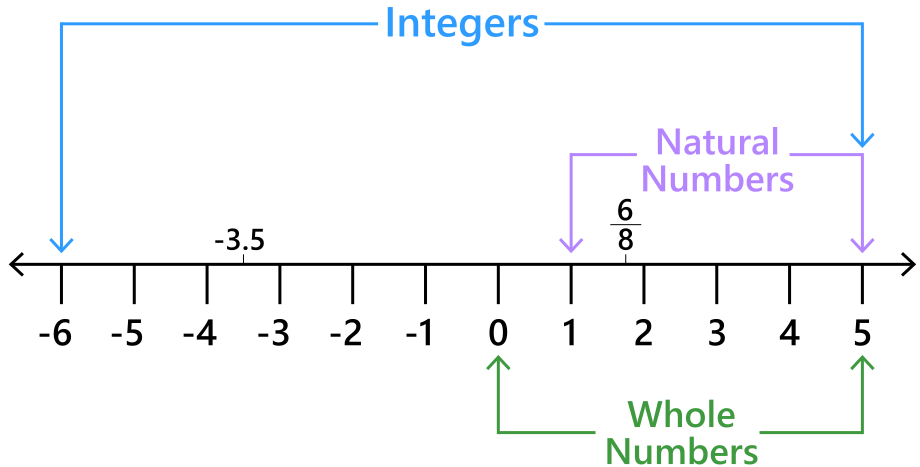
Number Line Representation
Rational Numbers
A rational number is any number that can be expressed as a fraction or ratio of two integers, where the denominator is not zero.
\( \frac{a}{b} \), where \( a, b \in \mathbb{Z} \) and \( b \neq 0 \)
Examples of Rational Numbers:
- \( \frac{1}{2}, -\frac{4}{7}, 3, -10, 0 \)
- \( 0.75 = \frac{3}{4},\quad -2.5 = -\frac{5}{2} \)
- \( 0.333\ldots = \frac{1}{3} \) (recurring decimal)
Important Notes:
- All integers are rational numbers because \( a = \frac{a}{1} \).
- Terminating and recurring decimals are rational.
- Irrational numbers cannot be written as fractions (e.g. \( \pi, \sqrt{2} \)).
Operations on Rational Numbers:
- You can add, subtract, multiply, and divide rational numbers (except divide by zero).
- Always convert mixed numbers to improper fractions before operations.
Example:
Determine whether the following numbers are rational:
- \( \frac{7}{8} \)
- \( 0.121212\ldots \)
- \( \sqrt{9} \)
- \( \pi \)
- \( -4 \)
▶️ Answer/Explanation
Check if each number can be written as a fraction
\( \frac{7}{8} \): already a fraction → Rational
\( 0.121212\ldots = \frac{1212}{9999} \): recurring → Rational
\( \sqrt{9} = 3 \): integer → Rational
\( \pi \): non-repeating, non-terminating decimal → Irrational
\( -4 = \frac{-4}{1} \): integer → Rational
Example:
Write the decimal \( 0.6\overline{3} \) as a fraction.
▶️ Answer/Explanation
Let \( x = 0.6\overline{3} \)
Then \( 10x = 6.3\overline{3} \)
And \( 100x = 63.3\overline{3} \)
Subtract
\( 100x – 10x = 63.3\overline{3} – 6.3\overline{3} = 57 \)
\( 90x = 57 \Rightarrow x = \frac{57}{90} = \frac{19}{30} \)
Final Answer:
\(\boxed{\frac{19}{30}}\)
Irrational Numbers
An irrational number is a number that cannot be written as a fraction \( \frac{a}{b} \), where \( a, b \in \mathbb{Z} \) and \( b \neq 0 \).
Its decimal representation is non-terminating and non-repeating.
Examples of Irrational Numbers:
- \( \pi \approx 3.1415926\ldots \)
- \( \sqrt{2} \approx 1.4142\ldots \)
- \( \sqrt{3},\ \sqrt{5},\ \sqrt{7},\ \sqrt{11}, \ldots \)
- \( \text{e} \approx 2.71828\ldots \) (Euler’s number)
Important Notes:
- If a square root cannot be simplified to a rational number, it is irrational.
- Recurring or terminating decimals are not irrational — they are rational.
- Irrational numbers fill the gaps on the number line between rational numbers.
Visual Understanding:
\( \sqrt{2} \) lies between 1 and 2. On a number line, it is not exactly representable as a fraction.
Example:
Determine whether each of the following is rational or irrational:
- \( \sqrt{16} \)
- \( \pi \)
- \( 0.252525\ldots \)
- \( \sqrt{7} \)
▶️ Answer/Explanation
Evaluate or identify each number
\( \sqrt{16} = 4 \Rightarrow \) Rational
\( \pi \) is non-terminating, non-repeating → Irrational
\( 0.252525\ldots = \frac{25}{99} \Rightarrow \) Rational
\( \sqrt{7} \approx 2.645751\ldots \Rightarrow \) Irrational
Example:
Arrange the following numbers in ascending order:
\( \sqrt{2},\ \frac{7}{5},\ \pi,\ 1.5 \)
▶️ Answer/Explanation
Convert all numbers to decimal approximations
\( \sqrt{2} \approx 1.414 \)
\( \frac{7}{5} = 1.4 \)
\( \pi \approx 3.1416 \)
\( 1.5 = 1.5 \)
Arrange from smallest to largest
\( \frac{7}{5} (= 1.4),\ \sqrt{2} (\approx 1.414),\ 1.5,\ \pi (\approx 3.1416) \)
Example:
Use proof by contradiction to show that \( \sqrt{2} \) is an irrational number.
▶️ Answer/Explanation
Assume the opposite
Assume \( \sqrt{2} \) is rational. Then \( \sqrt{2} = \frac{a}{b} \), where \( a \) and \( b \) are integers with no common factors, and \( b \neq 0 \).
Square both sides
\( 2 = \frac{a^2}{b^2} \Rightarrow a^2 = 2b^2 \)
Analyze parity
So \( a^2 \) is even → \( a \) must be even. Let \( a = 2k \)
Then \( a^2 = 4k^2 \), so:
\( 4k^2 = 2b^2 \Rightarrow 2k^2 = b^2 \)
This means \( b^2 \) is also even → \( b \) is even.
Contradiction
If both \( a \) and \( b \) are even, they share a common factor of 2 – contradicting the assumption that \( \frac{a}{b} \) is in lowest terms.