Representing and Solving Inequalities
An inequality shows that one value is greater than or less than another. It uses symbols instead of an equals sign.
Symbols used in inequalities:
| Property | Description |
|---|---|
| \( a < b \) | \( a \) is less than \( b \) |
| \( a > b \) | \( a \) is greater than \( b \) |
| \( a \leq b \) | \( a \) is less than or equal to \( b \) |
| \( a \geq b \) | \( a \) is greater than or equal to \( b \) |
Representing inequalities on a number line:
- Use a hollow/open circle for \( < \) or \( > \)
- Use a filled/closed circle for \( \leq \) or \( \geq \)
- Draw an arrow in the direction of the solution
| Symbol | Words | Example |
|---|---|---|
| \( > \) | Greater than |  |
| \( < \) | Less than |  |
| \( \geq \) | Greater than or equal to |  |
| \( \leq \) | Less than or equal to |  |
Solving inequalities:
Follow the same steps as solving equations, but remember:
- If you multiply or divide both sides by a negative number, reverse the inequality sign.
Example:
Solve the inequality: \( 2x + 5 < 11 \)
▶️ Answer/Explanation
Subtract 5 from both sides
\( 2x < 6 \)
Divide both sides by 2
\( x < 3 \)
Example:
Solve and graph the inequality: \( x \geq -2 \)
▶️ Answer/Explanation
Solution is already simplified
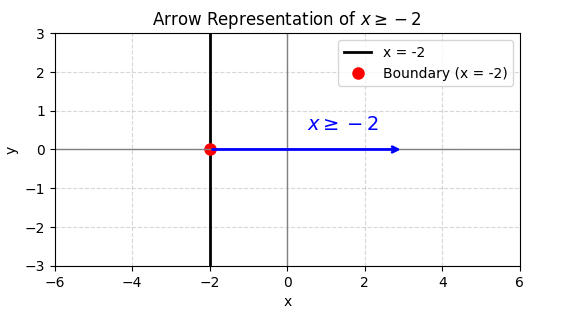
Inequality: \( x \geq -2 \)
Represent on number line (description)
Draw a number line with a closed circle at \( -2 \), and an arrow extending to the right.
Example:
Solve: \( -3x > 9 \)
▶️ Answer/Explanation
Divide both sides by -3 (remember to reverse the sign!)
\( x < -3 \)
Compound Inequalities
A compound inequality has two inequalities joined by “and” or “or”.
- “and”: The solution must satisfy both inequalities (intersection)
- “or”: The solution satisfies at least one of the inequalities (union)

Example:
Solve the compound inequality: \( -2 \leq x + 3 < 5 \)
▶️ Answer/Explanation
Subtract 3 from all three parts of the inequality
\( -2 – 3 \leq x + 3 – 3 < 5 – 3 \)
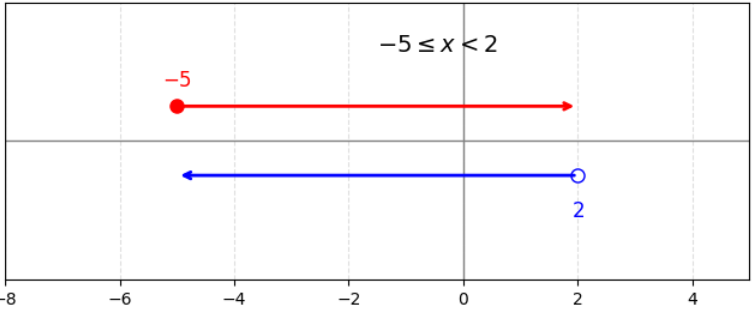
\( -5 \leq x < 2 \)
Represent the solution
A number line with a filled circle at -5 and an open circle at 2, shading between them.
Example:
A student needs at least 50 marks to pass a test, and the maximum possible score is 80. Write and solve an inequality for the number of marks, \( x \), the student can get if they pass.
▶️ Answer/Explanation
Translate the conditions into an inequality
Passing score means: \( x \geq 50 \)
Maximum possible: \( x \leq 80 \)
Write the compound inequality
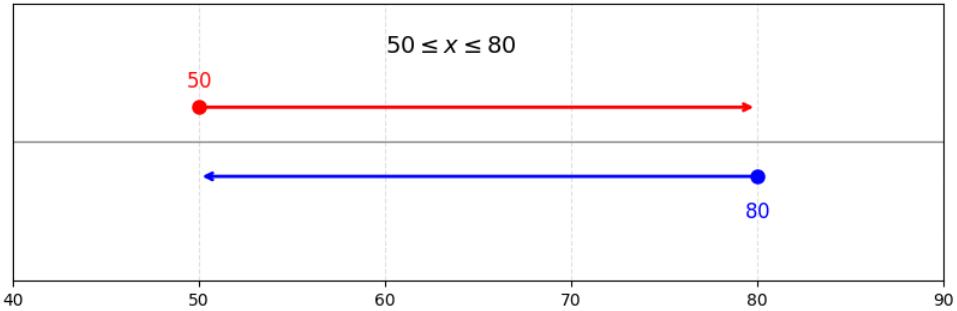
\( 50 \leq x \leq 80 \)
Represent
On a number line: Filled circles at 50 and 80, with shading in between.
Double Inequalities
A double inequality is a compound inequality written as a single expression with three parts, such as:
\( a \leq x < b \)
This means the variable \( x \) is between two values: it satisfies both inequalities simultaneously.
To solve double inequalities:
- Perform the same operation on all three parts at once (e.g., subtracting, adding, multiplying/dividing).
- Important: If you multiply or divide all parts by a negative number, reverse the inequality signs.
Example:
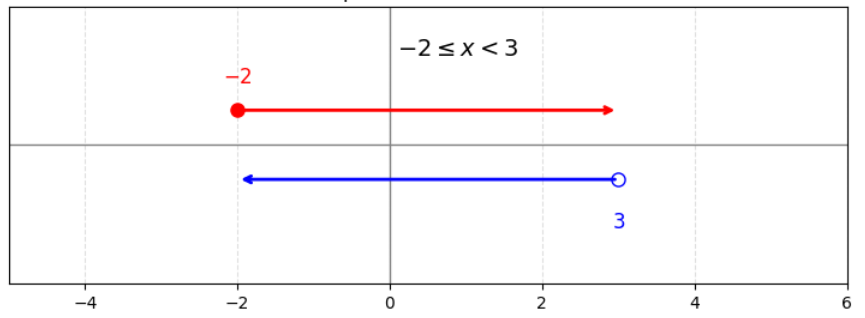
Solve the inequality: \( -4 \leq 2x < 6 \)
▶️ Answer/Explanation
Divide all parts of the inequality by 2
\(\frac{-4}{2} \leq \frac{2x}{2} < \frac{6}{2}\)
\(-2 \leq x < 3\)
Example:
Solve the inequality: \( 10 > -x + 2 \geq 4 \)
▶️ Answer/Explanation
Subtract 2 from all three parts
\( 10 – 2 > -x + 2 – 2 \geq 4 – 2 \)
\( 8 > -x \geq 2 \)
Multiply all parts by -1 (reverse all signs)
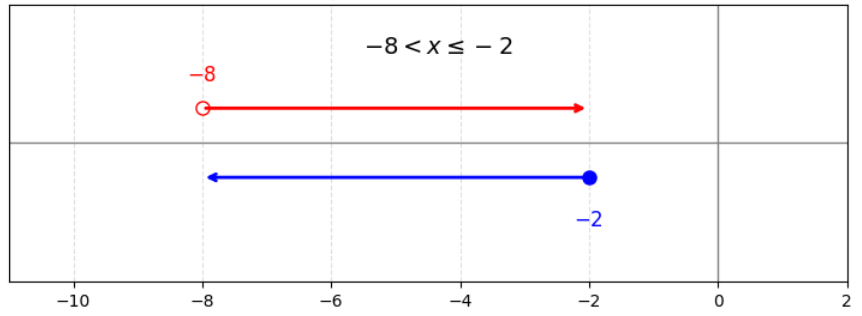
\( -8 < x \leq -2 \)