
Blood Components
🌟 Introduction
Blood is the body’s transport system.
It carries oxygen, nutrients, hormones, wastes and helps in defense, clotting, and maintaining internal balance.
It has two main parts:
- Plasma (liquid)
- Formed elements (cells + platelets)
🌊 Plasma (Fluid Part)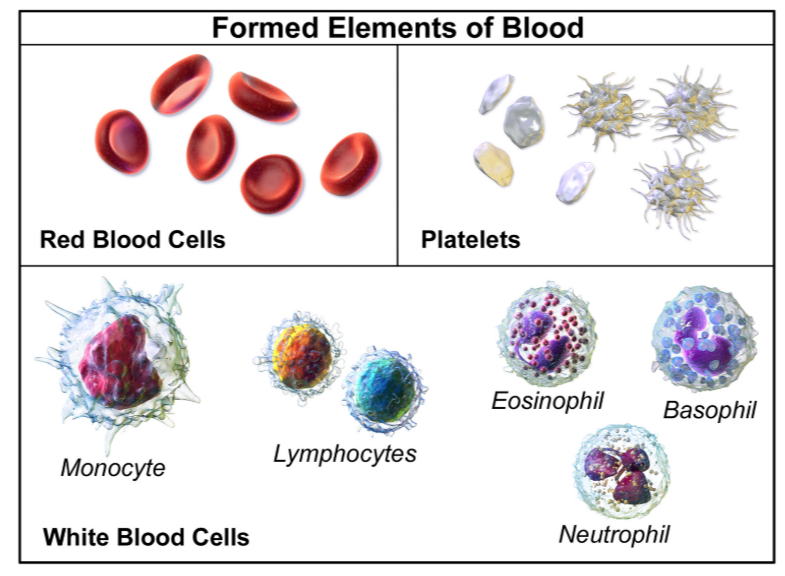
Pale yellow fluid, 55 percent of total blood.
Made of 90 percent water plus dissolved substances.
It helps in transport, maintaining pH, and maintaining fluid balance.
What plasma carries:
- Nutrients: glucose, amino acids, fatty acids.
- Gases: carbon dioxide (mostly as bicarbonate).
- Wastes: urea, uric acid.
- Proteins:
- Albumin (maintains osmotic pressure)
- Globulins (antibodies)
- Fibrinogen (clotting)
- Hormones, salts, vitamins.
🔴 Red Blood Cells (RBCs) / Erythrocytes
- Most abundant blood cells.
- Biconcave discs to increase surface area.
- No nucleus (in mammals).
- Packed with hemoglobin that binds oxygen.
Functions
- Carry oxygen from lungs to tissues.
- Carry carbon dioxide from tissues to lungs (small amount).
Life span: About 120 days, destroyed in liver and spleen.
Made in: Bone marrow (red bone marrow).
⚪ White Blood Cells (WBCs) / Leukocytes
Have nucleus, fewer in number than RBCs.
Defend the body against pathogens.
📌 Types of WBCs
A. Granulocytes
- Neutrophils
Most abundant.
First responders.
Kill bacteria by engulfing them (phagocytosis). - Eosinophils
Fight parasitic infections.
Involved in allergies. - Basophils
Release histamine and heparin.
Important in inflammation.
B. Agranulocytes
- Lymphocytes
B-cells: make antibodies.
T-cells: kill infected cells.
Memory cells: long-term immunity. - Monocytes
Largest WBC.
Turn into macrophages and eat dead cells, bacteria.
🟡 Platelets (Thrombocytes)
- Fragments of big cells called megakaryocytes.
- No nucleus.
- Essential for blood clotting.
Role in clotting:
- Stick to damaged blood vessels.
- Release chemicals that turn fibrinogen into fibrin threads.
- Fibrin forms a mesh trapping RBCs → clot is formed.
📋 Summary Table
| Component | Key Features | Function |
|---|---|---|
| Plasma | Liquid, 55 percent of blood, water + proteins | Transport, pH balance |
| RBCs | No nucleus, hemoglobin, biconcave | Carry oxygen & some CO2 |
| WBCs | Nucleated, immune cells | Defense against infection |
| Platelets | Cell fragments | Blood clotting |
🧠 Quick Recap
Plasma = transport liquid.
RBCs = oxygen carriers, no nucleus.
WBCs = body’s defense army.
Platelets = clot makers.
WBC order: N L M E B.