
Carbon Cycle
🌱 Introduction
The carbon cycle is the natural movement of carbon between the atmosphere, living organisms, oceans, and the Earth.
It helps maintain the balance of CO₂, controls climate, and supports life processes like photosynthesis and respiration.
Carbon exists as:
- CO₂: Carbon dioxide in the atmosphere.
- Glucose: Carbohydrates in plants and animals.
- Fossil fuels: Coal, oil, and natural gas.
- Carbonates: Found in rocks and shells.
- Biomass: Organic carbon in living tissues.
🌤️ Main Processes of the Carbon Cycle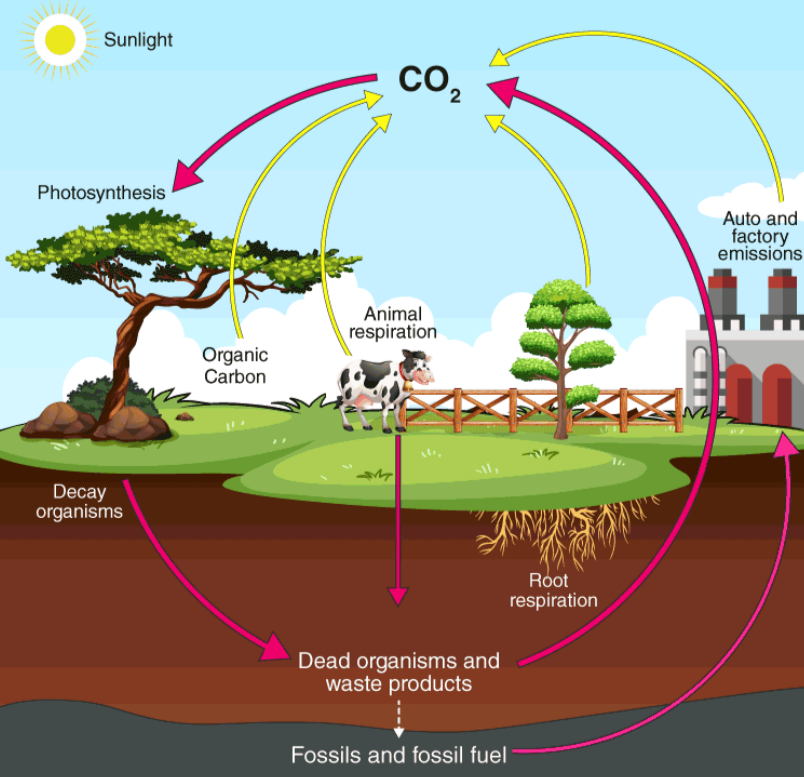
1) Photosynthesis
Plants, algae, and some bacteria take in CO₂ from the air and convert it into glucose, storing carbon in their tissues.
Equation: $$6CO_2 + 6H_2O \rightarrow C_6H_{12}O_6 + 6O_2$$
This is the entry point of carbon into the food chain.
2) Respiration
All living organisms (plants, animals, microbes) break down glucose for energy and release CO₂ back to the atmosphere.
This process balances photosynthesis.
3) Feeding & Assimilation
Carbon moves through the food web: Herbivores → Carnivores → Top Predators. It is stored as organic molecules in body tissues.
This forms the trophic carbon flow.
4) Decomposition
Decomposers (bacteria and fungi) break down dead plants and animals, releasing CO₂ (aerobic) or CH₄ (anaerobic).
This prevents carbon accumulation in dead matter.
5) Fossil Fuel Formation
If dead organisms are not decomposed completely, pressure and heat over millions of years turn them into coal, oil, and natural gas.
This is long-term carbon storage.
6) Combustion
Burning fossil fuels, wood, or biomass releases stored CO₂ back into the atmosphere.
This is a major contributor to global warming.
7) Ocean Uptake & Release
Oceans act as carbon sinks: CO₂ dissolves in water, is used by phytoplankton, and forms carbonates ($CaCO_3$) for shells.
Oceans store significantly more carbon than the atmosphere.
8) Rock Weathering & Volcanic Activity
Weathering of rocks releases carbonates, while volcanic eruptions release CO₂.
These are very slow, long-term processes.
🔁 Summary Table – Carbon Movement
| Process | Moves From | Moves To | Key Point |
|---|---|---|---|
| Photosynthesis | Atmosphere | Plants | CO₂ to glucose |
| Respiration | Organisms | Atmosphere | Energy release |
| Feeding | Food | Consumers | Biomass buildup |
| Decomposition | Dead matter | Air/soil | CO₂/CH₄ released |
| Combustion | Fuels/wood | Air | Rapid CO₂ release |
| Ocean uptake | Air | Ocean | Dissolves CO₂ |
| Sedimentation | Sea water | Rocks | Long-term storage |
| Volcanic release | Rocks | Air | Slow CO₂ return |
📦 Quick Recap
• Carbon Cycle = continuous movement of carbon between atmosphere, organisms, oceans, and Earth.
• Plants absorb CO₂; animals feed; respiration and decomposition return CO₂.
• Fossil fuels and oceans act as major storage areas.
• Trick (PCR-DOC-FV): Photosynthesis, Combustion, Respiration, Decomposition, Ocean processes, Carbonate rocks, Fossil fuel formation, Volcanic activity.