
Classification
🌱 Introduction
Living organisms on Earth are incredibly diverse from bacteria living in hot springs to massive blue whales.
To study all this diversity properly, biologists use classification, a scientific method that groups organisms based on similarities in structure, function, and evolutionary origin.
Classification makes biology organized, predictable, and easy to compare.
🧬 Why Classification Is Needed
- Millions of species exist, and new ones are still being discovered.
- Common names vary between languages and regions, which creates confusion.
- Classification gives a standard system to identify organisms globally.
- Helps scientists understand how organisms evolved and how they are related.
- Makes prediction possible – if you know the group, you can guess the organism’s features.
🔍 What Classification Is Based On
Modern classification considers several types of characteristics:
1. Morphological Characteristics: Visible traits like shape, size, body covering, leaf pattern, limb structure.
2. Anatomical Characteristics: Internal structures – types of tissues, arrangement of organs.
3. Embryological Evidence: Early developmental stages often show evolutionary links (Example: Vertebrate embryos show gill slits).
4. Physiological Evidence: Metabolism, nutrient use, respiration type, enzyme systems.
5. Molecular Evidence: DNA and RNA sequences, amino acid similarities in proteins. This is the most accurate tool today.
6. Evolutionary Relationships: Called phylogeny – organisms that share a common ancestor are grouped more closely.
📚 Taxonomy – The Science Behind Classification
Taxonomy is the specialized branch of biology that deals with identifying, naming, and grouping organisms. A taxonomist studies traits carefully and decides how organisms should be arranged in the classification system.
🧾 Binomial Nomenclature (Scientific Naming)
A universal naming system developed by Linnaeus. Each organism gets two names, similar to a “first name” and “surname”.
Structure:
Genus name – always capitalized
Species name – always lowercase
Written in italics when typed (or underlined when handwritten)
Example: Homo sapiens
Why It’s Useful: Scientific names are the same in every country and avoid confusion created by local names.
Hierarchy of Classification
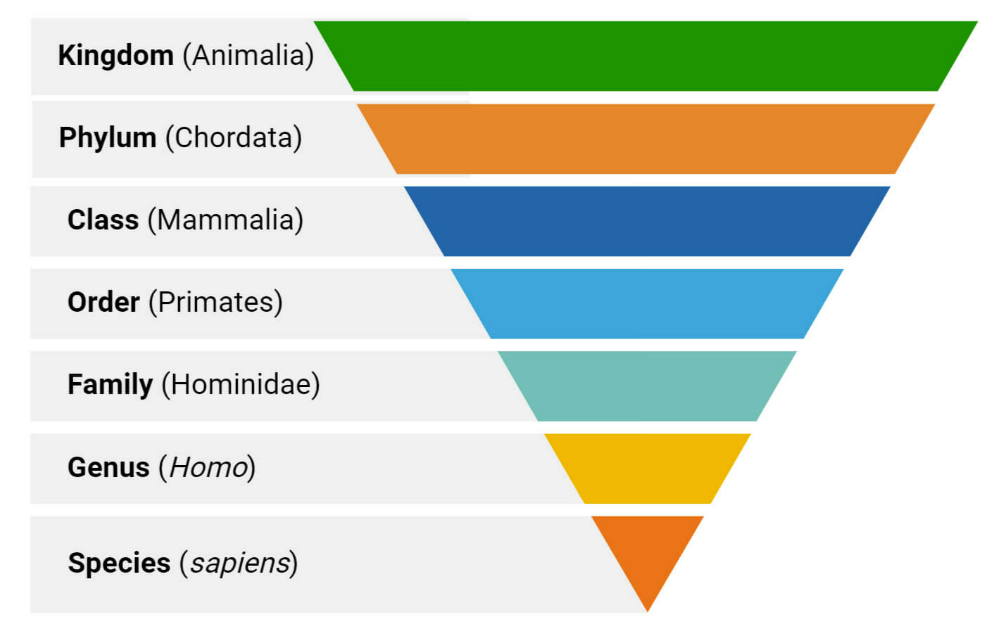
Organisms are arranged in steps from broadest to most specific. Levels in order:
- Domain
- Kingdom
- Phylum (Division in plants)
- Class
- Order
- Family
- Genus
- Species
Memory Trick: Don’t Kick Princess Cherry Or Froggy Gets Sad.
🌍 The Two Major Classification Systems
1. Five-Kingdom System (Traditional)
Based mostly on cell structure and mode of nutrition.
- Monera: all bacteria (prokaryotic)
- Protista: unicellular eukaryotes
- Fungi: heterotrophic decomposers
- Plantae: multicellular autotrophs
- Animalia: multicellular heterotrophs
2. Three-Domain System (Modern)
Created using genetic studies, especially rRNA.
- Archaea: ancient bacteria-like organisms in extreme habitats
- Bacteria: true bacteria
- Eukarya: all organisms with eukaryotic cells
🌳 Phylogenetic Classification
Instead of grouping by only visible traits, modern biology groups organisms based on shared ancestry. A phylogenetic tree is a diagram showing evolutionary relationships.
Additional Concepts
- Homologous vs Analogous Structures:
- Homologous: Same basic structure, different functions (e.g., Forelimbs of humans and bats). Indicates common ancestry.
- Analogous: Same function, different structure (e.g., Wings of birds and insects). No common ancestor.
- Species Concept: A group of organisms that can interbreed and produce fertile offspring under natural conditions. (Example: Horse × Donkey = Mule (infertile), so they are separate species).
📊 Summary Table
| Concept | Key Idea | Why It Matters |
|---|---|---|
| Taxonomy | Naming + grouping | Clear communication |
| Scientific Naming | Genus + species | Universal identity |
| Hierarchy | 8 levels | Systematic placement |
| 5-Kingdom | Old system | Basic classification |
| 3-Domain | Modern, molecular | Shows ancestry |
📦 Quick Recap
Classification groups organisms to make study easier.
Modern classification uses DNA, anatomy, development, and evolution.
Scientific names are two words: Genus species.
The classification hierarchy moves from domain to species.
Three-domain system is the most accurate evolutionary model.
Phylogenetic trees show how species are connected.
Homologous structures support evolutionary relationships.