
Enzymes and Homeostasis
🌟 Introduction
Enzymes and homeostasis are closely linked.
Enzymes speed up chemical reactions, while homeostasis keeps internal conditions stable so enzymes function properly.
Together, they keep metabolism smooth and efficient.
🧪 Enzymes – What They Are
- Enzymes are biological catalysts made of proteins.
- They speed up reactions without being used up.
- Each enzyme works on a specific substrate.
Key properties:
- Highly specific (lock and key).
- Needed in small amounts.
- Affected by temperature, pH, and substrate concentration.
- Lower activation energy of reactions.
How enzymes work:
Lock and Key Model: active site is exactly complementary to substrate.
Induced Fit Model: active site adjusts slightly to fit substrate more precisely.
🌡️ Factors Affecting Enzyme Activity
a) Temperature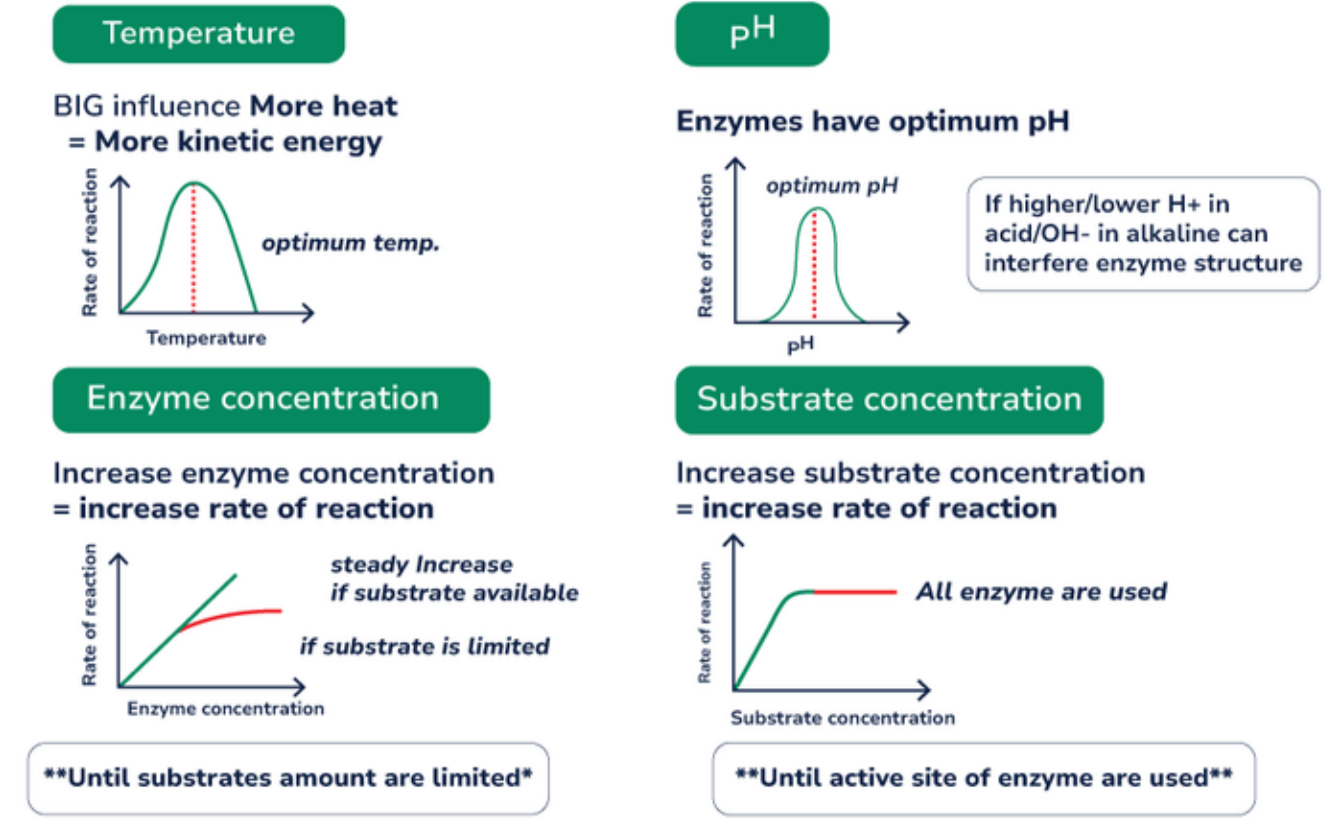
- Rate increases until optimum temperature.
- Beyond optimum, enzymes denature.
- Human optimum: around 37°C.
b) pH
- Each enzyme has an optimum pH.
- Example: pepsin works best in acidic pH.
- Extreme pH denatures enzymes.
c) Substrate concentration
- Higher concentration increases rate until saturation point.
- After saturation, all active sites are full.
d) Enzyme concentration
- More enzymes → more active sites available.
- Reaction rate increases as long as enough substrate is present.
- If substrate becomes limited, increasing enzyme amount does not increase the rate.
🏠 Homeostasis – What It Means
Homeostasis is the ability of the body to maintain a stable internal environment despite external changes.
Conditions kept constant:
- Body temperature
- Blood glucose level
- Water balance
- pH of blood and tissues
- Ion balance (Na, K, Ca)
These conditions are vital because enzymes work only within narrow ranges.
🔁 Components of Homeostasis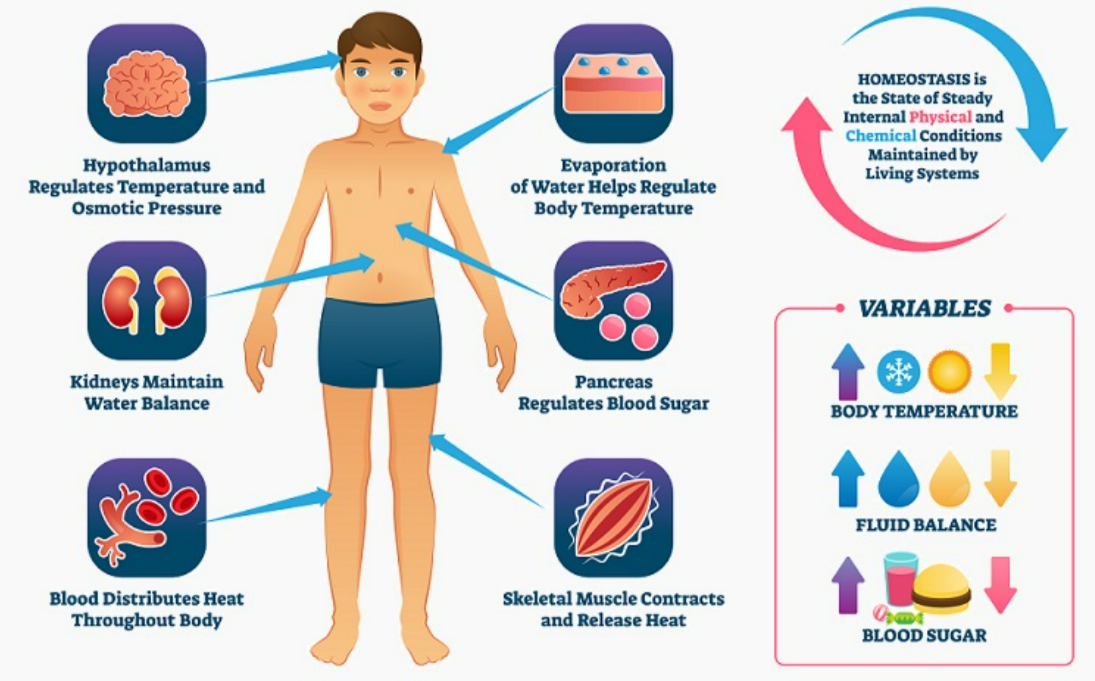
a) Receptor
- Detects changes like temperature or glucose level.
b) Control center
- Usually brain/hypothalamus.
- Decides the response.
c) Effector
- Muscles or glands that carry out the response.
d) Negative feedback
- The main regulatory mechanism.
- Change occurs.
- Body responds to reverse the change.
- System returns to normal.
Example: body temperature control.
🌡️ Thermoregulation (Temperature Control)
Controlled mainly by the hypothalamus.
If temperature rises:
- Sweating increases.
- Vasodilation.
- More heat lost.
If temperature falls:
- Shivering produces heat.
- Vasoconstriction.
- Hairs stand up to trap air (in some animals).
Stable temperature is essential for enzyme action.
🍬 Blood Glucose Regulation
Maintained by insulin and glucagon from the pancreas.
High blood sugar:
- Insulin released.
- Glucose converted to glycogen and stored in liver.
Low blood sugar:
- Glucagon released.
- Glycogen converted back to glucose.
Stable glucose ensures proper respiration and enzyme function.
💧 Water and Ion Balance (Osmoregulation)
Controlled by: kidneys and ADH hormone.
If body has less water:
- ADH increases.
- Kidneys reabsorb more water.
- Urine becomes concentrated.
If body has excess water:
- ADH decreases.
- Kidneys excrete more water.
- Urine becomes dilute.
🔗 Link Between Enzymes and Homeostasis
- Enzymes need specific internal conditions.
- Homeostasis maintains those conditions.
- If temperature, pH, or water balance shifts, enzymes stop working.
- Without functioning enzymes, metabolism fails.
Homeostasis protects enzyme activity, and enzymes drive homeostasis reactions.
📌 Summary Table
| Concept | Key Points |
|---|---|
| Enzymes | Biological catalysts, specific, sensitive to temperature and pH |
| Factors affecting enzymes | Temperature, pH, substrate concentration |
| Homeostasis | Stable internal conditions |
| Mechanisms | Sensors, control center, effectors, negative feedback |
| Major controls | Temperature, glucose, water balance |
| Enzyme–homeostasis connection | Homeostasis keeps enzyme conditions optimal |
⚡ Quick Recap
Enzymes speed reactions; homeostasis keeps them in the right environment.
Too high or low temperature or pH leads to denaturation.
Homeostasis uses receptors, control centers, and effectors.
Negative feedback restores balance.
Key areas: thermoregulation, glucose regulation, osmoregulation.
If homeostasis collapses, enzyme activity fails.