
Food Chains and Food Webs
🌟 Introduction
Every ecosystem depends on energy flow. Energy begins from the sun, enters producers, and then moves through consumers. Food chains and food webs explain who eats whom in an ecosystem.
🌱 Food Chain
A food chain is a simple, straight pathway showing how energy and nutrients pass from one organism to another.
Example:
Grass → Grasshopper → Frog → Snake → Eagle
🌟 Components of a Food Chain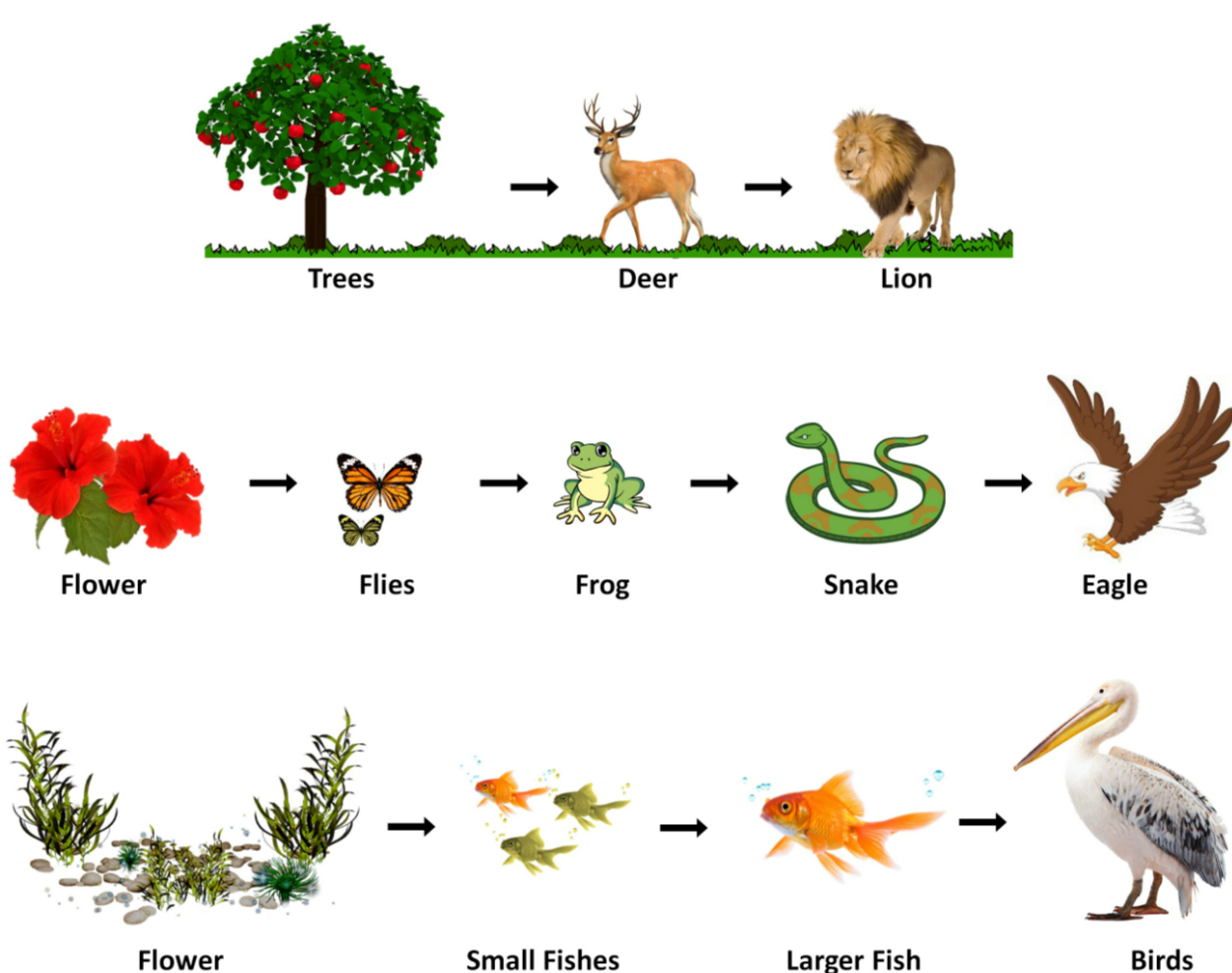
a) Producers (Autotrophs)
- Green plants, algae
- Capture sunlight and prepare food by photosynthesis
- Starting point of all food chains
b) Primary Consumers (Herbivores)
- Eat producers
- Examples: deer, grasshopper, caterpillar
c) Secondary Consumers (Carnivores)
- Eat herbivores
- Examples: frogs, small fish
d) Tertiary Consumers
- Eat secondary consumers
- Examples: snake, large fish
e) Apex Predators
- Top of the chain, no natural predators
- Examples: eagle, tiger, shark
f) Decomposers
- Bacteria and fungi
- Break down dead organisms
- Return nutrients to the soil
🕸️ Food Web
A food web is a complex network formed by many linked food chains in an ecosystem.
Why is it more accurate?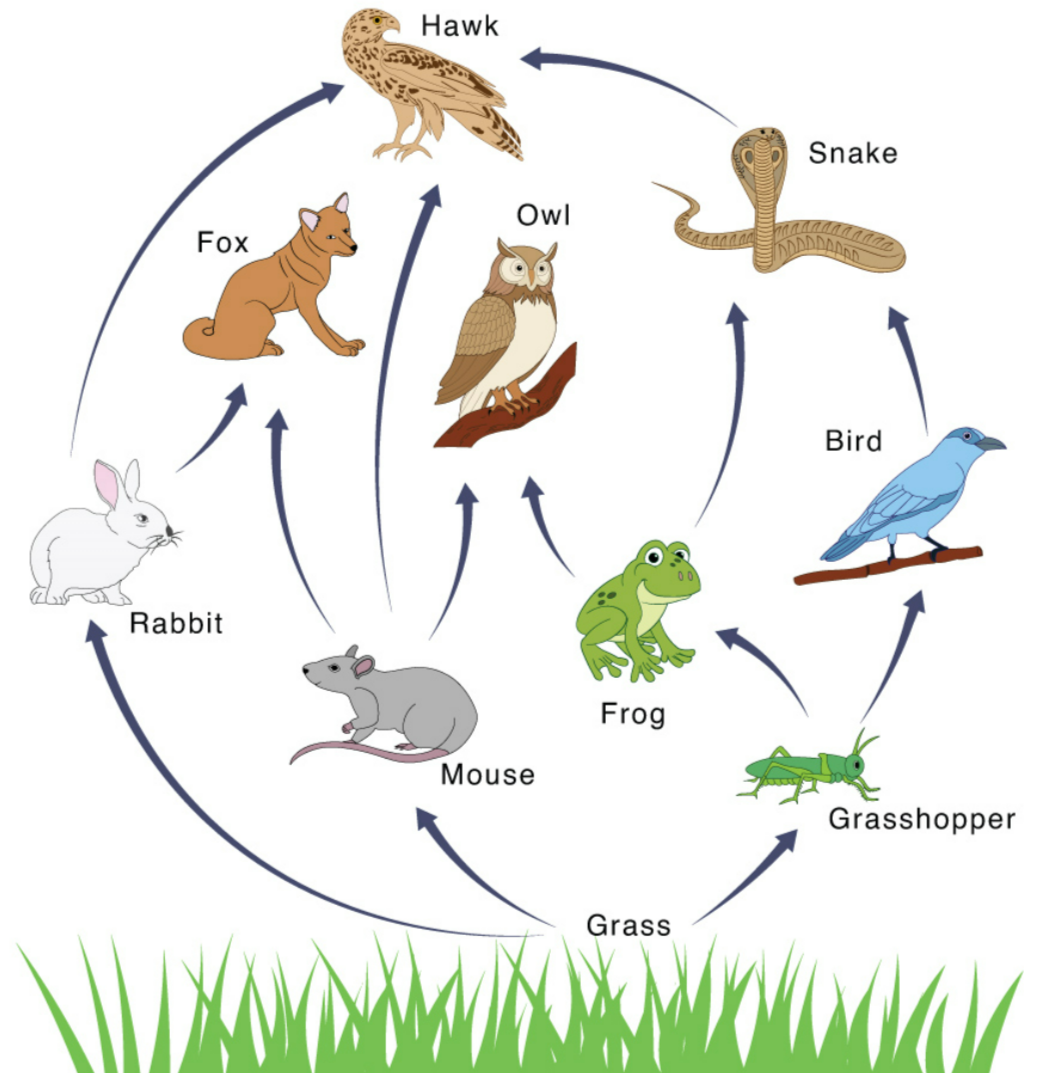
- Organisms usually eat more than one type of food
- Shows multiple feeding relationships
- More realistic representation of nature
Example (basic idea):
Plants → Deer, Insects → Birds, Fox Insects → Frog → Snake All dead organisms → Decomposers
🔁 Energy Flow in an Ecosystem
Rule: Only 10 percent of energy is passed to the next trophic level.
The remaining energy is lost as heat or used by the organism.
Producers → 100 percent energy Herbivores → 10 percent Carnivores → 1 percent Top predators → 0.1 percent
This explains why:
- Food chains are short
- Top predators are fewer
🧩 Trophic Levels
| Trophic Level | Organisms | Example |
|---|---|---|
| 1 | Producers | Grass, algae |
| 2 | Primary consumers | Rabbit, insect |
| 3 | Secondary consumers | Snake, frog |
| 4 | Tertiary consumers | Hawk, tiger |
| 5 | Apex predators | Lion, shark |
🌿 Importance of Food Chains & Webs
- Show energy flow
- Help understand population balance
- Allow prediction of effects if an organism is removed
- Support conservation planning
- Highlight the role of decomposers in nutrient recycling
⚠️ What Happens If One Species Is Removed?
In a food chain
- Simple chain → larger impact
- If frogs disappear: insects increase, snakes decline
In a food web
- Smaller impact because organisms have alternative food sources
- More stable ecosystem
📊 Summary Table
| Feature | Food Chain | Food Web |
|---|---|---|
| Definition | Linear feeding path | Network of many food chains |
| Structure | Simple | Complex |
| Stability | Less stable | More stable |
| Realistic? | Less | More |
| Energy Flow | One path | Multiple paths |
⚡ Quick Recap
Food chain → simple energy path.
Food web → interconnected chains, more stable.
Starts with producers, ends with apex predators or decomposers.
10 percent rule explains energy loss at each level.
Food webs provide stability; food chains are simpler.
Removing one organism can disturb ecosystem balance.