
Habitat and Ecosystems
🌱 Introduction
Every living organism lives in a specific place that provides everything it needs to survive. This place is called its habitat.
When you combine the living organisms of an area with the nonliving conditions around them, you get an ecosystem.
🏡 Habitat
Definition
A habitat is the natural home of an organism where it obtains food, water, shelter, and appropriate environmental conditions.
Key Features of a Habitat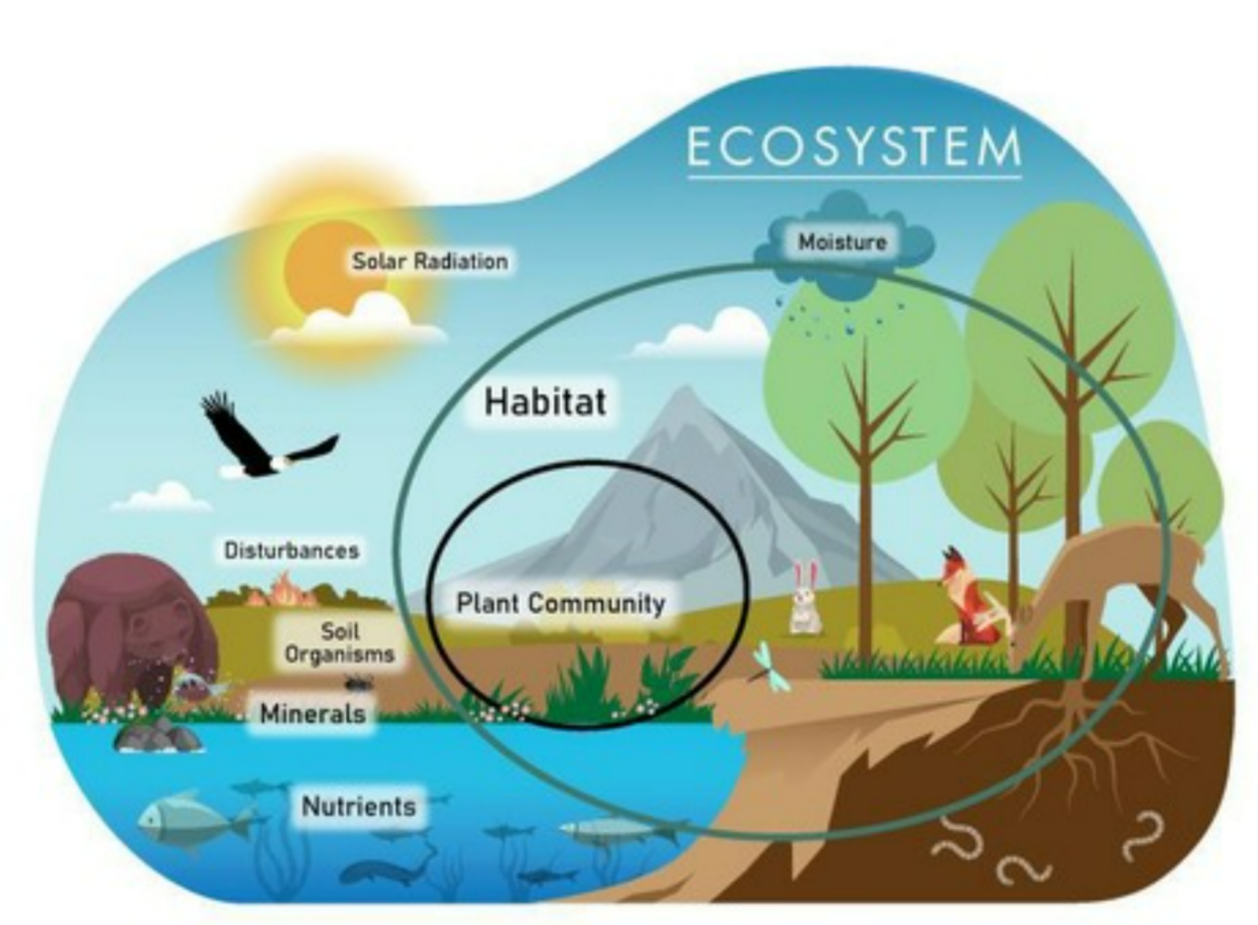
- Temperature
- Water availability
- Light
- Shelter and space
- Type of food available
- Presence of predators or competitors
Major Types of Habitats
- Terrestrial habitats: Forests, deserts, grasslands, mountains (Conditions vary in moisture, temperature, and shelter)
- Aquatic habitats: Freshwater (ponds, rivers, lakes) and Marine (seas and oceans)
- Arboreal habitats: Organisms living on trees (birds, monkeys, insects)
- Aerial habitats: Organisms that spend most time in air (many birds and insects)
Examples
- Cactus survives in desert because it stores water
- Frogs live in moist areas to prevent drying
- Fish live in water because their gills allow gas exchange
🌎 Ecosystems
Definition
An ecosystem is a system formed by interactions between living organisms (biotic factors) and nonliving components (abiotic factors).
Abiotic Components
- Light, Temperature, Water, Minerals, Soil, Air
Biotic Components
- Producers: Plants
- Consumers: Animals (Primary, secondary, tertiary)
- Decomposers: Fungi, bacteria (Break down dead matter)
🔄Levels of Organization
Individual → Population → Community → Ecosystem → Biome → Biosphere
🌿 Types of Ecosystems
Natural Ecosystems
Forests, Grasslands, Deserts, Rivers, lakes, oceans
Artificial Ecosystems
Farms, Aquariums, Gardens (Usually maintained by humans)
🔁 Energy Flow in Ecosystems
Energy flows in one direction: Sun → Producers → Consumers → Decomposers
- Plants convert solar energy into chemical energy
- Consumers eat plants or animals
- Decomposers return nutrients to soil
- Energy decreases at each level (shown using a pyramid of energy)
🧪 Roles of Organisms
- Producers: Make their own food; Base of all food chains
- Consumers: Depend on others for food (Primary/Herbivores, Secondary/Carnivores, Tertiary/Top predators)
- Decomposers: Recycle nutrients; Essential for soil fertility
Balance in an Ecosystem
Ecosystems remain stable due to predator-prey balance, nutrient cycling, competition, and adaptations. If one species is removed, it can disturb the entire ecosystem.
Examples of Simple Ecosystems
- Pond: Algae (Producers), Fish/Frogs (Consumers), Bacteria (Decomposers)
- Forest: High biodiversity, canopy layers, various trees and predators
- Grassland: Dominated by grasses, large grazers, and fast predators
📊 Summary Table
| Topic | Key Points |
|---|---|
| Habitat | Natural home of organisms, provides survival needs |
| Types of habitats | Terrestrial, aquatic, arboreal, aerial |
| Ecosystem | Interaction of biotic and abiotic components |
| Biotic components | Producers, consumers, decomposers |
| Energy flow | Moves from Sun to producers to consumers |
| Organization | Individual → Population → Community → Ecosystem → Biome → Biosphere |
📦 Quick Recap
Habitat is where an organism lives.
Ecosystem is how organisms interact with each other and the environment.
Includes abiotic + biotic components.
Energy flows one way, nutrients cycle.
Producers start the chain, decomposers end it.
Healthy ecosystems depend on balance and interactions.