
Inheritance
🌟 Introduction
Inheritance is the process by which genetic information passes from parents to offspring.
This flow of DNA ensures that traits (like eye color, height, blood type, etc.) appear in the next generation.
Inheritance forms the bridge between genetics and evolution.
🧪 What Exactly Is Inherited?
- Genes: Segments of DNA that code for a specific trait. Each gene exists in pairs in diploid organisms.
- Alleles: Different versions of the same gene. Example: allele for brown eyes (B) and allele for blue eyes (b).
- Genotype: The actual allele combination (BB, Bb, bb).
- Phenotype: Physical expression of the genotype (e.g., brown or blue eyes).
- Chromosomes: DNA is packed into chromosomes. One set comes from the mother, the other from the father.
🧬 How Inheritance Works
Step-by-Step Process:
- Parents produce gametes by meiosis.
- Gametes contain one allele of each gene (haploid).
- During fertilization, gametes fuse → zygote (diploid).
- The zygote gets one allele from each parent.
- This combination decides the phenotype.
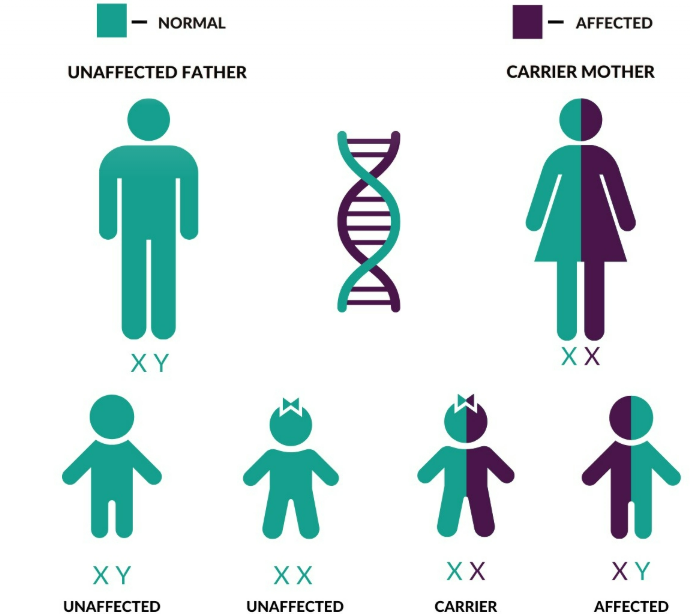 Two important features: Random segregation of alleles and Random fertilization. Both increase variation.
🔹 Patterns of Inheritance
These show how alleles interact:
- Dominant & Recessive: Dominant allele is expressed even if one copy exists (A). Recessive is expressed only when both copies are recessive (aa).
- Codominance: Both alleles are fully expressed. Example: AB blood group.
- Incomplete Dominance: Neither allele is fully dominant. Offspring show a blended phenotype.
- Polygenic Inheritance: Trait controlled by many genes. Example: height, skin color.
- Sex-linked Inheritance: Genes located on the X or Y chromosome. X-linked traits appear more in males.
🔄 Why Variation Exists
Inheritance is not just copying; it’s mixing and reshuffling.
Sources of Variation:
- Crossing over during meiosis
- Independent assortment of chromosomes
- Random fertilization
- Mutations creating new alleles
This variation is essential for adaptation and evolution.
🧬 Predicting Inheritance
Scientists use different tools to forecast genetic outcomes:
- Punnett Squares: Predict probability of genotypes/phenotypes.
- Pedigrees: Track inheritance through generations.
- Probability Rules: Applied to predict ratios in offspring.
Importance of Inheritance
- Ensures continuity of traits.
- Allows selective breeding in plants/animals.
- Helps understand diseases (dominant, recessive, sex-linked).
- Provides the foundation for evolution.
📋 Summary Table
| Term | Meaning | Example |
|---|---|---|
| Gene | DNA unit controlling trait | Gene for blood type |
| Allele | Variants of a gene | A, O, B alleles |
| Genotype | Allele combination | AO |
| Phenotype | Physical feature | Blood group A |
| Dominant | Expressed allele | A |
| Recessive | Hidden by dominant | o |
| Polygenic | Many genes controlling trait | Height |
| Sex-linked | Trait on X/Y chromosome | Color blindness |
📦 Quick Recap
• Inheritance = passing of DNA from parent to offspring.
• Traits depend on alleles received from parents.
• Genotype forms the blueprint; phenotype is the visible trait.
• Different patterns: dominant, recessive, codominance, incomplete dominance, polygenic, sex-linked.
• Variation arises from meiosis + mutation.
• Tools: Punnett squares and pedigrees help predict traits.