
Nervous System
🌟 Introduction
The nervous system is the body’s control and communication network.
It helps us sense, think, move, and respond to changes inside and outside the body.
It works using electrical signals (nerve impulses) and chemical messages (neurotransmitters).
🧩 What the Nervous System Does?
- Detects changes (stimuli)
- Processes information
- Sends commands to muscles and glands
- Maintains body coordination
- Enables learning, memory, emotions, thinking
🧬 Basic Unit: The Neuron
Structure of a Neuron
- Dendrites – receive signals
- Cell body – has nucleus, controls activities
- Axon – carries impulses away
- Myelin sheath – insulates axon, speeds impulses
- Axon terminals – pass signal to next cell
Types of Neurons
- Sensory neurons
Carry impulses from sense organs to CNS - Motor neurons
Carry impulses from CNS to muscles/glands - Interneurons
Connect neurons inside CNS
🧠 Divisions of the Nervous System
A) Central Nervous System (CNS)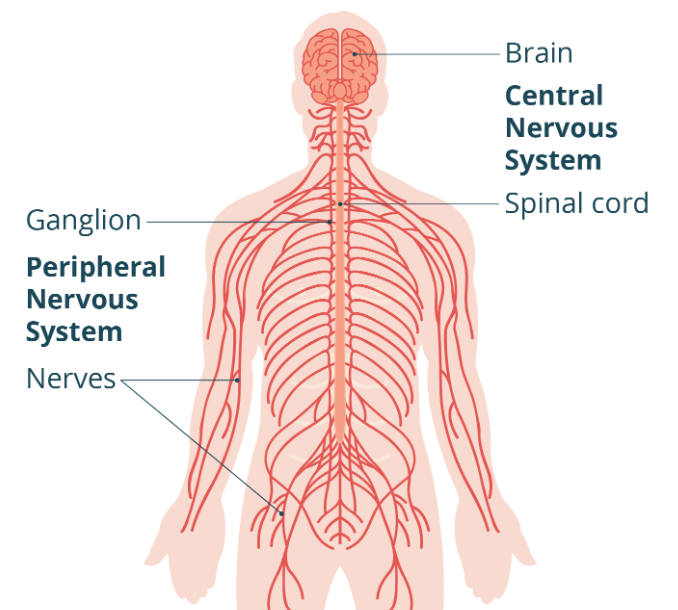
Made of brain + spinal cord
- Receives information
- Processes it
- Sends decisions to body
Brain Parts
- Cerebrum
Thinking, memory, learning
Voluntary actions - Cerebellum
Balance, posture
Coordination of movement - Medulla (brainstem)
Controls involuntary actions
Breathing, heartbeat, swallowing
Spinal cord
- Main pathway between brain and body
- Controls reflex actions
B) Peripheral Nervous System (PNS)
All nerves outside CNS.
Two Divisions
- Somatic nervous system
Voluntary movements - Autonomic nervous system
Involuntary functions- Sympathetic – fight or flight
- Parasympathetic – rest and digest
⚡ How a Nerve Impulse Travels
- Stimulus detected
- Electrical impulse travels along axon
- Jumps across synapse using neurotransmitters
- Next neuron carries signal forward
Synapses ensure one-way transmission.
🛡️Reflex Actions
Quick, automatic responses that protect the body.
Example:
Touching something hot → sensory neuron → spinal cord → motor neuron → pull hand away
Reflex arc components:
Stimulus → receptor → sensory neuron → interneuron → motor neuron → effector
👁️ Sense Organs & Their Roles
- Eye – vision, light detection
- Ear – hearing + balance
- Tongue – taste
- Skin – touch, temperature, pain
- Nose – smell
These organs provide input to nervous system.
🔌 Coordination with Other Systems
- Works with endocrine system to maintain homeostasis
- Controls muscles, enabling movement
- Links with respiratory and circulatory systems to match oxygen needs
- Controls digestion via autonomic nerves
⚠️ Disorders of the Nervous System
- Stroke
- Paralysis
- Parkinson’s disease
- Alzheimer’s
- Epilepsy
- Multiple sclerosis (myelin damage)
📌 Summary Table
| Topic | Key Points |
|---|---|
| Neuron | Basic unit; dendrites, axon, myelin |
| CNS | Brain + spinal cord; processing center |
| PNS | Nerves; voluntary & involuntary control |
| Brain parts | Cerebrum, cerebellum, medulla |
| Impulse | Electrical + chemical transmission |
| Reflex | Fast, protective pathway |
| Sense organs | Provide input to CNS |
⚡ Quick Recap
Nervous system controls everything you feel, think, and do.
Neurons carry impulses using electrical and chemical signals.
CNS = brain + spinal cord; PNS = all nerves.
Brain has cerebrum (thinking), cerebellum (coordination), medulla (involuntary).
Reflex actions protect the body and are very quick.
Sense organs provide sensory input.
Works closely with all organ systems to maintain balance.