
Nitrogen Cycle
🌱 Introduction
Nitrogen is essential for Proteins, DNA/RNA, and Chlorophyll. Although 78% of the atmosphere is nitrogen gas ($N_2$), plants and animals cannot use $N_2$ directly. The nitrogen cycle converts $N_2$ into usable forms and moves nitrogen through soil, air, water, and living organisms.
🔄 Key Processes of the Nitrogen Cycle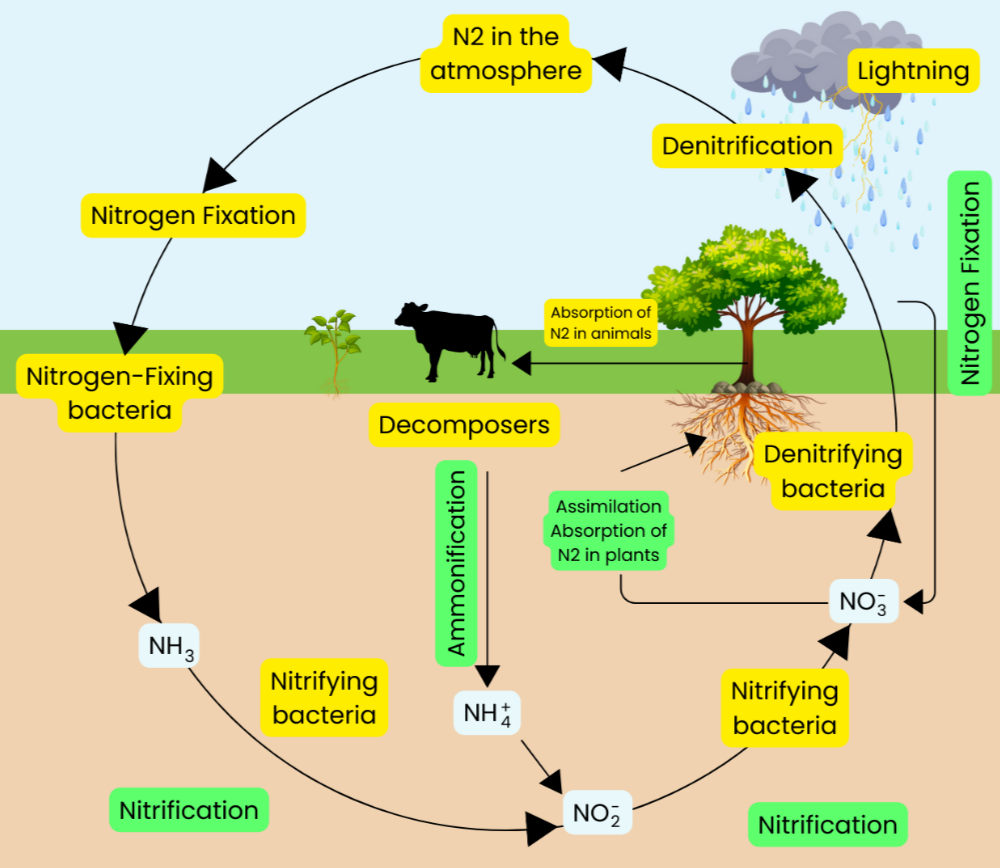
Nitrogen Fixation
Converts atmospheric $N_2$ into ammonia ($NH_3$) or ammonium ($NH_4^+$) that plants can use. This occurs by:
- Nitrogen-fixing bacteria: Rhizobium in root nodules of legumes or Azotobacter in soil.
- Lightning: High energy converts $N_2 \rightarrow$ nitrates ($NO_3^-$).
- Industrial fixation: The Haber process.
This is the entry point of nitrogen into the ecosystem.
Ammonification (Decomposition)
Decomposers break down dead plants/animals and waste (urea, feces) into ammonia ($NH_3$) or ammonium ($NH_4^+$).
Returns nitrogen to the soil in a usable form.
Nitrification
A two-step process done by nitrifying bacteria:
- Nitrosomonas: $NH_4^+ \rightarrow NO_2^-$ (nitrite)
- Nitrobacter: $NO_2^- \rightarrow NO_3^-$ (nitrate)
Plants absorb nitrate ($NO_3^-$) most easily.
Assimilation
Plants absorb nitrates from the soil and convert them into amino acids and proteins. Animals eat plants or other animals to get nitrogen for their own proteins.
Moves nitrogen into living organisms.
Denitrification
Specific bacteria (like Pseudomonas and Clostridium) convert nitrates ($NO_3^-$) back into $N_2$ gas, returning it to the atmosphere. This happens mostly in low-oxygen, waterlogged soils.
Completes the cycle by returning nitrogen to the air.
🌊 Additional Components
- Fertilizers: Add nitrates and ammonium to soil to increase growth; overuse can cause eutrophication.
- Leaching: Nitrates dissolve and wash into rivers, leading to algal blooms.
- Lightning: Carried to soil by rain after conversion.
📋 Summary Table – Nitrogen Pathways
| Process | Converts | Done By | End Product |
|---|---|---|---|
| Nitrogen fixation | $N_2 \rightarrow NH_3/NH_4^+$ | Rhizobium, lightning, industry | Ammonia |
| Ammonification | Organic N $\rightarrow$ $NH_3/NH_4^+$ | Decomposers | Ammonium |
| Nitrification | $NH_4^+ \rightarrow NO_2^- \rightarrow NO_3^-$ | Nitrosomonas, Nitrobacter | Nitrates |
| Assimilation | $NO_2^-/NO_3^-$ $\rightarrow$ organic N | Plants, animals | Proteins/DNA |
| Denitrification | $NO_3^-$ $\rightarrow$ $N_2$ | Denitrifying bacteria | Nitrogen gas |
📦 Quick Recap
Nitrogen Cycle = Conversion of atmospheric $N_2$ into usable forms ($NH_4^+$, $NO_3^-$) and back.
Fixation: $N_2$ to ammonia.
Ammonification: Decay to ammonium.
Nitrification: Ammonium to nitrate.
Assimilation: Plants/animals build proteins.
Denitrification: Nitrates back to $N_2$.