
Nutrient Cycles
🌱 Introduction
Nutrients like carbon, nitrogen, phosphorus, sulfur, and water constantly circulate between:
- Living organisms
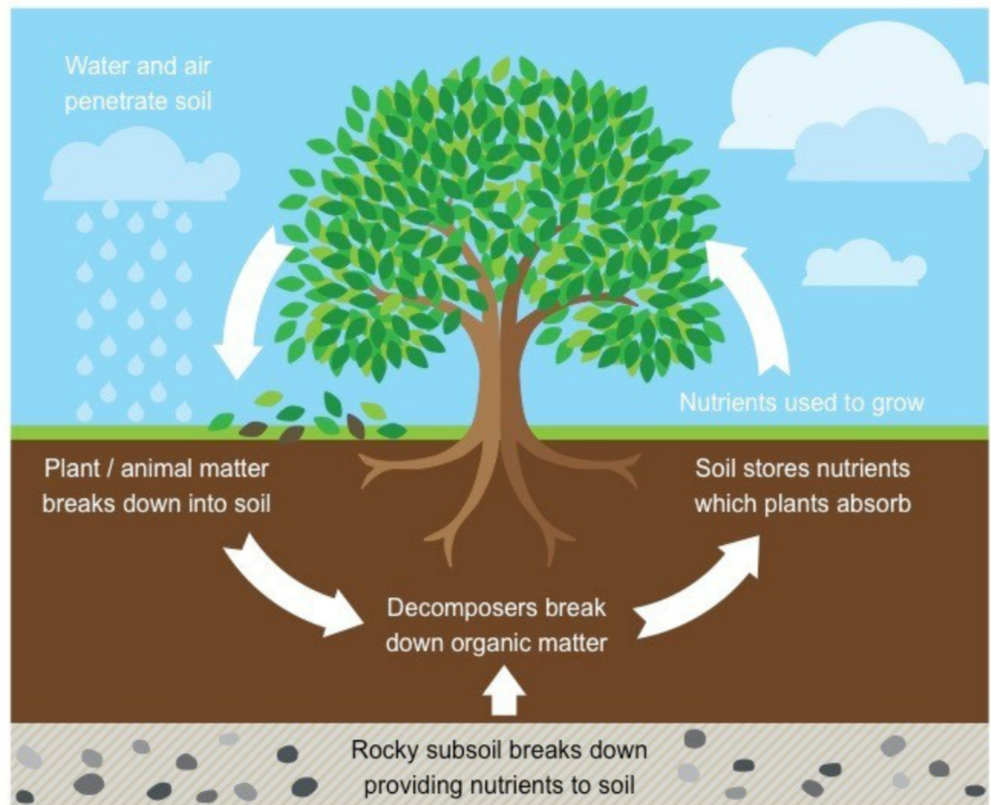
- Soil
- Water
- Atmosphere
These cycles ensure that essential elements are reused instead of being lost.
Without nutrient cycles, life would run out of raw materials for growth, repair, and energy.
🔄 Why Nutrient Cycles Matter
- Maintain ecosystem balance
- Recycle essential elements
- Support plant growth (primary productivity)
- Link abiotic and biotic components
- Allow nutrients to flow from non-living → living → non-living
🌿 Major Nutrient Cycles
Carbon Cycle
Movement of Carbon
Carbon flows as:
- CO₂ in the air and dissolved in water
- Glucose, proteins, fats in living organisms
- Fossil fuels
- Carbonates in rocks
Main Steps
- Photosynthesis: CO₂ → glucose (plants)
- Respiration: glucose → CO₂ (all organisms)
- Combustion: burning fuels releases CO₂
- Decomposition: carbon in dead organisms → CO₂
- Ocean exchange: CO₂ dissolves into oceans
- Formation of fossil fuels: dead organisms under pressure
Carbon cycle is tightly linked to climate change.
Nitrogen Cycle
Needed for: Proteins, DNA, ATP, chlorophyll.
Main Steps
- Nitrogen fixation (N₂ → NH₃/NH₄⁺)
- Ammonification
- Nitrification
- Assimilation
- Denitrification (NO₃⁻ → N₂)
Ensures plants get nitrates, the most usable nitrogen form.
Phosphorus Cycle
Why Important? Essential for DNA, RNA, ATP (energy currency), and Cell membranes (phospholipids).
Key Features
- No atmospheric phase
- Starts from rock weathering
- Phosphate ions (PO₄³⁻) enter soil/water
- Plants absorb phosphates
- Animals obtain phosphates by feeding
- Decomposers return phosphates to the soil
- Sedimentation → rocks → uplift
Slow cycle often limits plant growth.
Water Cycle (Hydrologic Cycle)
Movement of Water
Involves:
- Evaporation
- Transpiration (plants lose water vapor)
- Condensation
- Precipitation
- Runoff
- Groundwater flow
Powers energy flow and nutrient distribution.
Sulfur Cycle
Importance: Sulfur forms some amino acids (cysteine, methionine) and important proteins and enzymes.
Key Steps
- Weathering of rocks releases sulfate (SO₄²⁻)
- Plants absorb sulfate
- Animals ingest sulfur through food
- Decomposition releases sulfur into soil
- Bacteria convert sulfur compounds → H₂S, SO₂
- Volcanic eruptions emit sulfur gases
Influences acid rain formation.
Oxygen Cycle
Key Processes
- Photosynthesis: releases O₂
- Respiration: uses O₂
- Decomposition: uses O₂
- Combustion: uses O₂
Oxygen also stored in oceans and rocks.
Linked closely with the carbon cycle.
🌾 How Nutrient Cycles Link Biotic and Abiotic Worlds
- Plants (Producers): Take in carbon (CO₂), nitrogen (nitrates), phosphorus, sulfur, water and convert them into biomass.
- Animals (Consumers): Get nutrients by eating plants/animals and return nutrients through waste.
- Decomposers (Fungi, Bacteria): Break down dead organisms and release nutrients back into soil/water. Essential for nutrient recycling; without decomposers → cycles stop.
🌊 Human Impacts on Nutrient Cycles
- Carbon Cycle: Burning fossil fuels → excess CO₂; Deforestation reduces CO₂ absorption.
- Nitrogen & Phosphorus Cycles: Overuse of fertilizers → eutrophication; Sewage and livestock waste add excess nutrients.
- Sulfur Cycle: Industrial emissions → acid rain.
Human activity speeds some cycles and disrupts others.
📋 Summary Table – Major Nutrient Cycles
| Cycle | Key Inputs | Major Processes | Key Outputs |
|---|---|---|---|
| Carbon | CO₂, organic carbon | Photosynthesis, respiration, decomposition | Biomass, CO₂ |
| Nitrogen | N₂, nitrates, ammonium | Fixation, nitrification, assimilation, denitrification | Proteins, N₂ gas |
| Phosphorus | Phosphates from rocks | Weathering, uptake, feeding, decomposition | DNA, ATP |
| Water | Liquid water | Evaporation, condensation, precipitation | Groundwater, freshwater |
| Sulfur | Sulfates, volcanic gases | Weathering, uptake, decomposition, emissions | Amino acids, SO₂ |
| Oxygen | O₂ | Photosynthesis, respiration | Water, CO₂ |
📦 Quick Recap
Nutrient cycles recycle essential elements through living and non-living parts of ecosystems.
✔ Carbon → energy flow, climate
✔ Nitrogen → proteins, DNA
✔ Phosphorus → ATP, DNA
✔ Water → movement of substances
✔ Sulfur → proteins
✔ Oxygen → respiration, photosynthesis