
Photosynthesis
🌟 Introduction
Photosynthesis is the process by which green plants, algae, and some bacteria use sunlight to make their own food.
They convert light energy → chemical energy (glucose).
It is the foundation of all food chains.
🌱 What Is Photosynthesis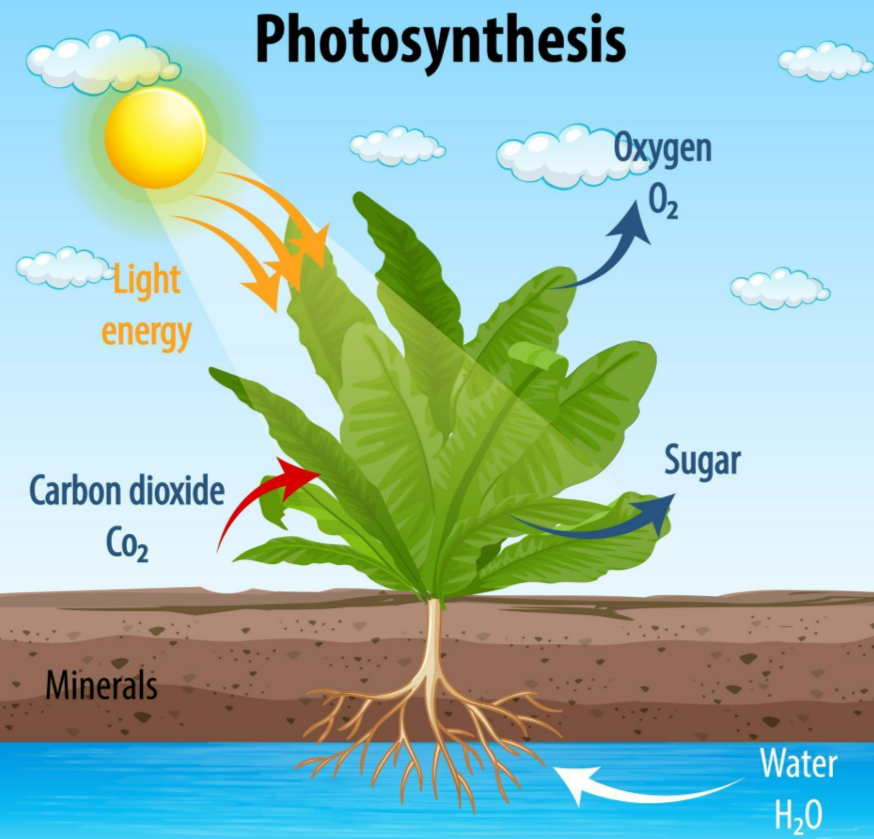
- Happens mainly in leaves.
- Occurs inside chloroplasts (contain chlorophyll).
- Uses carbon dioxide + water + sunlight to produce glucose + oxygen.
Basic equation
CO₂ + H₂O → C₆H₁₂O₆ + O₂
(Sunlight + chlorophyll required)
🍃 Structure of a Leaf (for photosynthesis)
Leaves are adapted to absorb maximum light.
- Broad surface → more light.
- Thin → short diffusion distance.
- Stomata → allow CO₂ entry and O₂ exit.
- Veins → carry water (xylem) and food (phloem).
- Chloroplasts packed in upper layers for light absorption.
🧬 Chloroplast Structure
Chloroplasts contain:
- Thylakoids (flattened membranes)
- Grana (stacks of thylakoids)
- Stroma (fluid filled)
- Chlorophyll pigment embedded in thylakoid membranes
Light reactions occur in grana.
Dark reactions occur in stroma.
🔆 Two Stages of Photosynthesis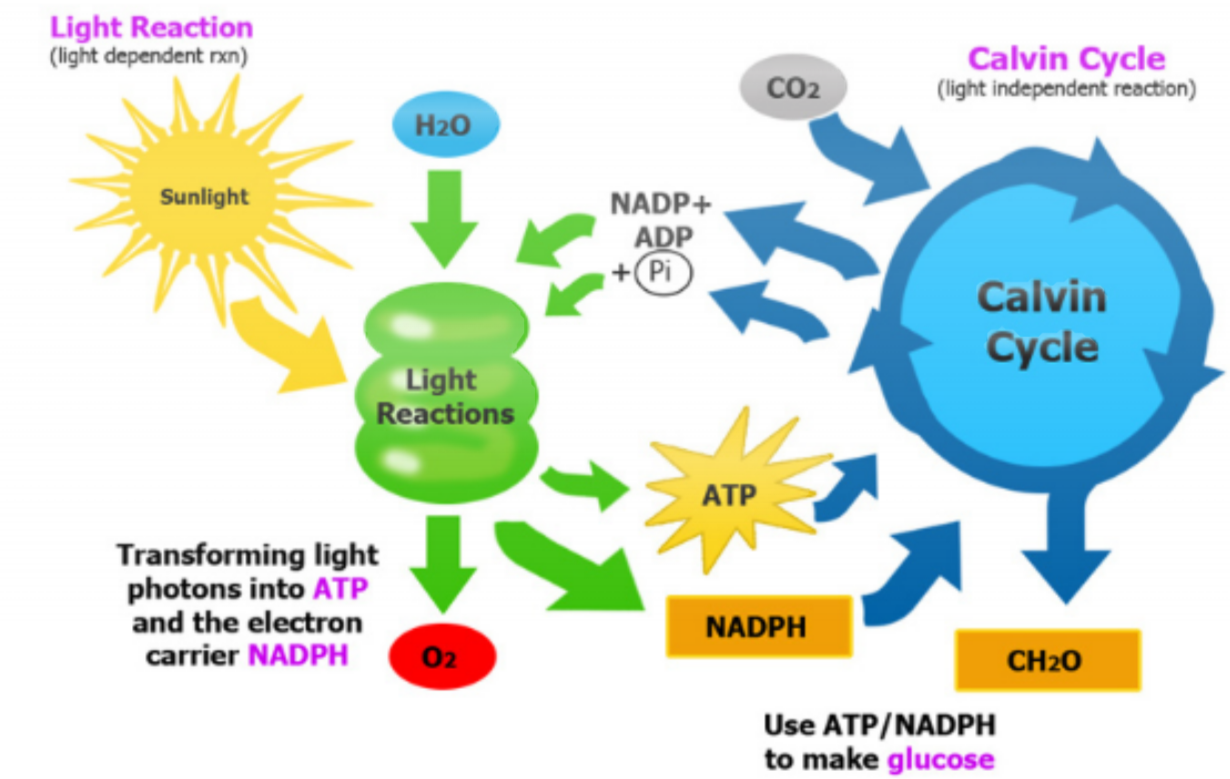
A) Light Dependent Reactions (in Thylakoids)
- Require light.
- Main events:
- Light energy absorbed by chlorophyll
- Water splits (photolysis) → releases O₂
- ATP and NADPH are produced
- These molecules drive the next stage.
Outputs
- Oxygen (waste)
- ATP
- NADPH
B) Light Independent Reactions / Calvin Cycle (in Stroma)
- Do not require light directly.
- Use ATP + NADPH to convert CO₂ → glucose.
Steps:
- CO₂ enters the cycle
- Carbon fixation
- Glucose formation
- Some molecules recycled to restart cycle
💧 Raw Materials for Photosynthesis
- Carbon dioxide
Enters through stomata. Comes from the air. - Water
Absorbed by roots. Transported through xylem. - Light
Sunlight is the natural source. Artificial light also works. - Chlorophyll
Captures light energy. Gives green color to leaves.
🌡️ Factors Affecting Photosynthesis
- Light intensity
Higher light → faster rate until saturation. - Carbon dioxide concentration
More CO₂ → faster rate. Limited in air (0.04 percent). - Temperature
Controlled by enzymes. Very high heat denatures enzymes. - Water
Less water slows photosynthesis and closes stomata.
Importance of Photosynthesis
- Produces oxygen for respiration
- Provides glucose for energy
- Base of food chains
- Removes CO₂ from atmosphere
- Maintains global oxygen carbon balance
Products of Photosynthesis and Their Uses
- Glucose
Used for respiration, stored as starch, forms cellulose, makes proteins and lipids. - Oxygen
Released into air, supports aerobic respiration.
📌 Summary Table
| Feature | Light Dependent | Light Independent |
|---|---|---|
| Location | Grana | Stroma |
| Requires light | Yes | No direct light |
| Inputs | Light, water | CO₂, ATP, NADPH |
| Outputs | O₂, ATP, NADPH | Glucose |
| Main role | Split water, capture energy | Build glucose |
📦 Quick Recap
Photosynthesis makes glucose + oxygen using light.
Happens in chloroplasts.
Two stages:
Light reactions → make oxygen + energy molecules
Calvin cycle → makes glucose
Rate depends on light, CO₂, temperature, water.
Essential for life: provides food and oxygen.