
Structure of the Heart & Blood Vessels
🌟 Introduction
The heart and blood vessels together form the circulatory system.
The heart pumps blood, and the vessels distribute it throughout the body.
Goal: supply oxygen + nutrients and remove wastes.
Structure of the Heart
The heart is a muscular, cone-shaped organ located slightly left of the chest.
Made of cardiac muscle (does not fatigue easily).
A. External Structure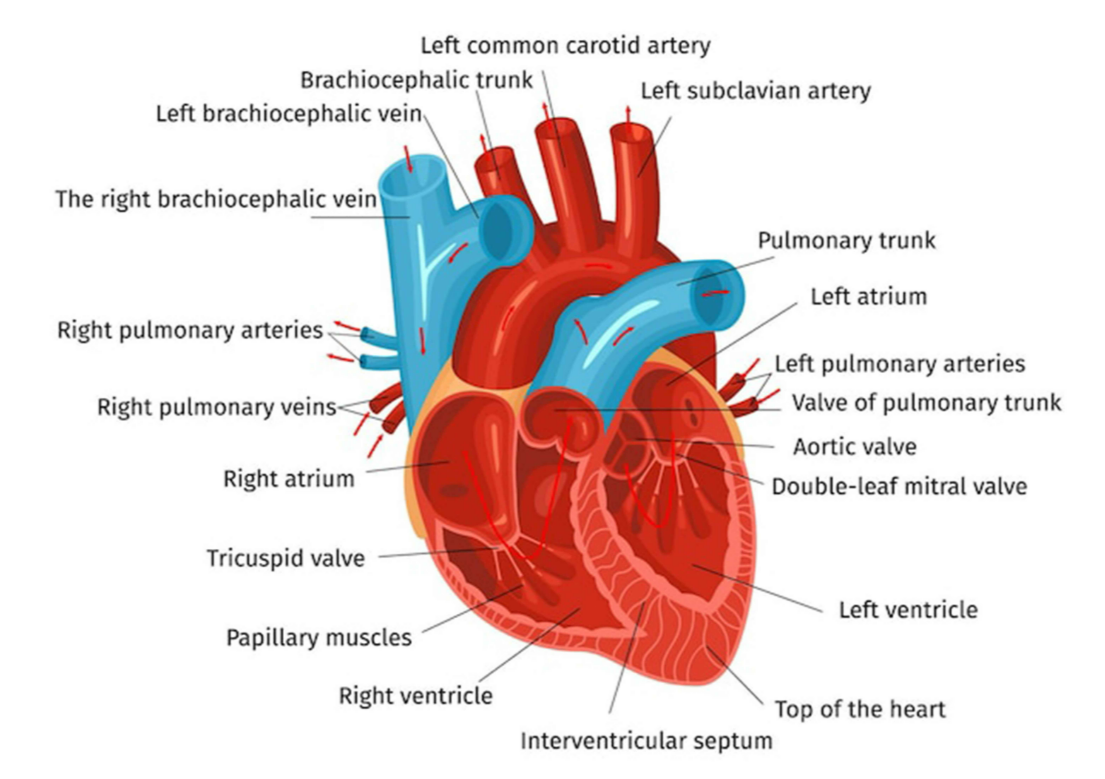
- Protected by pericardium (double-layered membrane).
- Filled with pericardial fluid to reduce friction.
- Has 4 chambers:
- Upper: Right atrium, Left atrium
- Lower: Right ventricle, Left ventricle
- Left ventricle is the thickest because it pumps blood to the whole body.
B. Internal Structure
1. Right Atrium
- Receives deoxygenated blood from the body through:
- Superior vena cava
- Inferior vena cava
2. Right Ventricle
- Pumps deoxygenated blood to the lungs through the pulmonary artery.
- Has the tricuspid valve between right atrium and right ventricle.
3. Left Atrium
- Receives oxygenated blood from the lungs through pulmonary veins (only veins carrying oxygen rich blood).
4. Left Ventricle
- Pumps oxygenated blood to the whole body through the aorta.
- Has the bicuspid (mitral) valve between left atrium and left ventricle.
C. Valves in the Heart
Valves ensure one-way flow and prevent backflow.
Atrioventricular (AV) Valves:
- Tricuspid (right side)
- Bicuspid/Mitral (left side)
Semilunar Valves:
- Pulmonary valve
- Aortic valve
D. Double Circulation
Pulmonary circulation:
Heart → Lungs → Heart
(Blood becomes oxygenated)
Systemic circulation:
Heart → Body → Heart
(Delivers oxygen, picks up wastes)
– Ensures efficient oxygen supply.
– Maintains high pressure.
Blood Vessels
Three major types: arteries, veins, capillaries.
Arteries
- Carry blood away from the heart.
- Usually carry oxygenated blood (except pulmonary artery).
- Thick, elastic walls to handle high pressure.
- Narrow lumen.
Function: Transport blood under high pressure.
Veins
- Carry blood toward the heart.
- Usually carry deoxygenated blood (except pulmonary vein).
- Thin walls, large lumen.
- Have valves to prevent backflow (pressure is low).
Function: Return blood to the heart at low pressure.
Capillaries
- Smallest, one-cell-thick vessels.
- Connect arteries and veins.
- Allow exchange of gases, nutrients, wastes.
Function: Diffusion between blood and tissues.
📋 Summary Table
| Feature | Arteries | Veins | Capillaries |
|---|---|---|---|
| Direction | Away from heart | Towards heart | Connect A & V |
| Oxygen Level | Mostly oxygenated | Mostly deoxygenated | Mixed exchange |
| Wall Thickness | Thick, elastic | Thin | One-cell thick |
| Valves | No | Yes | No |
| Pressure | High | Low | Very low |
| Lumen | Narrow | Wide | Very narrow |
🧠 Quick Recap
Heart has 4 chambers: RA, RV, LA, LV.
Left ventricle = strongest (thickest wall).
Valves: tricuspid (right), bicuspid (left), plus 2 semilunar.
Pulmonary artery is the only artery with deoxygenated blood.
Pulmonary vein is the only vein with oxygenated blood.
Arteries = thick walls, no valves.
Veins = thin walls, have valves.
Capillaries = one-cell thick, exchange happens here.