
Variation, Natural Selection & Adaptation
Variation
Variation means differences that exist among individuals of the same species. Without variation, evolution cannot occur because natural selection needs differences to act upon.
🧬 Why Variation Occurs
Variation arises from both genetic factors and environmental influences.
Genetic (Inherited) Variation
Comes from DNA differences and is passed from parents to offspring.
- Sources of Genetic Variation:
- Mutations: Random changes in DNA; May create new alleles (Example: mutation causing sickle-cell hemoglobin).
- Meiosis: Crossing over creates new allele combinations; Independent assortment mixes chromosomes; Random orientation of homologous pairs.
- Fertilization: Random fusion of gametes; Each sperm and egg is genetically unique.
- Examples: Blood group (A, B, AB, O), Eye color, Height (partly genetic), Ability to roll tongue.
Environmental Variation
Caused by surroundings and lifestyle.
- Examples: Body weight and nutrition, Muscle mass from exercise, Skin tone from sunlight, Speaking accent, Leaf size in plants depending on sunlight/water.
Combined Variation
Both genes and environment shape the trait.
- Examples: Height (genes + diet), Intelligence (genes + education), Skin color (genes + tanning).
🌿 Natural Selection
Natural selection is the process by which individuals with advantageous traits survive and reproduce more successfully.
Why It Happens
- Populations produce more offspring than can survive.
- There is constant competition for resources.
- Individuals vary in traits.
- Those with better adaptations live longer and reproduce more; Their alleles become more common.
Steps of Natural Selection (Exam-friendly sequence)
- Variation exists: Individuals differ in size, strength, color, resistance, etc.
- Struggle for survival: Limited food, space, mates, predators, disease pressure.
- Survival of the fittest: Individuals with beneficial traits survive better. (“Fittest” means best suited, not strongest).
- Successful reproduction: Those that survive are more likely to reproduce.
- Inheritance of advantageous traits: Beneficial alleles pass to offspring.
- Evolution over generations: Trait becomes more common; Population becomes better adapted.
Classic Example: Peppered Moth
- Light moths common before Industrial Revolution.
- Pollution darkened tree bark.
- Birds preyed on light moths.
- Dark moths survived and reproduced.
- Dark phenotype increased (This is directional selection).
🧠 Adaptation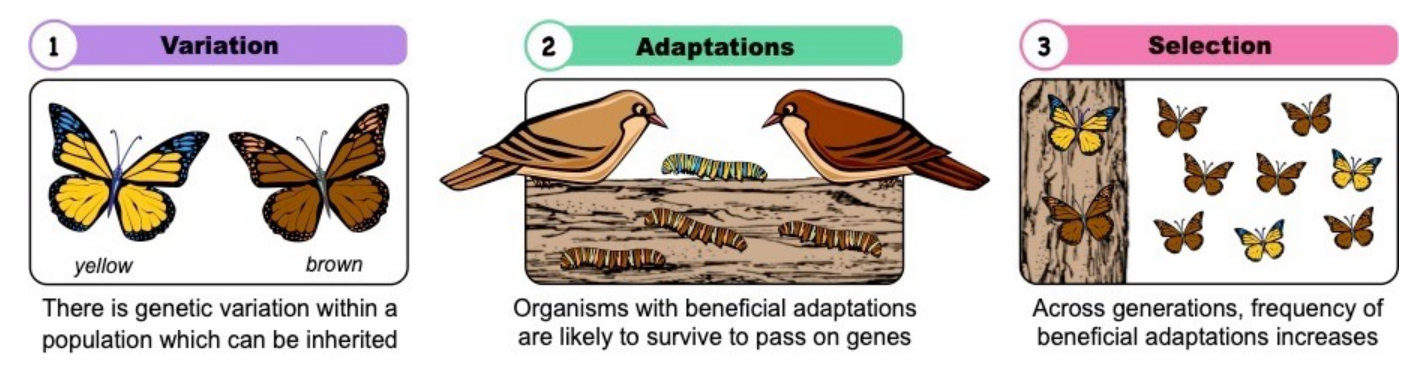
Adaptations are inherited characteristics that help organisms survive and reproduce.
Why adaptations evolve: Through many generations of natural selection acting on variation.
Types of Adaptations
- A. Structural Adaptations (physical features): Thick fur in polar bears, Webbed feet in ducks, Cacti spines instead of leaves, Long roots in desert plants.
- B. Behavioral Adaptations (actions): Migration in birds, Hibernation in mammals, Courtship dances in birds, Nocturnal activity in desert animals.
- C. Physiological Adaptations (internal processes): Snake venom production, Ability of kangaroo rats to conserve water, Sweating to regulate temperature, CAM photosynthesis in cacti.
🌍 Relationship Between Variation, Natural Selection & Adaptation
Variation → Selection → Adaptation
- Variation provides different traits.
- Natural selection favors useful traits.
- Adaptation occurs when these traits become common in the population.
Example: Some bacteria have mutation for antibiotic resistance. They survive antibiotic exposure, reproduce, and pass the resistance. Over generations, population becomes antibiotic-resistant. This is evolution in real time.
Types of Selection
- 1. Stabilizing Selection: Favors average phenotype (Example: human birth weight).
- 2. Directional Selection: Pushes toward one extreme phenotype (Example: antibiotic resistance).
- 3. Disruptive Selection: Favors both extremes; Can lead to speciation (Example: bird beak size extremes favored depending on food type).
Importance of Natural Selection
- Explains evolutionary change.
- Helps develop medicines and vaccines.
- Foundation of genetics + evolution.
- Predicts how species respond to environmental change.
- Key for conservation biology.
📋 Summary Table
| Topic | Key Idea | Summary |
|---|---|---|
| Variation | Differences within species | Genetic + environmental |
| Natural Selection | Better adapted survive | Leads to evolution |
| Adaptation | Inherited survival traits | Structural, behavioral, physiological |
| Evolution | Population changes over time | Driven by selection on variation |
| Selection Types | Stabilizing, directional, disruptive | Shape populations differently |
📦 Quick Recap
• Variation gives the raw material for evolution.
• Natural selection chooses the most useful variations.
• Adaptations are traits that help survival.
• These traits increase in frequency across generations.
• Natural selection leads to evolution.