
Static Charge (Positive & Negative)
Definition
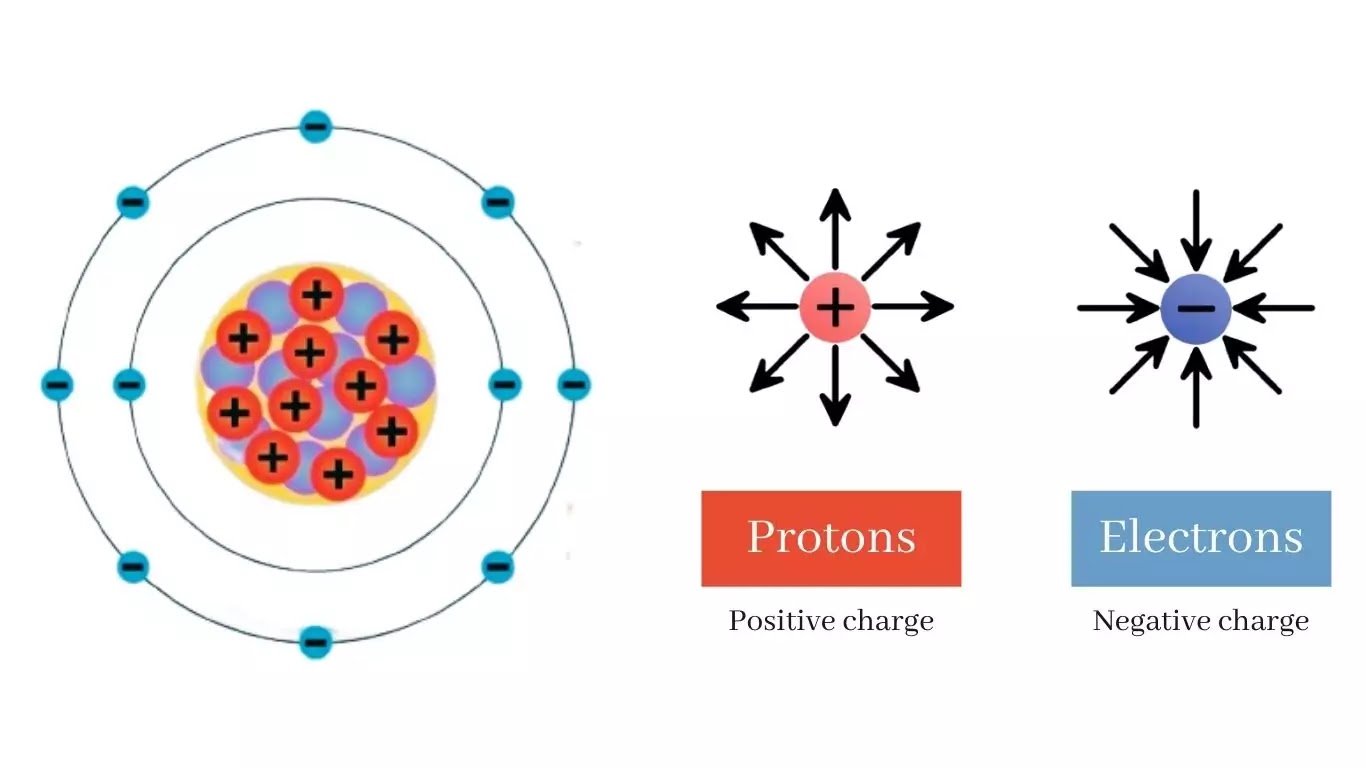
Static charge is the build-up of electric charge on the surface of an object due to the gain or loss of electrons.
Key Concepts
- There are two types of charges:
- Positive charge → loss of electrons
- Negative charge → gain of electrons
- Like charges repel and unlike charges attract
- Only electrons move (protons remain fixed in the nucleus)
- Charge is measured in coulombs (C)
- Charge is conserved (cannot be created or destroyed)
Interaction of Charges
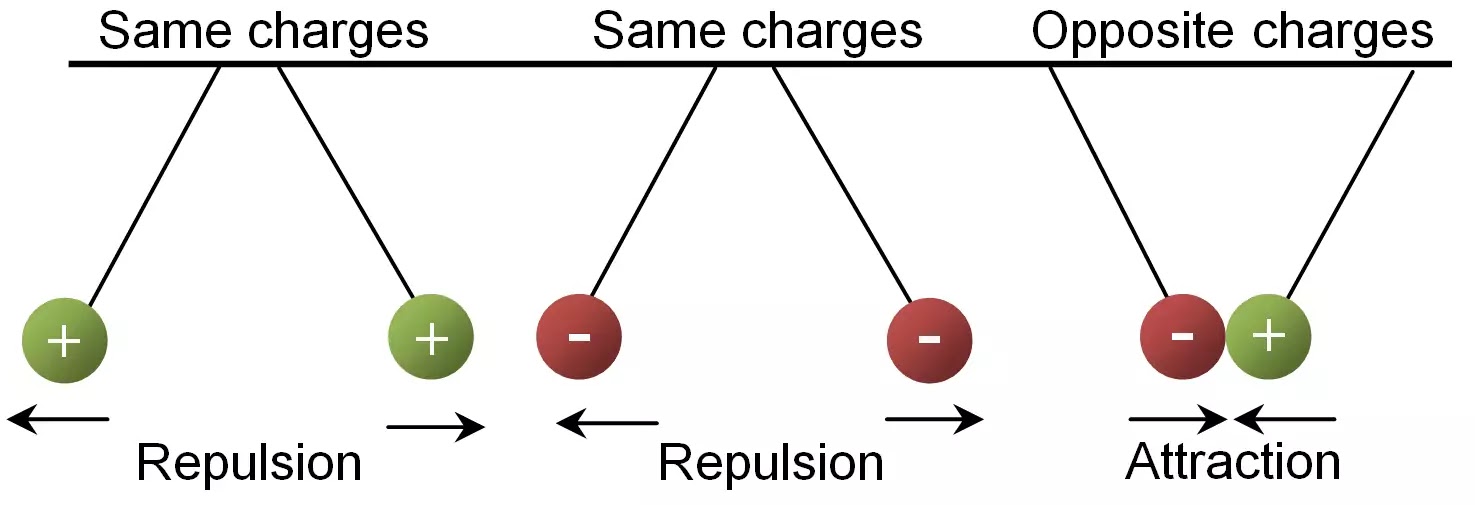
- Positive + Positive → Repel
- Negative + Negative → Repel
- Positive + Negative → Attract
Example:
A rod loses electrons. What type of charge does it become?
▶️ Answer/Explanation
Losing electrons means fewer negative charges.
This results in a net positive charge.
Final Answer: \( \boxed{\text{Positive charge}} \)
Example:
Two negatively charged objects are brought close together. What happens?
▶️ Answer/Explanation
Like charges repel each other.
Final Answer: \( \boxed{\text{They repel}} \)
Charging Methods (Friction and Induction)
Charging by Friction
Definition
Charging by friction occurs when two objects are rubbed together, causing electrons to transfer from one object to another.

Key Concepts
- Electrons move from one material to another
- One object becomes positively charged, the other negatively charged
- Common example: rubbing a balloon on hair
- Works best with insulating materials
Example:
When a balloon is rubbed on dry hair, it sticks to a wall. Why?
▶️ Answer/Explanation
Electrons transfer from hair to the balloon.
The balloon becomes negatively charged.
It attracts the neutral wall due to induced charges.
Final Answer: \( \boxed{\text{Electrostatic attraction due to charge transfer}} \)
Example:
A glass rod is rubbed with silk. What charges do they acquire?
▶️ Answer/Explanation
Electrons transfer from glass to silk.
Glass loses electrons → positive.
Silk gains electrons → negative.
Final Answer: \( \boxed{\text{Glass: positive, Silk: negative}} \)
Charging by Induction
Definition
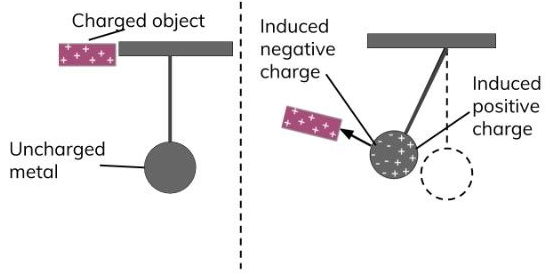
Charging by induction is the process of charging an object without direct contact, using the influence of a nearby charged object.
Key Concepts
- No physical contact is required
- Charges rearrange within the object due to a nearby charged body
- Often involves grounding to transfer charge
- Final charge is opposite to the inducing charge
Example:
A negatively charged rod is brought near a neutral metal sphere. What happens inside the sphere?
▶️ Answer/Explanation
Electrons in the sphere are repelled away from the rod.
This causes charge separation inside the sphere.
Final Answer: \( \boxed{\text{Charge separation occurs}} \)
Example:
After grounding during induction, what type of charge does the object acquire?
▶️ Answer/Explanation
The object gains charge opposite to the inducing object.
Final Answer: \( \boxed{\text{Opposite charge}} \)
Electric Current
Definition
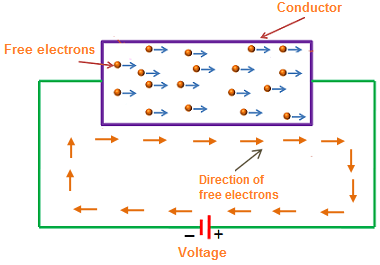
Electric current is the rate of flow of electric charge through a conductor.
Formula
\( I = \dfrac{Q}{t} \)
- \( I \) = current (amperes, A)
- \( Q \) = charge (coulombs, C)
- \( t \) = time (seconds, s)
Key Concepts
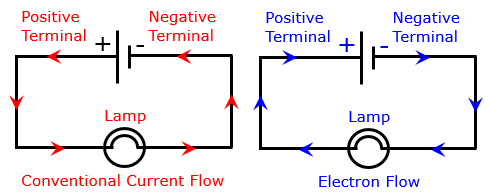
- Current is caused by the movement of electrons in a conductor
- Conventional current flows from positive → negative
- Electron flow is from negative → positive
- Current requires a closed circuit to flow
- Measured using an ammeter (connected in series)
Flow of Current
Example:
Calculate the current if 10 C of charge flows in 2 seconds.
▶️ Answer/Explanation
Using \( I = \dfrac{Q}{t} \)
\( I = \dfrac{10}{2} = 5 \, \text{A} \)
Final Answer: \( \boxed{5 \, \text{A}} \)
Example:
Why does current stop when a switch is opened?
▶️ Answer/Explanation
An open switch breaks the circuit.
Without a closed path, charges cannot flow.
Final Answer: \( \boxed{\text{Circuit is incomplete, so no current flows}} \)
Basic Circuit Components
Definition
Basic circuit components are the essential parts required to build an electric circuit and allow current to flow.
Key Components
| Component | Function | Symbol |
|---|---|---|
| Cell | Provides electrical energy | 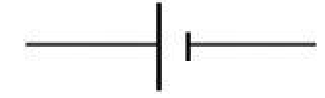 |
| Battery | Multiple cells combined | 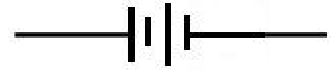 |
| Wire | Conducts current |  |
| Switch | Opens/closes circuit |  |
| Bulb (Lamp) | Produces light | 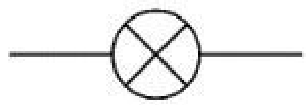 |
| Resistor | Limits current | 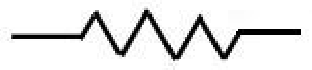 |
| Ammeter | Measures current | 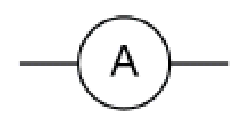 |
| Voltmeter | Measures voltage | 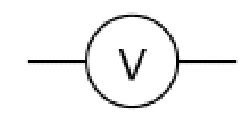 |
Circuit Diagram Example
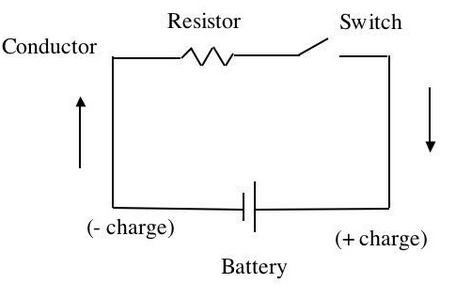
- A complete circuit must form a closed loop
- Components are connected using wires
- Switch controls the flow of current
Example:
Which device is used to measure current and how is it connected?
▶️ Answer/Explanation
An ammeter is used to measure current.
It is connected in series so that current flows through it.
Final Answer: \( \boxed{\text{Ammeter in series}} \)
Example:
Why does a bulb not glow in an open circuit?
▶️ Answer/Explanation
An open circuit breaks the path.
No current flows, so the bulb does not receive energy.
Final Answer: \( \boxed{\text{No current flows in open circuit}} \)
Series vs Parallel Circuits
Series Circuits
Definition
A series circuit is a circuit in which components are connected in a single path, so the same current flows through all components.

Key Concepts
- Only one path for current
- Same current flows through all components
- Voltage is shared between components
- If one component fails, the entire circuit stops working
- Total resistance increases when more components are added
Formula
\( R_{\text{total}} = R_1 + R_2 + R_3 \)
Example:
What happens to the brightness of bulbs when more bulbs are added in series?
▶️ Answer/Explanation
Total resistance increases.
Current decreases, so bulbs become dimmer.
Final Answer: \( \boxed{\text{Brightness decreases}} \)
Example:
Calculate total resistance if two resistors of 2 Ω and 3 Ω are connected in series.
▶️ Answer/Explanation
\( R_{\text{total}} = 2 + 3 = 5 \, \Omega \)
Final Answer: \( \boxed{5 \, \Omega} \)
Parallel Circuits
Definition
A parallel circuit is a circuit in which components are connected across multiple paths, so each component has the same voltage across it.

Key Concepts
- Multiple paths for current
- Voltage is the same across all components
- Current is divided between branches
- If one component fails, others continue to work
- Total resistance decreases when more components are added
Parallel Circuit Diagram
Formula
\( \dfrac{1}{R_{\text{total}}} = \dfrac{1}{R_1} + \dfrac{1}{R_2} + \dfrac{1}{R_3} \)
Comparison of Series and Parallel Circuits
| Feature | Series Circuit | Parallel Circuit |
|---|---|---|
| Path | Single path | Multiple paths |
| Current | Same everywhere | Splits between branches |
| Voltage | Shared | Same across each branch |
| Failure | Whole circuit stops | Others keep working |
| Resistance | Increases | Decreases |
Example:
Why do household appliances work independently in parallel circuits?
▶️ Answer/Explanation
Each appliance has its own path.
If one stops, others are unaffected.
Final Answer: \( \boxed{\text{Independent paths allow separate operation}} \)
Example:
Calculate total resistance for two resistors of 6 Ω and 3 Ω in parallel.
▶️ Answer/Explanation
\( \dfrac{1}{R} = \dfrac{1}{6} + \dfrac{1}{3} = \dfrac{1}{6} + \dfrac{2}{6} = \dfrac{3}{6} \)
\( R = 2 \, \Omega \)
Final Answer: \( \boxed{2 \, \Omega} \)