
Cells and Batteries
Definition
A cell is a device that converts chemical energy into electrical energy to provide a potential difference in a circuit. A battery is a combination of two or more cells connected together.
Key Concepts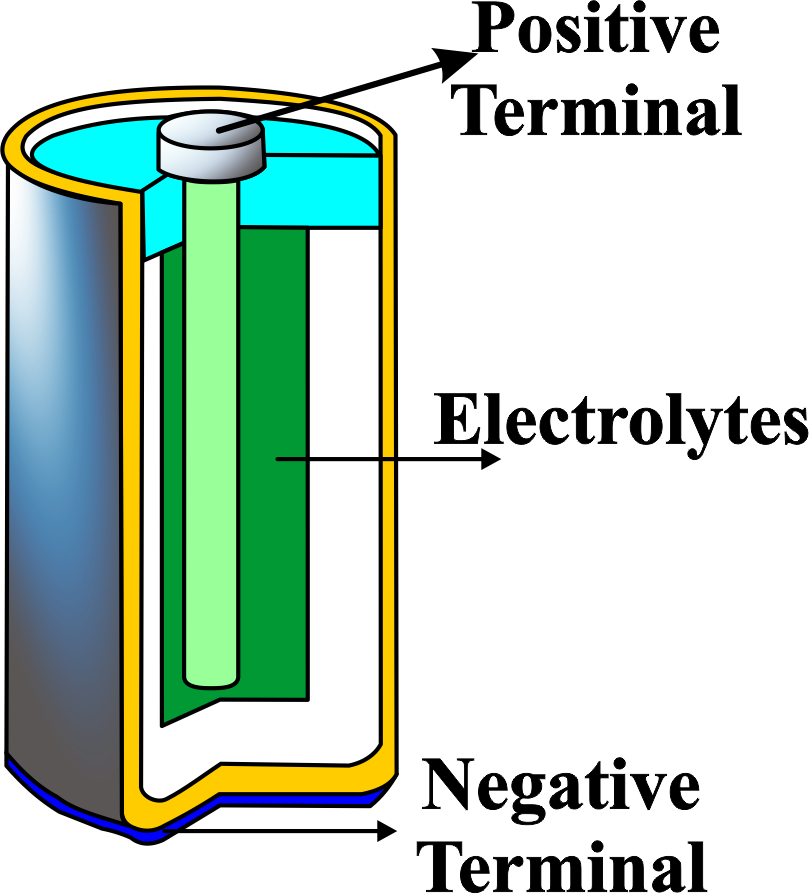
- A cell provides the energy source for a circuit
- It creates a potential difference (voltage) that drives current
- A battery consists of multiple cells connected together
- Chemical reactions inside the cell cause electrons to flow
- Cells have two terminals:
- Positive terminal (+)
- Negative terminal (−)
Cell Symbol and Structure
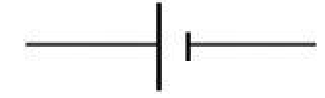
- Long line represents positive terminal
- Short line represents negative terminal
Cells vs Batteries
| Feature | Cell | Battery |
|---|---|---|
| Definition | Single unit | Multiple cells |
| Voltage | Lower | Higher |
| Usage | Small devices | Larger devices |
Connecting Cells
Cells in Series
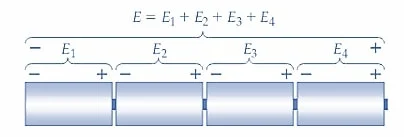
- Voltages add up
- Used when higher voltage is needed
Formula
\( V_{\text{total}} = V_1 + V_2 + V_3 \)
Cells in Parallel
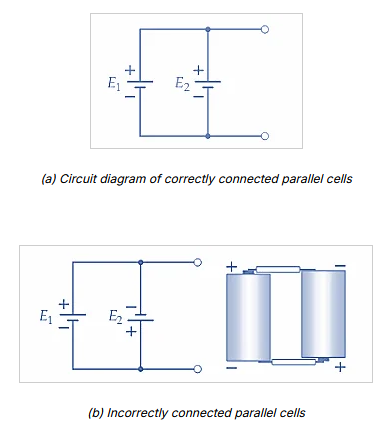
- Voltage remains the same
- Increases the duration (battery life)
Formula
\( V_{\text{total}} = V \)
Example:
Three cells of 1.5 V each are connected in series. What is the total voltage?
▶️ Answer/Explanation
\( V_{\text{total}} = 1.5 + 1.5 + 1.5 = 4.5 \, \text{V} \)
Final Answer: \( \boxed{4.5 \, \text{V}} \)
Example:
Why are cells connected in parallel in some devices?
▶️ Answer/Explanation
Parallel connection keeps voltage the same.
It increases battery life (more charge available).
Final Answer: \( \boxed{\text{To increase battery life}} \)
AC vs DC (Basic Idea)
Definition
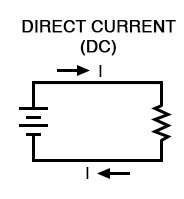
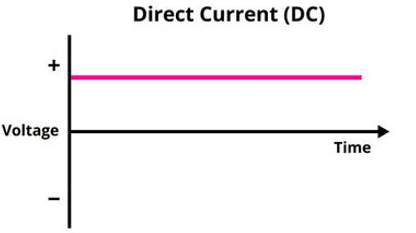
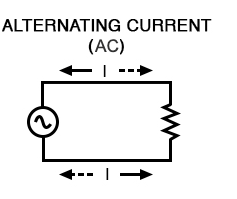
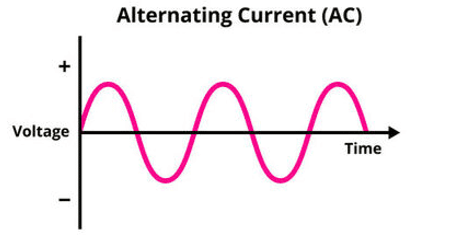
Electric current can flow in two ways: Direct Current (DC), where the current flows in one direction, and Alternating Current (AC), where the current changes direction periodically.
Direct Current (DC)
Key Concepts
- Current flows in one direction only
- Voltage is constant (does not change with time)
- Produced by cells and batteries
- Used in electronic devices like phones, laptops
Example:
Why do mobile phones use DC instead of AC?
▶️ Answer/Explanation
Electronic circuits require a steady and constant voltage.
DC provides a stable supply.
Final Answer: \( \boxed{\text{DC provides constant voltage}} \)
Example:
A battery provides 6 V. What type of current is this?
▶️ Answer/Explanation
Batteries supply current in one direction.
Final Answer: \( \boxed{\text{Direct Current (DC)}} \)
Alternating Current (AC)
Key Concepts
- Current changes direction periodically
- Voltage also changes with time
- Supplied by power stations
- Used in household electricity supply
Graph
Comparison of AC and DC
| Feature | DC | AC |
|---|---|---|
| Direction | One direction | Changes direction |
| Voltage | Constant | Varies with time |
| Source | Batteries | Power stations |
| Use | Electronics | Homes, industries |
Frequency
\( f = \dfrac{1}{T} \)
- \( f \) = frequency (Hz)
- \( T \) = time period (s)
Example:
Why is AC used for household electricity instead of DC?
▶️ Answer/Explanation
AC can be easily transformed to different voltages using transformers.
This makes transmission efficient.
Final Answer: \( \boxed{\text{AC is easier to transmit and transform}} \)
Example:
If the time period of AC is 0.02 s, find its frequency.
▶️ Answer/Explanation
\( f = \dfrac{1}{T} = \dfrac{1}{0.02} = 50 \, \text{Hz} \)
Final Answer: \( \boxed{50 \, \text{Hz}} \)
Transformers (Step-up & Step-down)
Definition
A transformer is a device that changes the voltage of alternating current (AC) using electromagnetic induction.
Key Concepts
- Works only with AC (Alternating Current)
- Consists of two coils:
- Primary coil (input)
- Secondary coil (output)
- Coils are wound around a soft iron core
- Changing current in primary coil creates a changing magnetic field
- This induces voltage in the secondary coil
Transformer Structure
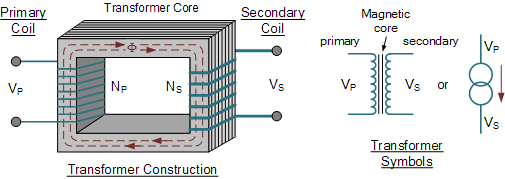
- Primary coil connected to AC supply
- Secondary coil connected to output circuit
- Iron core increases efficiency of magnetic field transfer
Transformer Equation
\( \dfrac{V_s}{V_p} = \dfrac{N_s}{N_p} \)
- \( V_s \) = secondary voltage
- \( V_p \) = primary voltage
- \( N_s \) = number of turns in secondary coil
- \( N_p \) = number of turns in primary coil
Step-Up Transformer
Definition
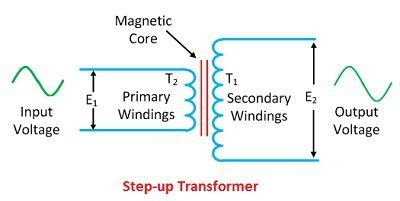
A step-up transformer increases the voltage from primary to secondary coil.
Key Concepts
- \( V_s > V_p \)
- \( N_s > N_p \)
- Used to increase voltage for transmission
Example:
A transformer has 100 turns in the primary coil and 500 turns in the secondary coil. If the input voltage is 20 V, find the output voltage.
▶️ Answer/Explanation
\( \dfrac{V_s}{20} = \dfrac{500}{100} = 5 \)
\( V_s = 20 \times 5 = 100 \, \text{V} \)
Final Answer: \( \boxed{100 \, \text{V}} \)
Example:
Why are step-up transformers used in power transmission?
▶️ Answer/Explanation
Higher voltage means lower current for the same power.
This reduces energy loss in wires.
Final Answer: \( \boxed{\text{To reduce power loss during transmission}} \)
Step-Down Transformer
Definition
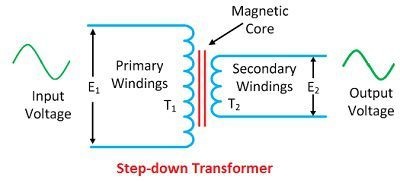
A step-down transformer decreases the voltage from primary to secondary coil.
Key Concepts
- \( V_s < V_p \)
- \( N_s < N_p \)
- Used in household appliances
Comparison of Step-Up and Step-Down Transformers
| Feature | Step-Up | Step-Down |
|---|---|---|
| Voltage | Increases | Decreases |
| Turns | \( N_s > N_p \) | \( N_s < N_p \) |
| Use | Power transmission | Home appliances |
Example:
A transformer reduces voltage from 240 V to 12 V. What type of transformer is this?
▶️ Answer/Explanation
Voltage decreases from input to output.
Final Answer: \( \boxed{\text{Step-down transformer}} \)
Example:
A transformer has 200 turns in the primary coil and 50 turns in the secondary coil. If input voltage is 120 V, find output voltage.
▶️ Answer/Explanation
\( \dfrac{V_s}{120} = \dfrac{50}{200} = \dfrac{1}{4} \)
\( V_s = 120 \times \dfrac{1}{4} = 30 \, \text{V} \)
Final Answer: \( \boxed{30 \, \text{V}} \)
Power Transmission (Basics)
Definition
Power transmission is the process of transferring electrical energy from power stations to homes and industries through transmission lines.

Key Concepts
- Electricity is generated at power stations and transmitted over long distances
- Energy is lost as heat in wires due to resistance
- This loss is called power loss
- To reduce losses, electricity is transmitted at high voltage and low current
Power and Power Loss
\( P = VI \)
\( P_{\text{loss}} = I^2 R \)
- \( P \) = power (watts, W)
- \( V \) = voltage (volts, V)
- \( I \) = current (amperes, A)
- \( R \) = resistance (ohms, Ω)
Why High Voltage is Used
- From \( P = VI \), for the same power:
- Increasing voltage → decreases current
- From \( P_{\text{loss}} = I^2 R \):
- Lower current → much lower energy loss
- This makes transmission more efficient
Transmission Process
- Electricity is generated at power stations
- A step-up transformer increases voltage
- Electricity travels through transmission lines
- A step-down transformer reduces voltage for safe use
Example:
Why is electrical energy transmitted at high voltage instead of low voltage?
▶️ Answer/Explanation
High voltage reduces current for the same power.
Lower current reduces heat loss in wires.
Final Answer: \( \boxed{\text{To reduce power loss}} \)
Example:
If current in a transmission line is reduced by half, what happens to power loss?
▶️ Answer/Explanation
\( P_{\text{loss}} = I^2 R \)
If current becomes \( \dfrac{1}{2}I \):
\( P_{\text{loss}} = \left(\dfrac{1}{2}I\right)^2 R = \dfrac{1}{4} I^2 R \)
Final Answer: \( \boxed{\text{Power loss becomes one-fourth}} \)