
Types of Waves (Transverse & Longitudinal)
A wave is a disturbance that transfers energy from one place to another without transferring matter.
Transverse Waves
Definition
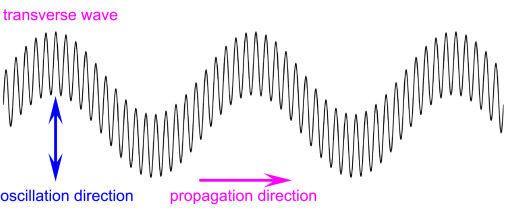
A transverse wave is a wave in which the particles vibrate perpendicular to the direction of wave propagation.
Key Concepts
- Particles move up and down while the wave moves forward
- Contains crests (highest points) and troughs (lowest points)
- Energy transfer is perpendicular to particle motion
- Can travel through solids and on surfaces of liquids
Examples
- Light waves (electromagnetic waves)
- Water waves
- Waves on a rope
Example:
In a wave, particles move up and down while the wave moves horizontally. What type of wave is this?
▶️ Answer/Explanation
Particle motion is perpendicular to wave direction.
Final Answer: \( \boxed{\text{Transverse wave}} \)
Example:
Name two features of transverse waves.
▶️ Answer/Explanation
They have crests and troughs.
Final Answer: \( \boxed{\text{Crests and troughs}} \)
Longitudinal Waves
Definition
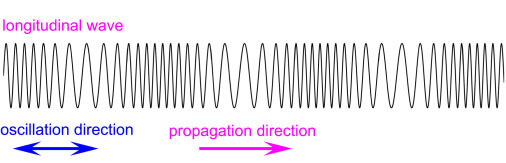
A longitudinal wave is a wave in which the particles vibrate parallel to the direction of wave propagation.
Key Concepts
- Particles move back and forth in the same direction as the wave

- Contains:
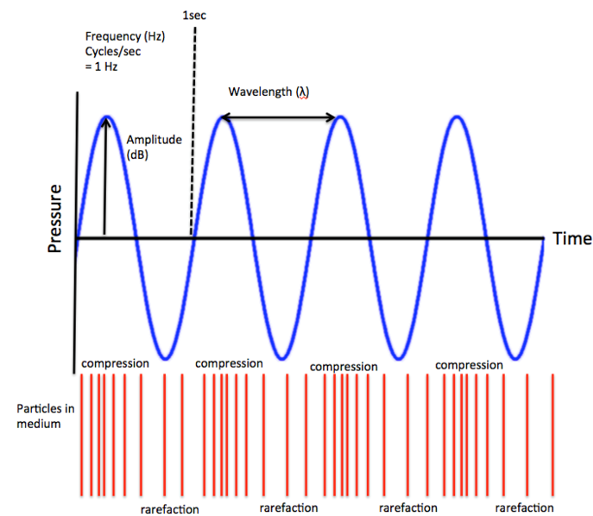
- Compressions (high pressure regions)
- Rarefactions (low pressure regions)
- Energy transfer is parallel to particle motion
- Can travel through solids, liquids, and gases
Examples
- Sound waves
- Compression waves in springs
Comparison of Transverse and Longitudinal Waves
| Feature | Transverse | Longitudinal |
|---|---|---|
| Particle Motion | Perpendicular | Parallel |
| Features | Crests & Troughs | Compressions & Rarefactions |
| Medium | Solids / surface | All media |
Example:
In a wave, particles move back and forth in the same direction as the wave. Identify the type of wave.
▶️ Answer/Explanation
Particle motion is parallel to wave direction.
Final Answer: \( \boxed{\text{Longitudinal wave}} \)
Example:
What are compressions and rarefactions?
▶️ Answer/Explanation
Compressions are regions of high pressure.
Rarefactions are regions of low pressure.
Final Answer: \( \boxed{\text{High and low pressure regions}} \)