
Magnetic Materials
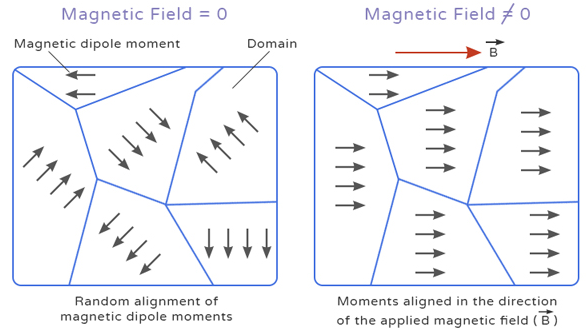
Magnetic materials are substances that can be attracted by a magnet and can be magnetized due to the alignment of magnetic domains within them.
Key Concepts
- Magnetism is caused by the alignment of tiny regions called magnetic domains
- Only certain materials show strong magnetic behavior (ferromagnetic materials)
- Magnetic properties depend on the internal structure of the material
Types of Magnetic Materials
Ferromagnetic Materials Definition : Materials that are strongly attracted to magnets and can be permanently magnetized.
| Non-Magnetic Materials Definition : Materials that are not attracted to magnets and cannot be magnetized.
|

Permanent vs Induced Magnets
Magnets can be classified based on how they gain and retain magnetism.
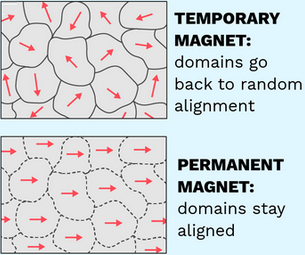
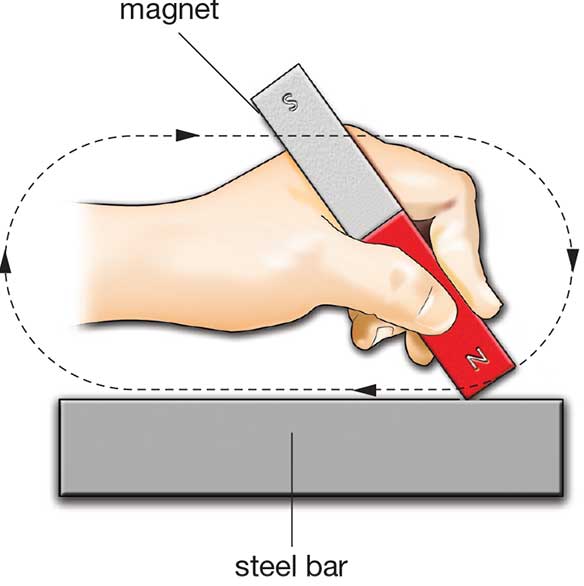
Permanent Magnets Definition : Magnets that produce their own magnetic field and retain magnetism for a long time.
| Induced Magnets Definition : Materials that become magnetized only when placed in an external magnetic field.
|
Comparison of Permanent and Induced Magnets
| Property | Permanent Magnet | Induced Magnet |
|---|---|---|
| Magnetism | Permanent | Temporary |
| External Field Needed | No | Yes |
| Retention | Retains magnetism | Loses magnetism quickly |
| Strength | Strong | Weak |
Key Takeaways
- Magnetic materials work due to domain alignment
- Ferromagnetic materials are strongly magnetic
- Permanent magnets retain magnetism without external fields
- Induced magnets are temporary and depend on external fields
Example:
Why is iron used for temporary magnets while steel is used for permanent magnets?
▶️ Answer/Explanation
Iron is easily magnetized and demagnetized, so it is suitable for temporary magnets.
Steel retains magnetism for a long time, so it is used for permanent magnets.
Final Answer: \( \boxed{\text{Iron → temporary, Steel → permanent}} \)
Example:
A paperclip sticks to a magnet but falls off when the magnet is removed. What type of magnetism is this?
▶️ Answer/Explanation
The paperclip becomes magnetized only in the presence of the magnet.
This is induced magnetism.
Final Answer: \( \boxed{\text{Induced magnetism}} \)
Magnetic Field Lines
Definition
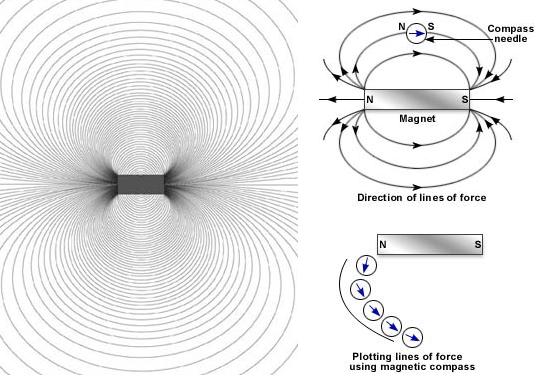
Magnetic field lines are imaginary lines used to represent the direction and strength of a magnetic field around a magnet.
Key Concepts
- Magnetic field lines show the direction of the magnetic force
- Outside a magnet, field lines go from North → South
- Inside the magnet, they go from South → North (forming closed loops)
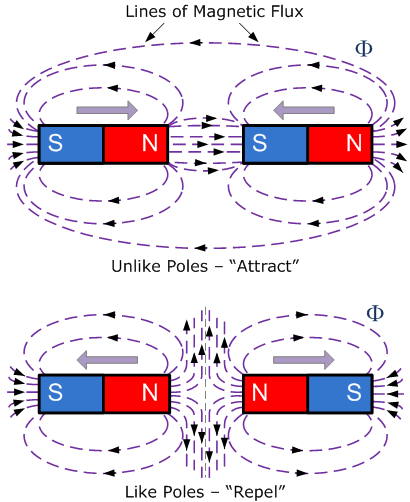
- Field lines never cross each other
- The closer the lines, the stronger the magnetic field
- Magnetic field is strongest at the poles
Magnetic Field Line Patterns
- Field lines form continuous closed loops
- They are densest near the poles, showing stronger magnetic field
- Iron filings can be used to visualize these patterns experimentally
Properties of Magnetic Field Lines
- Always form closed loops
- Never intersect each other
- Direction is given by the tangent to the field line
- Spacing indicates field strength
Example:
Why are magnetic field lines closer together near the poles of a magnet?
▶️ Answer/Explanation
Closer spacing indicates stronger magnetic field.
The poles are the regions where magnetic forces are strongest.
Final Answer: \( \boxed{\text{Field is strongest at the poles}} \)
Earth’s Magnetic Field
Definition
Earth’s magnetic field is the region around the Earth where magnetic forces can be detected, behaving like a giant bar magnet.

Key Concepts
- Earth acts like a giant magnet with North and South magnetic poles
- The magnetic field is generated by molten iron moving in Earth’s core
- A compass aligns with Earth’s magnetic field
- The magnetic poles are not exactly the same as geographic poles
Earth’s Magnetic Field Structure
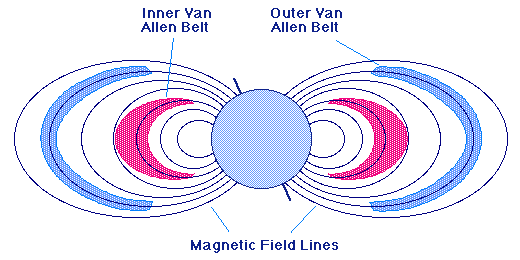
- Field lines emerge near the geographic South and enter near the geographic North
- The field forms a protective region called the magnetosphere
- It protects Earth from harmful solar radiation
Applications
- Navigation using compasses
- Protection from solar winds
- Animal migration (birds use Earth’s magnetic field)
Example:
Why does a compass needle point towards the North?
▶️ Answer/Explanation
The compass needle aligns with Earth’s magnetic field.
The north-seeking end of the needle is attracted to Earth’s magnetic south pole near the geographic North.
Final Answer: \( \boxed{\text{Compass aligns with Earth’s magnetic field}} \)
Magnetic Fields Around Wires and Coils
Magnetic Field Around a Current-Carrying Wire
Definition
When an electric current flows through a wire, it produces a magnetic field around the wire.
Key Concepts
- A current-carrying conductor creates a magnetic field
- The field lines form concentric circles around the wire
- The strength of the field increases with:
- Increase in current
- Decrease in distance from the wire
Magnetic Field Pattern Around a Straight Wire
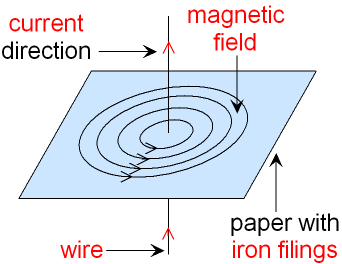
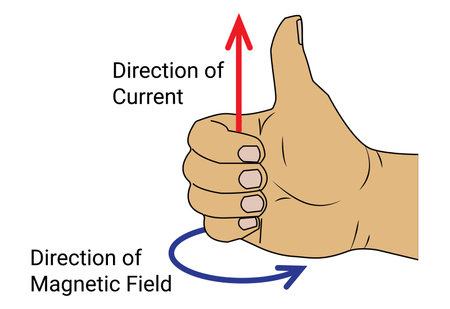
Right-Hand Grip Rule
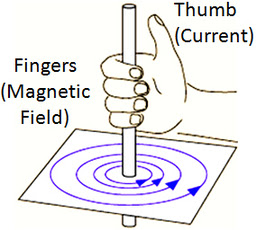
- Thumb points in the direction of current
- Fingers curl in the direction of magnetic field lines
Example:
If current flows upward in a vertical wire, what is the direction of the magnetic field?
▶️ Answer/Explanation
Using the right-hand grip rule, thumb points upward (current direction).
Fingers curl around the wire showing the field direction.
Final Answer: \( \boxed{\text{Magnetic field forms anticlockwise circles (top view)}} \)
Magnetic Field Around a Coil (Solenoid)
Definition
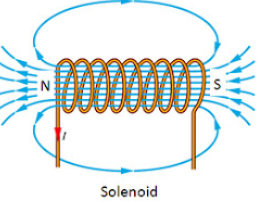
A coil (or solenoid) carrying current produces a magnetic field similar to that of a bar magnet.
Key Concepts
- A solenoid is a coil of many turns of wire
- The magnetic field inside the coil is:
- Strong
- Uniform (parallel field lines)
- The field outside resembles a bar magnet
- One end behaves as North pole and the other as South pole
Magnetic Field Pattern Around a Coil
Determining Poles of a Coil
- Use the right-hand grip rule:

- Fingers follow direction of current in the coil
- Thumb points towards the North pole
Electromagnet
When a soft iron core is placed inside a coil, it becomes an electromagnet
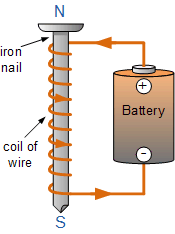
- Strength of electromagnet increases with:
- More turns in the coil
- Higher current
- Use of iron core
- Magnetism disappears when current is switched off
Example:
If current flows downward in a vertical wire, what is the direction of the magnetic field?
▶️ Answer/Explanation
Using the right-hand grip rule, thumb points downward.
Fingers curl showing direction of magnetic field.
Final Answer: \( \boxed{\text{Clockwise (top view)}} \)
Example:
How can you determine the North pole of a current-carrying coil?
▶️ Answer/Explanation
Use the right-hand grip rule.
Fingers follow current direction, thumb points to North pole.
Final Answer: \( \boxed{\text{Thumb gives North pole direction}} \)