
Distance and Displacement
Distance is the total path length travelled by an object, regardless of direction.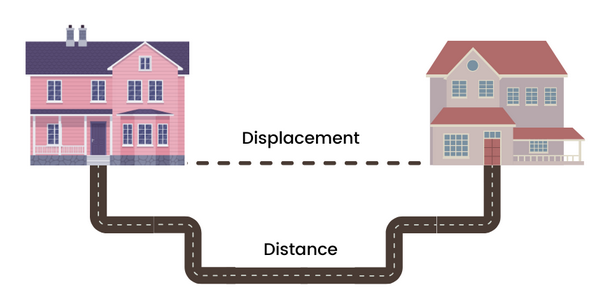
Displacement is the shortest straight-line distance from the initial to the final position, including direction.
Key Concepts
- Distance is a scalar quantity (only magnitude)
- Displacement is a vector quantity (magnitude + direction)
- Distance is always positive
- Displacement can be positive, negative, or zero
- Distance is always greater than or equal to displacement
- If an object returns to its starting point:
- Distance ≠ 0
- Displacement = 0
Formula
\( \text{Displacement} = \text{Final Position} – \text{Initial Position} \)
Comparison of Distance and Displacement
| Feature | Distance | Displacement |
|---|---|---|
| Type | Scalar | Vector |
| Direction | No | Yes |
| Value | Always positive | Can be +, −, or 0 |
| Path | Actual path | Shortest path |
Example:
A student walks 5 m east and then 5 m west. Find distance and displacement.
▶️ Answer/Explanation
Total distance = \( 5 + 5 = 10 \, \text{m} \)
Final position = starting position → displacement = 0
Final Answer: \( \boxed{\text{Distance = 10 m, Displacement = 0}} \)
Example:
A car moves 20 m north. What are its distance and displacement?
▶️ Answer/Explanation
Distance = 20 m
Displacement = 20 m north (includes direction)
Final Answer: \( \boxed{\text{Distance = 20 m, Displacement = 20 m north}} \)
Speed and Velocity
Speed is the rate at which distance is covered.
Velocity is the rate of change of displacement, including direction.
Formula
\( \text{Speed} = \dfrac{\text{Distance}}{\text{Time}} \)
\( \text{Velocity} = \dfrac{\text{Displacement}}{\text{Time}} \)
Key Concepts
- Speed is a scalar quantity
- Velocity is a vector quantity
- Speed has only magnitude, velocity has magnitude and direction
- Speed is always positive
- Velocity can be positive, negative, or zero
- If direction changes, velocity changes even if speed remains constant

Average Speed and Velocity
\( \text{Average Speed} = \dfrac{\text{Total Distance}}{\text{Total Time}} \)
\( \text{Average Velocity} = \dfrac{\text{Total Displacement}}{\text{Total Time}} \)
Comparison of Speed and Velocity
| Feature | Speed | Velocity |
|---|---|---|
| Type | Scalar | Vector |
| Direction | Not included | Included |
| Sign | Always positive | Can be + or − |
| Based on | Distance | Displacement |
Example:
A car travels 100 m in 20 s. Find its speed.
▶️ Answer/Explanation
\( \text{Speed} = \dfrac{100}{20} = 5 \, \text{m/s} \)
Final Answer: \( \boxed{5 \, \text{m/s}} \)
Example:
A person walks 50 m east in 10 s. Find velocity.
▶️ Answer/Explanation
\( \text{Velocity} = \dfrac{50}{10} = 5 \, \text{m/s east} \)
Final Answer: \( \boxed{5 \, \text{m/s east}} \)
Acceleration
Acceleration is the rate of change of velocity with respect to time.
Formula
\( a = \dfrac{v – u}{t} \)
- \( a \) = acceleration (m/s²)
- \( v \) = final velocity
- \( u \) = initial velocity
- \( t \) = time (s)
Key Concepts
- Acceleration is a vector quantity (has direction)
- It occurs when:
- Speed increases
- Speed decreases (deceleration)
- Direction changes
- If velocity is constant → acceleration is zero
- Negative acceleration is called deceleration
Types of Acceleration
- Uniform acceleration → velocity changes at a constant rate
- Non-uniform acceleration → velocity changes at varying rate
Example:
A car increases its velocity from 10 m/s to 30 m/s in 5 s. Find acceleration.
▶️ Answer/Explanation
\( a = \dfrac{30 – 10}{5} = \dfrac{20}{5} = 4 \, \text{m/s}^2 \)
Final Answer: \( \boxed{4 \, \text{m/s}^2} \)
Example:
A car slows down from 20 m/s to 10 m/s in 5 s. Find acceleration.
▶️ Answer/Explanation
\( a = \dfrac{10 – 20}{5} = \dfrac{-10}{5} = -2 \, \text{m/s}^2 \)
The negative sign shows deceleration.
Final Answer: \( \boxed{-2 \, \text{m/s}^2} \)
Motion Graphs (Distance-Time & Velocity-Time)
Distance–Time Graph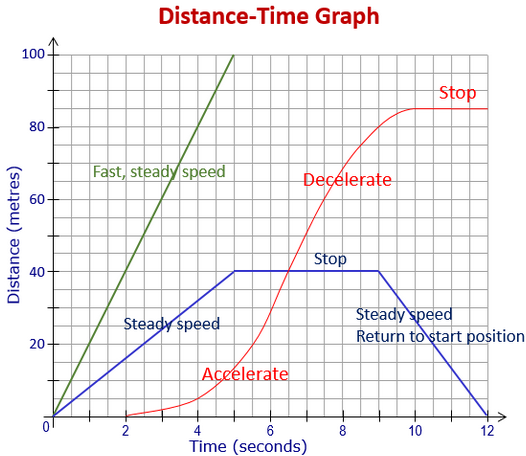
A distance–time graph shows how the distance travelled by an object changes with time.
Key Concepts
- Time is plotted on the x-axis
- Distance is plotted on the y-axis
- The slope (gradient) of the graph represents speed
Formula (Gradient)
\( \text{Speed} = \dfrac{\text{Change in distance}}{\text{Time}} \)
Types of Distance–Time Graphs
- Straight line (constant slope) → constant speed
- Horizontal line → object at rest
- Curved line → changing speed (acceleration)
Example:
A graph shows a straight line with constant slope. What does this indicate?
▶️ Answer/Explanation
A constant slope means constant speed.
Final Answer: \( \boxed{\text{Uniform motion (constant speed)}} \)
Example:
An object remains at the same position for some time. How will this appear on the graph?
▶️ Answer/Explanation
No change in distance means zero slope.
Final Answer: \( \boxed{\text{Horizontal line}} \)
Velocity–Time Graph
Definition
A velocity–time graph shows how velocity changes with time.
Key Concepts
- Time is plotted on the x-axis
- Velocity is plotted on the y-axis
- The slope represents acceleration
- The area under the graph represents displacement
Formulas
\( \text{Acceleration} = \dfrac{\text{Change in velocity}}{\text{Time}} \)
\( \text{Displacement} = \text{Area under graph} \)
Types of Velocity–Time Graphs
- Straight sloping line → constant acceleration
- Horizontal line → constant velocity
- Downward slope → deceleration
Example:
A velocity–time graph is a straight line sloping upwards. What does this indicate?
▶️ Answer/Explanation
Slope represents acceleration.
Upward slope means velocity is increasing.
Final Answer: \( \boxed{\text{Uniform acceleration}} \)
Example:
An object moves at constant velocity. How will this appear on a velocity–time graph?
▶️ Answer/Explanation
Constant velocity means no change in velocity.
Slope = 0
Final Answer: \( \boxed{\text{Horizontal line}} \)