
Newton’s First Law of Motion (Law of Inertia)
Definition
An object remains at rest or continues to move with constant velocity in a straight line unless acted upon by an external unbalanced force.

Key Concepts
- Objects resist changes in their state of motion
- If no net force acts on an object:
- At rest → stays at rest
- In motion → continues with constant velocity
- This property is called inertia
- More mass → greater inertia
- Unbalanced force is required to change motion
Inertia
Definition: The tendency of an object to resist changes in its motion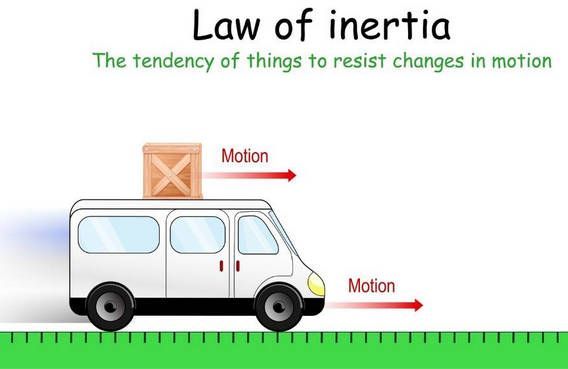
- Depends on mass:
- Large mass → high inertia
- Small mass → low inertia
Types of Inertia
- Inertia of rest → object resists starting motion
- Inertia of motion → object resists stopping
- Inertia of direction → object resists change in direction
Example:
Why do passengers fall backward when a bus suddenly starts?
▶️ Answer/Explanation
The lower body moves with the bus, but the upper body tends to remain at rest due to inertia.
Final Answer: \( \boxed{\text{Due to inertia of rest}} \)
Example:
Why is it harder to push a heavy box than a light box?
▶️ Answer/Explanation
A heavier box has more mass, so it has greater inertia.
More force is needed to change its state of motion.
Final Answer: \( \boxed{\text{Greater mass → greater inertia}} \)
Newton’s Second Law of Motion
Definition
The acceleration of an object is directly proportional to the net force acting on it and inversely proportional to its mass.
Formula
\( F = ma \)
- \( F \) = force (newtons, N)
- \( m \) = mass (kg)
- \( a \) = acceleration (m/s²)
Key Concepts
- Force causes acceleration
- Greater force → greater acceleration
- Greater mass → smaller acceleration (for same force)
- Acceleration is in the direction of the applied force
- 1 newton is the force needed to accelerate 1 kg mass by 1 m/s²
Rearranged Forms
\( a = \dfrac{F}{m} \)
\( m = \dfrac{F}{a} \)
Example:
A force of 10 N acts on a mass of 2 kg. Find acceleration.
▶️ Answer/Explanation
\( a = \dfrac{10}{2} = 5 \, \text{m/s}^2 \)
Final Answer: \( \boxed{5 \, \text{m/s}^2} \)
Example:
A 5 kg object accelerates at 2 m/s². Find the force acting on it.
▶️ Answer/Explanation
\( F = 5 \times 2 = 10 \, \text{N} \)
Final Answer: \( \boxed{10 \, \text{N}} \)
Extended Form (Momentum Form)
Newton’s Second Law can also be stated in terms of momentum.
\( F = \dfrac{dp}{dt} \)
- \( p \) = momentum
- \( p = mv \)
- \( \dfrac{dp}{dt} \) = rate of change of momentum
Explanation
- The net force acting on an object is equal to the rate of change of its momentum
- The force acts in the direction of the change in momentum
- This form is more general and applies even when mass changes
- The equation \( F = ma \) is a special case when mass is constant
Newton’s Third Law of Motion
Definition
For every action, there is an equal and opposite reaction.
Key Concepts
- Forces always occur in pairs
- The two forces are:
- Equal in magnitude
- Opposite in direction
- They act on different objects
- Forces do not cancel each other because they act on different bodies
Action–Reaction Pair
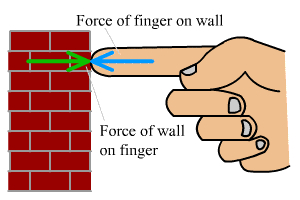
- Action: force applied by object A on object B
- Reaction: force applied by object B on object A
Example:
When a person pushes a wall, why doesn’t the wall move?
▶️ Answer/Explanation
The wall exerts an equal and opposite force on the person.
The wall is very massive, so it does not accelerate noticeably.
Final Answer: \( \boxed{\text{Equal and opposite reaction force}} \)
Example:
How does a rocket move forward in space?
▶️ Answer/Explanation
The rocket pushes gases backward (action).
The gases push the rocket forward (reaction).
Final Answer: \( \boxed{\text{Forward motion due to backward gas force}} \)