
Pressure (Solids & Liquids)
Pressure in Solids
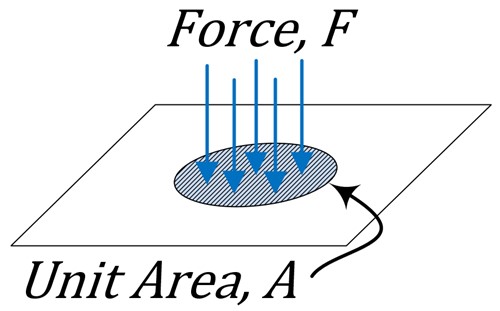
Pressure is the force acting per unit area.
Formula
\( P = \dfrac{F}{A} \)
- \( P \) = pressure (pascals, Pa)
- \( F \) = force (N)
- \( A \) = area (m²)
Key Concepts
- Pressure increases when:
- Force increases
- Area decreases
- Pressure decreases when:
- Area increases
- Small area → high pressure
- Large area → low pressure
Example:
A force of 100 N acts on an area of 2 m². Find pressure.
▶️ Answer/Explanation
\( P = \dfrac{100}{2} = 50 \, \text{Pa} \)
Final Answer: \( \boxed{50 \, \text{Pa}} \)
Example:
Why do sharp knives cut better than blunt knives?
▶️ Answer/Explanation
Sharp knives have smaller contact area.
This increases pressure for the same force.
Final Answer: \( \boxed{\text{Smaller area → higher pressure}} \)
Pressure in Liquids
Definition
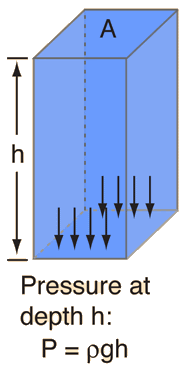
Pressure in a liquid is the force exerted by the liquid per unit area, increasing with depth.
Formula
\( P = \rho g h \)
- \( \rho \) = density of liquid (kg/m³)
- \( g \) = gravitational field strength (m/s²)
- \( h \) = depth (m)
Key Concepts
- Pressure increases with depth
- Pressure increases with density
- Pressure is independent of container shape
- Liquid pressure acts in all directions
Example:
Calculate pressure at a depth of 5 m in water (ρ = 1000 kg/m³, g = 10 m/s²).
▶️ Answer/Explanation
\( P = 1000 \times 10 \times 5 = 50000 \, \text{Pa} \)
Final Answer: \( \boxed{50000 \, \text{Pa}} \)
Example:
Why do dams have thicker walls at the bottom?
▶️ Answer/Explanation
Pressure increases with depth.
Bottom experiences highest pressure.
Final Answer: \( \boxed{\text{Greater depth → higher pressure}} \)
Pressure Calculations
Pressure in Solids
\( P = \dfrac{F}{A} \)
| Pressure in Liquids
\( P = \rho g h \)
| Total Pressure (with Atmosphere)
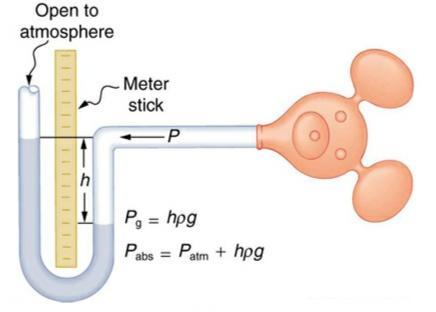
\( P_{\text{total}} = \rho g h + P_{\text{atm}} \)
|
Example:
A force of 200 N acts on an area of 4 m². Find pressure.
▶️ Answer/Explanation
\( P = \dfrac{200}{4} = 50 \, \text{Pa} \)
Final Answer: \( \boxed{50 \, \text{Pa}} \)
Example:
Find pressure at 2 m depth in water (ρ = 1000 kg/m³, g = 10 m/s²).
▶️ Answer/Explanation
\( P = 1000 \times 10 \times 2 = 20000 \, \text{Pa} \)
Final Answer: \( \boxed{20000 \, \text{Pa}} \)