
Nature of Sound
Definition
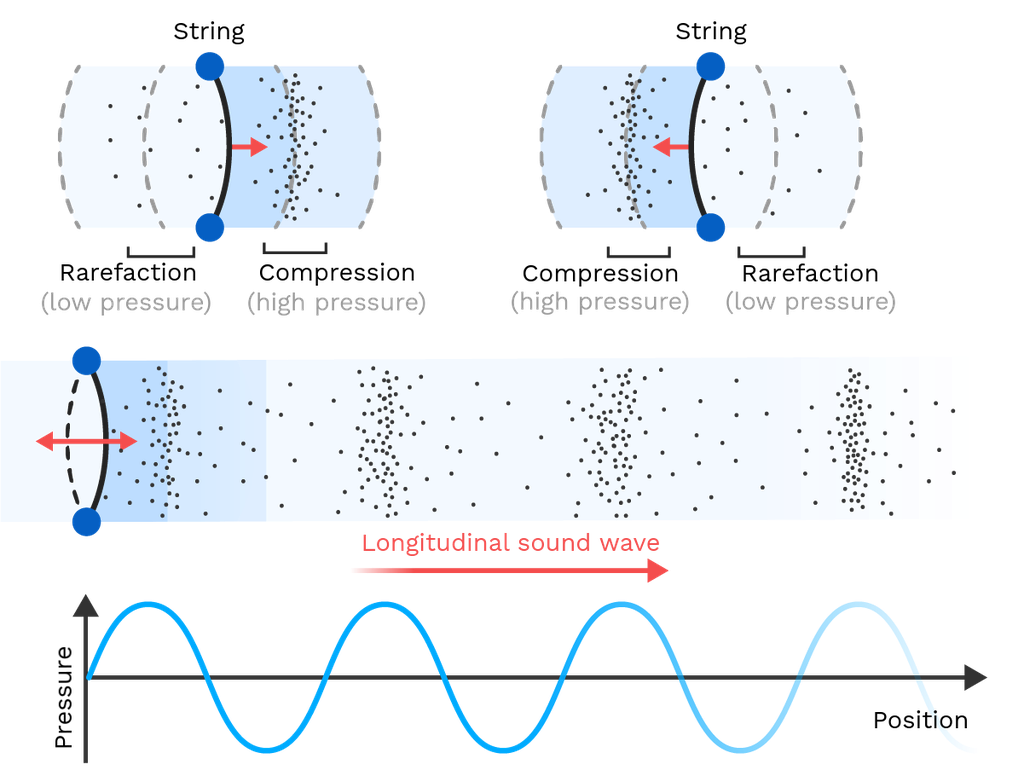
Sound is a form of energy that is produced by vibrating objects and travels through a medium as a longitudinal wave.
Key Concepts
- Sound is a mechanical wave (requires a medium)

- It travels as a longitudinal wave
- Consists of:
- Compressions (high pressure)
- Rarefactions (low pressure)
- Sound cannot travel in vacuum
- Produced by vibrating sources (e.g., vocal cords, speakers)
Key Properties
- Pitch → depends on frequency
- Loudness → depends on amplitude
- Quality (timbre) → depends on waveform
Example:
Why can sound not travel in space?
▶️ Answer/Explanation
Sound requires a medium to travel.
Space is a vacuum.
Final Answer: \( \boxed{\text{No medium → no sound transmission}} \)
Example:
What type of wave is sound?
▶️ Answer/Explanation
Particles vibrate parallel to wave direction.
Final Answer: \( \boxed{\text{Longitudinal wave}} \)
Speed of Sound
Definition
The speed of sound is the distance travelled by a sound wave per unit time.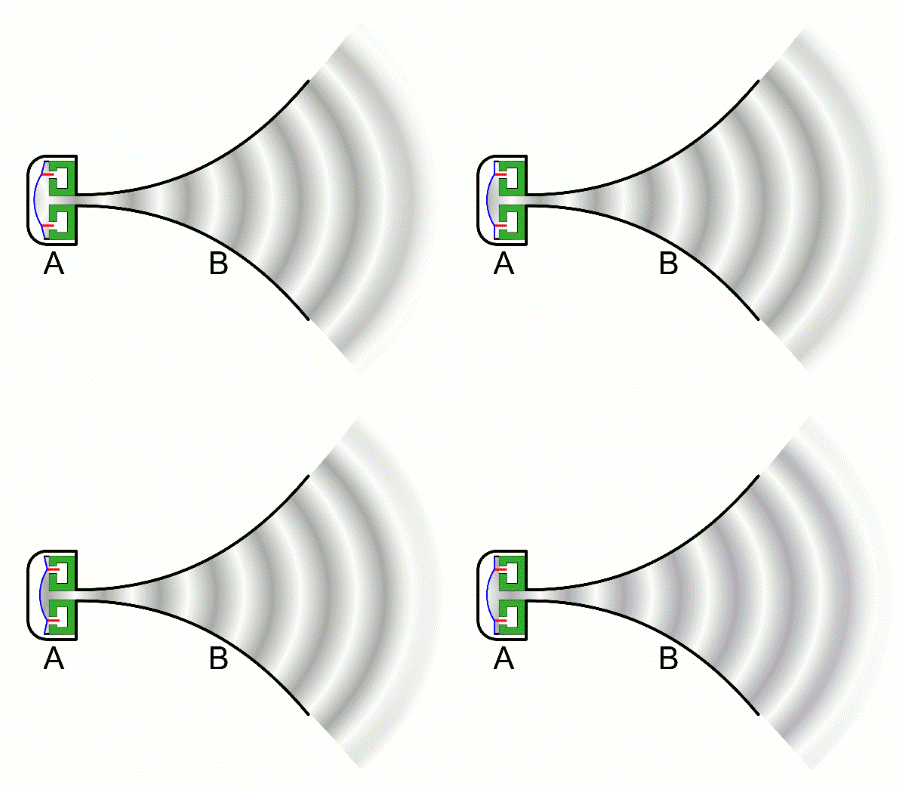
Formula
\( v = f \lambda \)
- \( v \) = speed of sound (m/s)
- \( f \) = frequency (Hz)
- \( \lambda \) = wavelength (m)
Key Concepts
- Speed depends on the medium
- Fastest in solids, slower in liquids, slowest in gases
- In air ≈ 340 m/s at room temperature
- Speed increases with temperature in gases
Example:
A sound wave has frequency 500 Hz and wavelength 0.68 m. Find speed.
▶️ Answer/Explanation
\( v = 500 \times 0.68 = 340 \, \text{m/s} \)
Final Answer: \( \boxed{340 \, \text{m/s}} \)
Example:
Why does sound travel faster in solids than in air?
▶️ Answer/Explanation
Particles in solids are closely packed.
Energy is transferred more quickly.
Final Answer: \( \boxed{\text{Closer particles → faster transfer}} \)
Echoes
Definition
An echo is the reflection of sound waves from a surface, heard after a short delay.
Condition for Echo
- Minimum time gap: 0.1 s
- Minimum distance ≈ 17 m (in air)
Formula
\( d = \dfrac{vt}{2} \)
- \( d \) = distance to reflecting surface
- \( v \) = speed of sound
- \( t \) = time for echo
Example:
An echo is heard after 2 s. Find distance (v = 340 m/s).
▶️ Answer/Explanation
\( d = \dfrac{340 \times 2}{2} = 340 \, \text{m} \)
Final Answer: \( \boxed{340 \, \text{m}} \)
Example:
Why is an echo not heard in a small room?
▶️ Answer/Explanation
Distance is too small, so reflected sound returns too quickly.
Final Answer: \( \boxed{\text{Time gap < 0.1 s}} \)
Applications of Sound
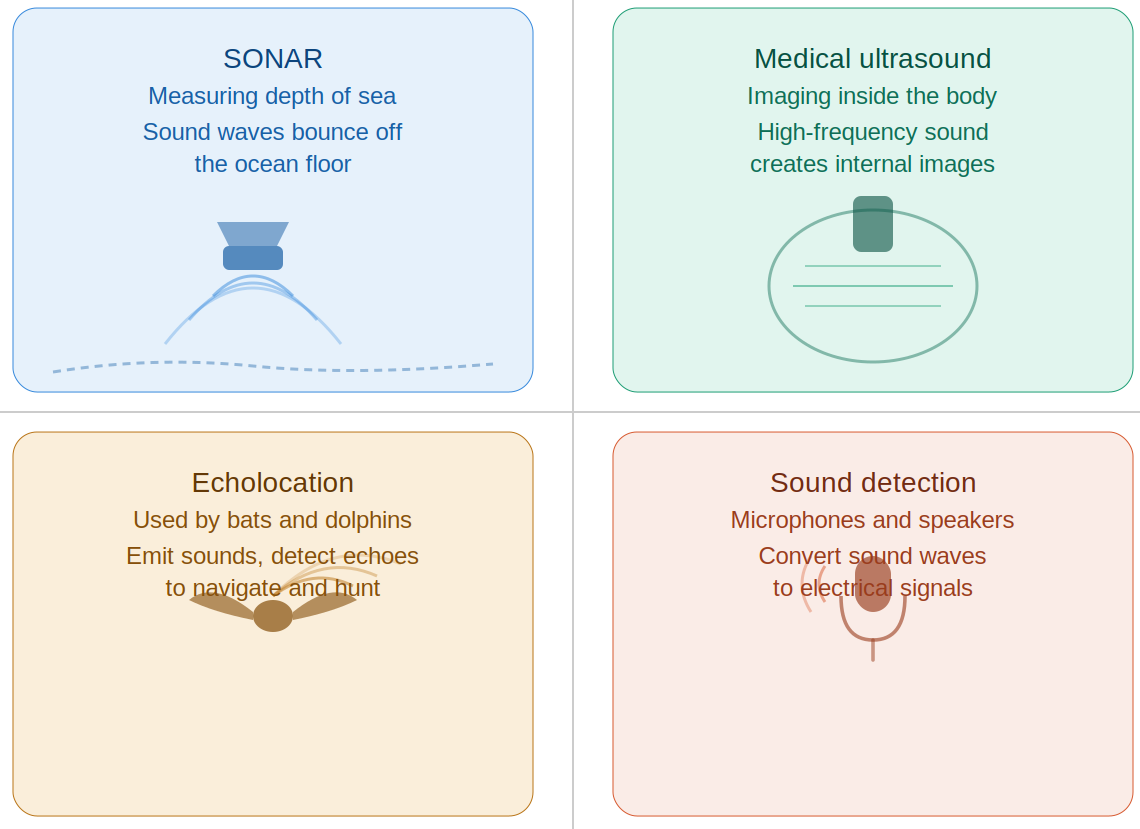
- SONAR → measuring depth of sea
- Medical ultrasound → imaging inside the body
- Echo location → used by bats and dolphins
- Sound detection → microphones, speakers
Example:
How do bats navigate in the dark?
▶️ Answer/Explanation
Bats emit sound waves and detect echoes.
Final Answer: \( \boxed{\text{Echo location}} \)
Example:
What is the use of SONAR?
▶️ Answer/Explanation
It uses sound waves to detect objects underwater.
Final Answer: \( \boxed{\text{Measuring depth or detecting objects}} \)