
Ohm’s Law
Definition
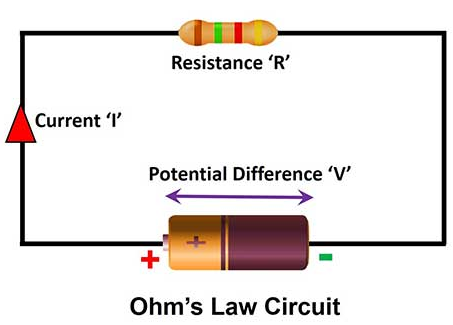
Ohm’s Law states that the current through a conductor is directly proportional to the voltage across it, provided the temperature remains constant.
Formula
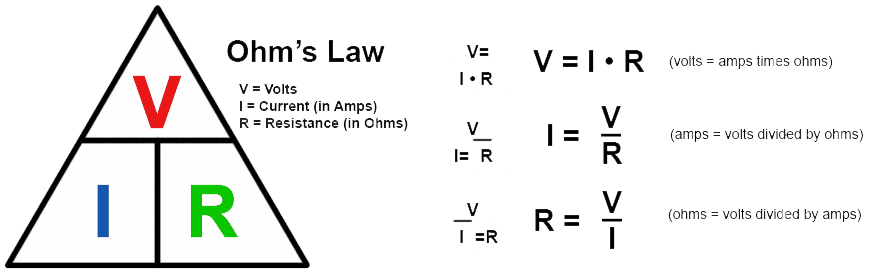
$\rm { V= IR}$
- \( V \) = voltage (volts, V)
- \( I \) = current (amperes, A)
- \( R \) = resistance (ohms, Ω)
Key Concepts
- Increasing voltage increases current (if resistance is constant)
- Increasing resistance decreases current (if voltage is constant)
- Ohm’s Law applies only to ohmic conductors
- The relationship between \( V \) and \( I \) is linear
Ohmic vs Non-Ohmic Conductors
| Type | Behavior | Example |
|---|---|---|
| Ohmic | Follows Ohm’s Law (linear graph) | Metal wire |
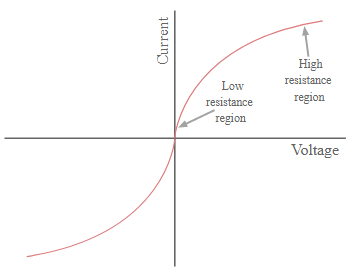
| Non-Ohmic | Does not follow Ohm’s Law | Filament lamp, diode |
Voltage-Current Graph
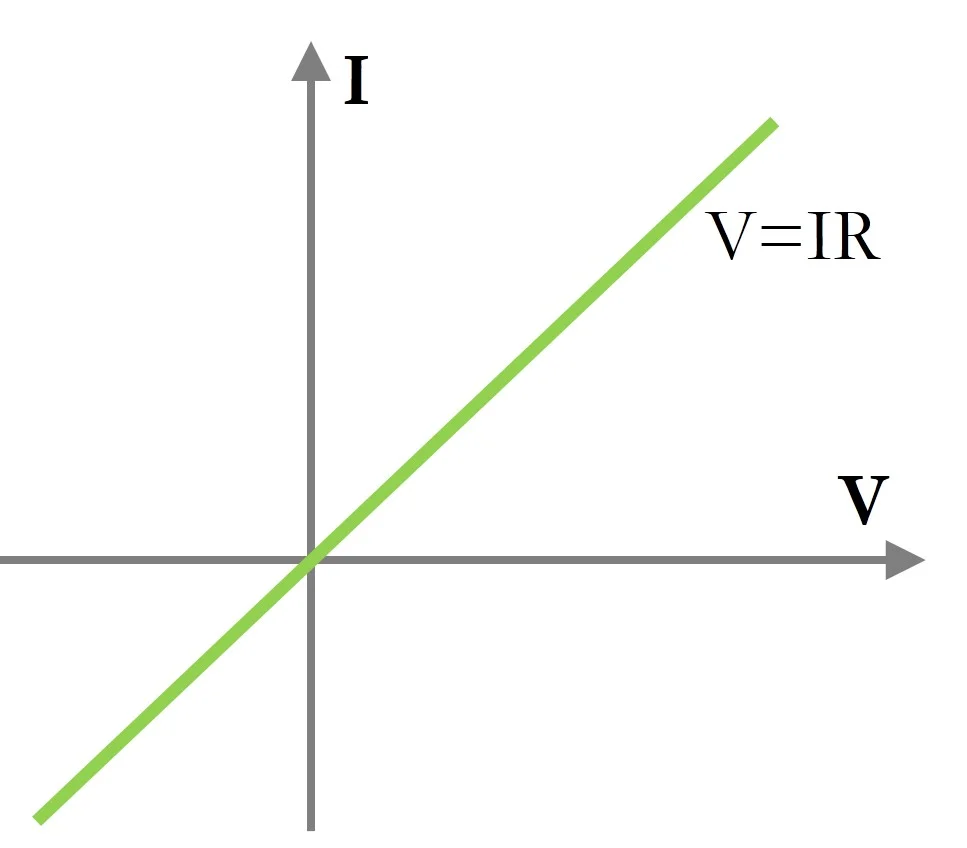
- Straight line through origin → Ohmic conductor
- Curve → Non-ohmic conductor
Example:
Calculate the current when a voltage of 12 V is applied across a resistor of 4 Ω.
▶️ Answer/Explanation
Using \( I = \dfrac{V}{R} \)
\( I = \dfrac{12}{4} = 3 \, \text{A} \)
Final Answer: \( \boxed{3 \, \text{A}} \)
Example:
A current of 2 A flows through a resistor when the voltage is 10 V. Find the resistance.
▶️ Answer/Explanation
Using \( R = \dfrac{V}{I} \)
\( R = \dfrac{10}{2} = 5 \, \Omega \)
Final Answer: \( \boxed{5 \, \Omega} \)
Factors Affecting Resistance
Definition
Resistance is the opposition offered by a conductor to the flow of electric current.
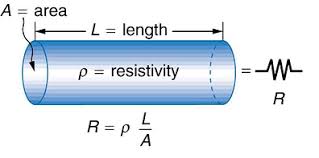
Formula
\( R = \rho \dfrac{L}{A} \)
- \( R \) = resistance (ohms, Ω)
- \( \rho \) = resistivity (material property)
- \( L \) = length of conductor (m)
- \( A \) = cross-sectional area (m²)
Key Factors
| Factor | Effect on Resistance | Explanation |
|---|---|---|
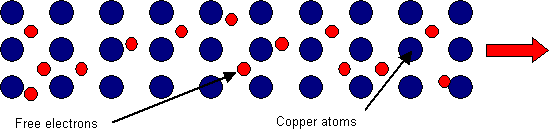
| Length (L) | Increases | Longer wire → more collisions → higher resistance |
| Area (A) | Decreases | Thicker wire → more space for electrons → lower resistance |
| Material (ρ) | Varies | Different materials have different resistivities |
| Temperature | Increases (metals) | Higher temperature → more vibrations → more resistance |

- Long wire → higher resistance
- Thick wire → lower resistance
- Material and temperature affect electron movement

Example:
Which wire has higher resistance: a long thin wire or a short thick wire?
▶️ Answer/Explanation
Resistance increases with length and decreases with area.
A long thin wire has both higher length and smaller area.
Final Answer: \( \boxed{\text{Long thin wire has higher resistance}} \)
Example:
A wire has length 2 m and resistance 4 Ω. If its length is doubled, what happens to resistance?
▶️ Answer/Explanation
Resistance is directly proportional to length.
If length doubles, resistance also doubles.
\( R = 8 \, \Omega \)
Final Answer: \( \boxed{8 \, \Omega} \)
I–V Characteristics (Basic Level)
Definition
I–V characteristics describe the relationship between current (I) and voltage (V) for an electrical component.
Key Concepts
- It shows how current changes when voltage is varied
- Represented using a graph of current (I) vs voltage (V)
- The shape of the graph depends on the type of component
- Helps identify whether a component is ohmic or non-ohmic
Ohmic Conductor (Resistor)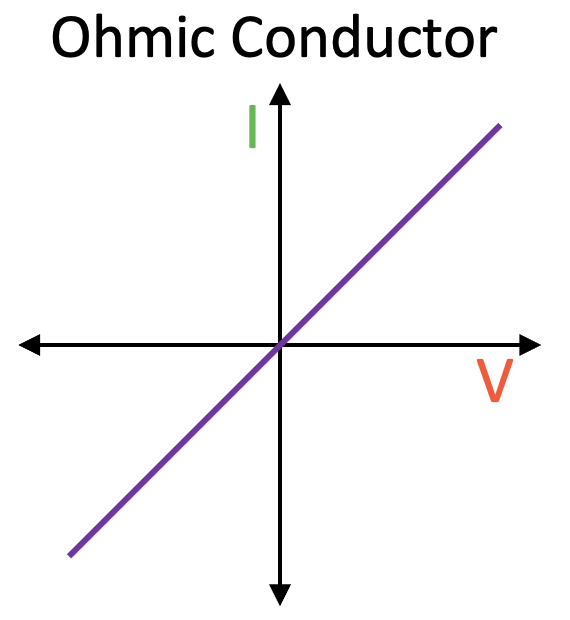
Key Concepts
- Follows Ohm’s Law
- Current is directly proportional to voltage
- Resistance remains constant
- Graph is a straight line through the origin
Relationship
\( V = IR \)
Example:
A resistor has constant resistance. What happens to current if voltage is doubled?
▶️ Answer/Explanation
From \( V = IR \), current is directly proportional to voltage.
If voltage doubles, current also doubles.
Final Answer: \( \boxed{\text{Current doubles}} \)
Example:
A resistor carries 2 A at 10 V. What is the resistance?
▶️ Answer/Explanation
\( R = \dfrac{V}{I} = \dfrac{10}{2} = 5 \, \Omega \)
Final Answer: \( \boxed{5 \, \Omega} \)
Non-Ohmic Conductor (Filament Lamp)
Key Concepts 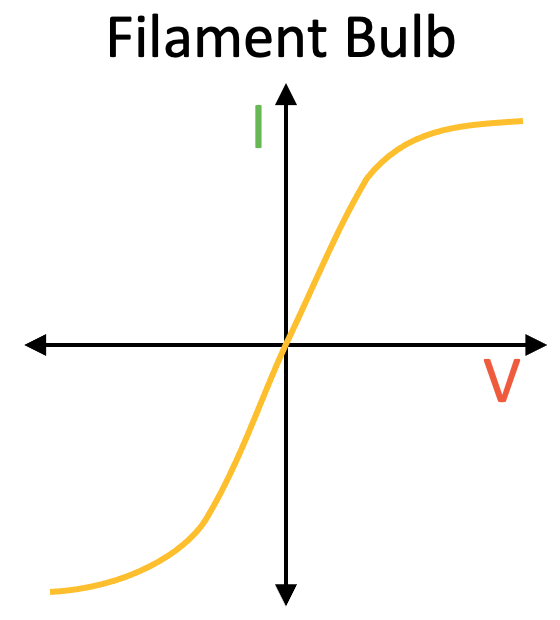
- Does not follow Ohm’s Law
- Resistance changes with temperature
- As current increases, temperature increases → resistance increases
- Graph is a curve (not a straight line)
Explanation
- At low voltage → current increases quickly
- At high voltage → filament heats up → resistance increases → current increases slowly
Example:
Why does the I–V graph of a filament lamp curve instead of being straight?
▶️ Answer/Explanation
As current increases, the filament heats up.
This increases resistance, so current does not increase proportionally.
Final Answer: \( \boxed{\text{Resistance increases with temperature}} \)
Example:
At high voltage, why does current increase slowly in a filament lamp?
▶️ Answer/Explanation
Higher voltage increases temperature.
Higher temperature increases resistance.
This limits the increase in current.
Final Answer: \( \boxed{\text{Increased resistance limits current}} \)