
Wave Phenomena and Wave Equation
Wavelength (\( \lambda \))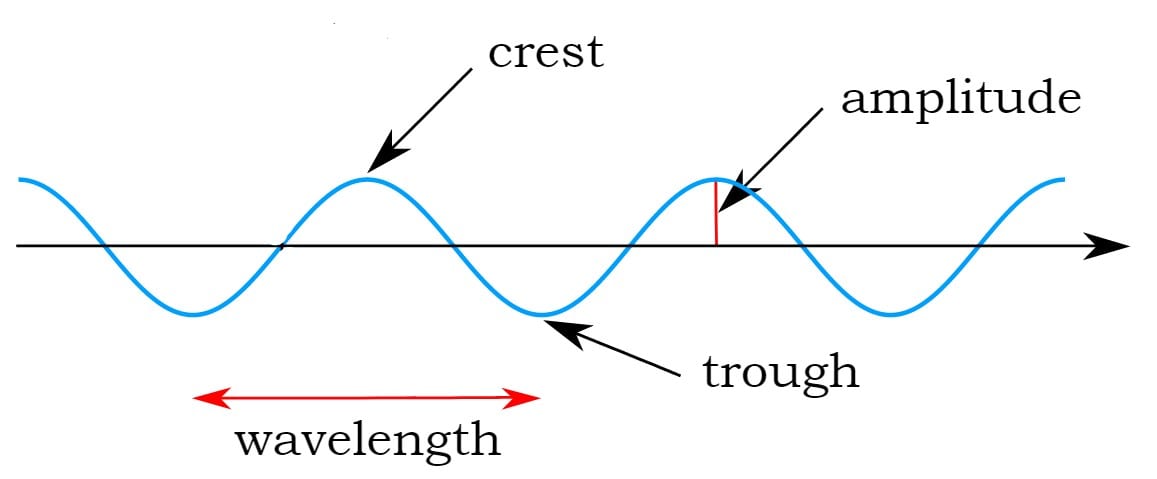
Definition
Wavelength is the distance between two consecutive points in phase on a wave (e.g., crest to crest or compression to compression).
Key Concepts
- Measured in meters (m)
- Represents one complete wave cycle
- Longer wavelength → lower frequency
- Shorter wavelength → higher frequency
Frequency (\( f \))
Definition
Frequency is the number of complete waves passing a point per second. 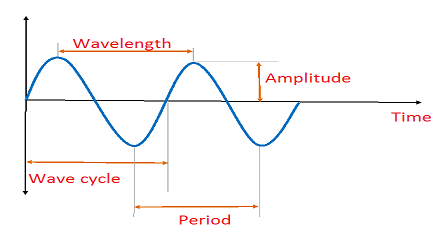
Formula
\( f = \dfrac{1}{T} \)
- \( f \) = frequency (Hz)
- \( T \) = time period (s)
Key Concepts
- Measured in hertz (Hz)
- Higher frequency → more waves per second
- Determines pitch in sound
Amplitude
Definition
Amplitude is the maximum displacement of a particle from its equilibrium position.
Key Concepts
- Indicates the energy of the wave
- Larger amplitude → more energy
- In sound:
- Higher amplitude → louder sound
Example:
What happens to energy if amplitude increases?
▶️ Answer/Explanation
Energy carried by the wave increases.
Final Answer: \( \boxed{\text{Energy increases}} \)
Example:
A wave has a time period of 0.02 s. Find its frequency.
▶️ Answer/Explanation
\( f = \dfrac{1}{0.02} = 50 \, \text{Hz} \)
Final Answer: \( \boxed{50 \, \text{Hz}} \)
Wave Equation
Formula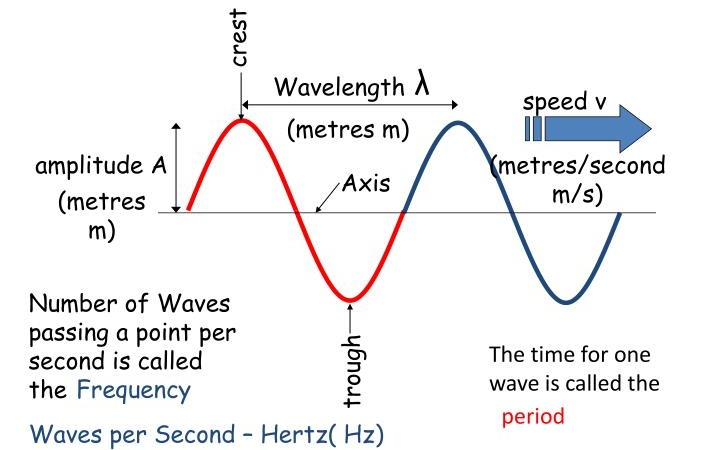
\( v = f \lambda \)
- \( v \) = wave speed (m/s)
- \( f \) = frequency (Hz)
- \( \lambda \) = wavelength (m)
Key Concepts
- Wave speed depends on the medium
- If speed is constant:
- Increase in frequency → decrease in wavelength
Example:
A wave has frequency 10 Hz and wavelength 2 m. Find speed.
▶️ Answer/Explanation
\( v = 10 \times 2 = 20 \, \text{m/s} \)
Final Answer: \( \boxed{20 \, \text{m/s}} \)
Example:
A wave travels at 300 m/s with frequency 100 Hz. Find wavelength.
▶️ Answer/Explanation
\( \lambda = \dfrac{300}{100} = 3 \, \text{m} \)
Final Answer: \( \boxed{3 \, \text{m}} \)
Reflection of Waves
Definition
Reflection is the bouncing back of waves when they strike a surface.
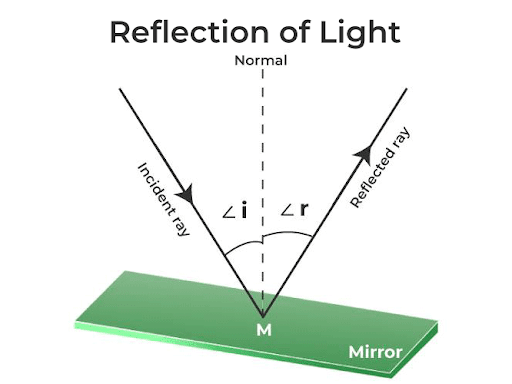
Law of Reflection
\( \text{Angle of incidence} = \text{Angle of reflection} \)
Key Concepts
- Occurs for all types of waves
- Used in echoes and mirrors
- Wave remains in the same medium
Example:
A wave strikes a surface at 30°. What is the angle of reflection?
▶️ Answer/Explanation
Angle of incidence = angle of reflection
Final Answer: \( \boxed{30^\circ} \)
Example:
What happens to sound when it hits a wall?
▶️ Answer/Explanation
It is reflected back, producing an echo.
Final Answer: \( \boxed{\text{Reflection}} \)
Refraction of Waves
Definition
Refraction is the change in direction of a wave when it passes from one medium to another due to a change in speed.

Key Concepts
- Occurs when wave enters a different medium
- Speed changes → wavelength changes
- Frequency remains constant
- Wave bends:
- Towards normal → slower medium
- Away from normal → faster medium

Example:
What happens to light when it passes from air to water?
▶️ Answer/Explanation
Light slows down and bends towards the normal.
Final Answer: \( \boxed{\text{Refraction towards normal}} \)
Example:
Does frequency change during refraction?
▶️ Answer/Explanation
Frequency remains constant.
Final Answer: \( \boxed{\text{Frequency remains unchanged}} \)