
IB MYP Integrated Sciences e-Assessment : Structure of the heart & Blood vessels Exam Style Practice Questions - New Syllabus
Fig. 2.1 shows a cross-section of a human heart.
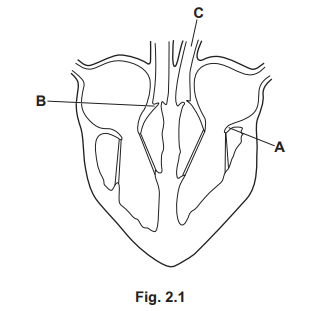
(a)(i) On Fig. 2.1, label with an R the position of the right ventricle.
(a)(ii) State the names of the structures labelled A and B on Fig. 2.1.
(a)(iii) Complete the sentence about blood vessel C. Blood vessel C transports blood from the ……………………. to the………………………
(b) Fig. 2.2 shows a cross-section of part of a heart that has an incomplete structure.
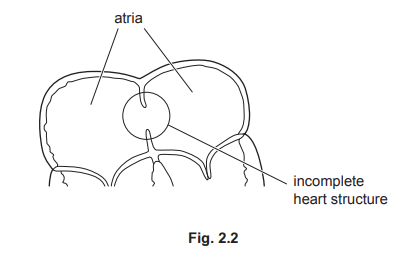
Explain how the incomplete heart structure shown in Fig. 2.2 may affect a person’s ability to transport oxygen.
(c) Fig. 2.3 shows how the body uses aerobic and anaerobic respiration during the first 120 seconds of vigorous physical activity. Between 0 and 20 seconds, the body also uses stored energy.
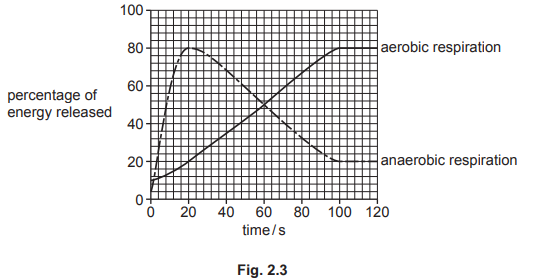
(c)(i) Describe the data shown in Fig. 2.3.
(c)(ii) State the balanced chemical equation for aerobic respiration.
(c)(iii) During anaerobic respiration an oxygen debt can build up. State the name of the chemical that causes this oxygen debt.
▶️ Answer/Explanation
(a)(i) R should be labeled on the right ventricle (lower right chamber of the heart).
(a)(ii)
- A: Atrioventricular valve (e.g., bicuspid/mitral or tricuspid valve).
- B: Semilunar valve (e.g., aortic or pulmonary valve).
(a)(iii) Blood vessel C (aorta) transports blood from the left ventricle to the body (systemic circulation).
Explanation: The aorta is the main artery carrying oxygenated blood from the heart to the body.
(b) The incomplete structure (e.g., a hole in the septum) allows mixing of oxygenated and deoxygenated blood. This reduces oxygen delivery to tissues because the blood pumped to the body is less oxygenated.
Explanation: Septal defects compromise the heart’s efficiency in separating oxygen-rich and oxygen-poor blood.
(c)(i) Key observations from Fig. 2.3:
- Aerobic respiration energy increases gradually, plateauing at 80% by 100 seconds.
- Anaerobic respiration peaks at 80% at 20 seconds, then declines to a steady 20%.
- Both contribute equally (50% each) at 60 seconds.
(c)(ii) Balanced equation for aerobic respiration: \[ C_6H_{12}O_6 + 6O_2 \rightarrow 6CO_2 + 6H_2O \]
(c)(iii) The chemical causing oxygen debt is lactic acid (produced during anaerobic respiration in muscles).
Explanation: Lactic acid accumulates when oxygen is insufficient, requiring post-exercise oxygen to metabolize it.