
Question : Biomes and Ecosystems [11 marks]
Biomes encompass diverse ecosystems, where organisms interact through food chains and other relationships. Understanding these dynamics, including natural selection, reveals how life adapts and thrives within these habitats.
Question a [2 marks] – Food Chain
A biome contains plants and animals living in a major habitat. A biome can be made up of multiple ecosystems.
1a (2 marks)
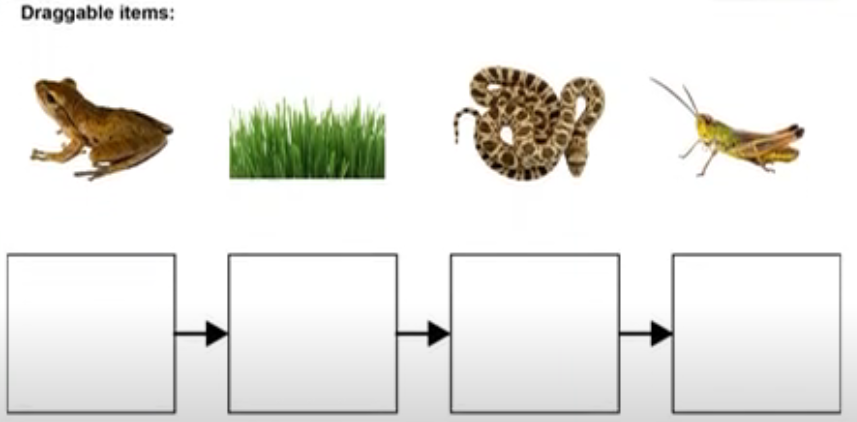
The images below show different organisms in a biome. Organize the organisms to create a food chain.
Food Chain:
▶️ Answer/Explanation
Answer:
Grass → Cricket → Frog → Snake
Explanation:
A food chain shows the transfer of energy through trophic levels in a biome:
- Grass: Producer (autotroph) – Uses photosynthesis to convert sunlight into energy, forming the base.
- Cricket: Primary consumer (herbivore) – Eats grass to obtain energy, common in grassland biomes.
- Frog: Secondary consumer (carnivore) – Preys on crickets, transferring energy up the chain.
- Snake: Tertiary consumer (carnivore) – Feeds on frogs, apex predator in this sequence.
This linear flow (Grass → Cricket → Frog → Snake) reflects a typical grassland ecosystem within a biome. Partial credit for two consecutive links (e.g., Cricket → Frog) recognizes partial understanding, but all four in order demonstrate full trophic comprehension.
Question b [3 marks] – Types of Interactions
Question b (3 marks)
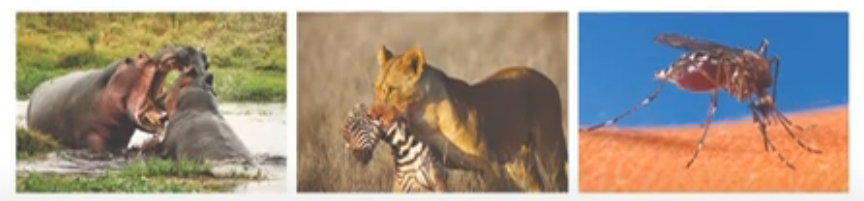
Select the type of interaction occurring between the organisms below.
Interaction 1:
Interaction 2:
Interaction 3:
▶️ Answer/Explanation
Answer:
- Interaction 1 (Two birds): Competition
- Interaction 2 (Lion and zebra): Predation
- Interaction 3 (Tick on deer): Parasitism
Explanation:
Organisms in ecosystems interact in distinct ways:
- Competition: Two birds vying for the same resource (e.g., food, nesting sites) illustrates competition. Both are harmed as they reduce each other’s access, common among similar species (e.g., finches competing for seeds).
- Predation: A lion hunting a zebra is predation—one benefits (lion eats), the other is harmed (zebra dies). This predator-prey dynamic drives energy transfer, as in savanna biomes.
- Parasitism: A tick feeding on a deer’s blood is parasitism—the tick gains nutrients, while the deer suffers (e.g., blood loss, disease risk like Lyme). This one-sided relationship typifies host-parasite interactions.
Correctly identifying all three reflects understanding of ecological relationships within a biome’s ecosystems.
Question c [2 marks] – Ecosystem Definition
c (2 marks)
The surface of the Earth is covered with a wide diversity of ecosystems. State the meaning of the term ecosystem.
▶️ Answer/Explanation
Answer:
The living things and the non-living things/physical environment, or biotic and abiotic factors, interacting together.
Explanation:
An ecosystem is a functional unit within a biome:
- Components: It includes biotic factors (living organisms like plants, animals, bacteria) and abiotic factors (non-living elements like water, air, sunlight, soil).
- Interaction: These elements interact—e.g., plants use sunlight and soil nutrients (abiotic) to grow, supporting herbivores (biotic), which predators then eat. In a forest ecosystem, trees, deer, wolves, rainfall, and temperature all interplay.
This definition captures the dynamic relationship sustaining life, distinguishing ecosystems from broader biomes by their specific interactions, earning full marks with either phrasing or explicit interaction reference.
Question d [4 marks] – Natural Selection
d (4 marks)
Using scientific terminology, explain the process of natural selection.
▶️ Answer/Explanation
Answer:
- Individuals in a population show variation due to genetic differences (e.g., mutations).
- Some traits provide advantages, leading to survival of the fittest (e.g., camouflage).
- These organisms survive to reproduce, passing alleles to offspring.
- The frequency of beneficial traits increases in the population over generations.
Explanation:
Natural selection is the mechanism driving adaptation in ecosystems:
- Variation: Within a population (e.g., snakes), traits like color vary due to genetic mutations—some are darker, aiding camouflage.
- Survival of the Fittest: Environmental pressures (e.g., predators) favor advantageous traits. Darker snakes hide better, surviving predation over lighter ones.
- Reproduction: Survivors reproduce, passing alleles (gene variants) for dark color to offspring, unlike less-fit individuals who die out.
- Trait Frequency: Over generations, the population shifts—dark snakes dominate as the trait’s frequency rises (e.g., from 10% to 80% in 100 years).
Using terms like “variation,” “allele,” and “population” (e.g., darker trait as an allele) ties this to Darwinian evolution, as seen in biome-specific adaptations (e.g., peppered moth). Three points earn 3 marks, with a fourth for terminology precision.