
Question : Evolution and Seed Dispersal – Topic: Evolution [10 marks]
This question examines the reproductive strategy of sycamore trees through seed dispersal, connecting to evolutionary adaptations for survival and reproduction.
Question Introduction
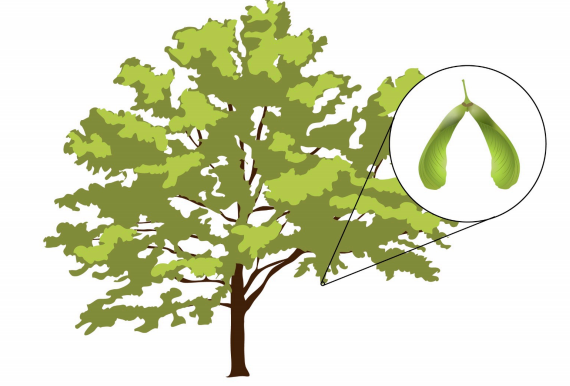
Sycamore seeds are contained in winged structures called samaras. When sycamore seeds fall, they spin in circles, aiding their dispersal as an evolutionary trait.
Question (a) [2 marks] – Spinning Motion (Topic: Evolution – Reproduction)
Question a (2 marks)
Explain how the spinning motion of sycamore seeds helps them disperse over a wider area.
▶️ Answer/Explanation
Answer:
The spinning motion increases air resistance, prolonging flight time, and allows seeds to travel farther from the parent tree, enhancing dispersal.
Detailed Explanation:
Dispersal mechanism:
- Air Resistance: Spinning (like a helicopter) generates lift, slowing descent (e.g., from 1m/s to 0.5m/s), keeping seeds aloft longer.
- Distance: Longer airtime means wider dispersal (e.g., 10-20m vs. 2m), reducing competition and aiding colonization, an evolutionary advantage.
Marks: 1 for air resistance/flight time, 1 for wider dispersal, totaling 2.
Question (b) [3 marks] – Height vs. Time Relationship (Topic: Evolution – Reproduction)
Question b (3 marks)
A group of MYP students investigated the relationship between the height from which a sycamore seed falls and the time it spends in the air. The results are shown in the lab book below:
| Height from which seed is dropped / m | Time spent in the air / s |
|---|---|
| 0.50 | 0.56 |
| 0.75 | 1.15 |
| 2.00 | 2.16 |
Describe the relationship between the height from which the seed is dropped and the time it spends in the air.
▶️ Answer/Explanation
Answer:
The relationship is positive; as height increases, time in the air increases, though not linearly, due to the spinning motion’s effect.
Detailed Explanation:
Relationship analysis:
- Trend: 0.5m: 0.56s, 0.75m: 1.15s, 2m: 2.16s—time rises with height.
- Pattern: Not proportional (e.g., 4x height from 0.5m to 2m, but time only ~4x), as spinning slows descent rate.
- Evolution Link: Longer airtime from greater heights enhances dispersal range, a reproductive adaptation.
Marks: 1 for positive correlation, 1 for increasing time, 1 for non-linear insight, totaling 3.
Question (c) [2 marks] – Additional Factor (Topic: Evolution – Reproduction)
Question c (2 marks)
Suggest one factor, other than height, that could affect the time a sycamore seed spends in the air.
▶️ Answer/Explanation
Answer:
Wind speed could affect the time a sycamore seed spends in the air.
Detailed Explanation:
Factor impact:
- Effect: Strong winds (e.g., 5m/s) increase lift and carry seeds farther, extending airtime; calm air (0m/s) shortens it.
- Evolution Link: Wind-aided dispersal improves reproductive success by spreading seeds to new habitats.
Marks: 1 for factor (wind speed), 1 for effect on airtime, totaling 2.
Question (d) [3 marks] – Experimental Design (Topic: Evolution – Reproduction)
Question d (3 marks)
Design an experiment to investigate how the angle of the samara wings affects the time the seed spends in the air. Include the following in your answer:
- Independent variable
- Dependent variable
- Control variables
- Method
▶️ Answer/Explanation
Answer:
- Independent variable: Angle of samara wings (e.g., 30°, 45°, 60°).
- Dependent variable: Time spent in the air (seconds).
- Control variables: Drop height (e.g., 2m), wind speed (e.g., still air), seed mass.
- Method:
- Adjust samara wing angle to 30° using a protractor.
- Drop seed from 2m height in a controlled indoor space.
- Measure airtime with a stopwatch, repeat 3 times, and average.
- Test 45° and 60°, recording results for comparison.
Detailed Explanation:
Design rationale:
- Variables: Angle affects lift (evolutionary trait); time reflects dispersal potential.
- Controls: Fixed height and no wind ensure only angle impacts results; mass consistency avoids size bias.
- Method: Repeats improve reliability; controlled setting isolates angle effect.
Marks: 1 for variables (independent/dependent), 1 for controls, 1 for method, totaling 3.