
Endothermic and Exothermic Reactions
Every chemical reaction involves an energy change. Energy is either released or absorbed as chemical bonds are broken and formed. These reactions are classified as endothermic or exothermic depending on the direction of energy transfer.
Exothermic Reactions
An exothermic reaction is a reaction in which energy is released to the surroundings, usually in the form of heat, light, or sound.
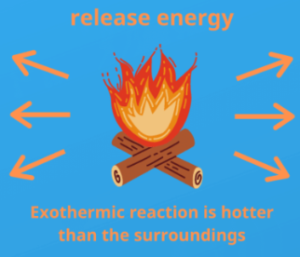
Energy Change:
\( \mathrm{Energy\ released\ (bond\ formation)\ >\ Energy\ absorbed\ (bond\ breaking)} \)
Result: Temperature of surroundings increases.
Examples:
- Combustion of fuels — \( \mathrm{CH_4 + 2O_2 \rightarrow CO_2 + 2H_2O + Energy} \)
- Neutralization — \( \mathrm{HCl + NaOH \rightarrow NaCl + H_2O + Heat} \)
- Respiration — energy is released in cells from glucose oxidation.
Endothermic Reactions
An endothermic reaction is a reaction in which energy is absorbed from the surroundings.

Energy Change:
\( \mathrm{Energy\ absorbed\ (bond\ breaking)\ >\ Energy\ released\ (bond\ formation)} \)
Result: Temperature of surroundings decreases.
Examples:
- Photosynthesis — \( \mathrm{6CO_2 + 6H_2O + Light\ Energy \rightarrow C_6H_{12}O_6 + 6O_2} \)
- Thermal decomposition — \( \mathrm{CaCO_3 \rightarrow CaO + CO_2} \)
- Instant cold packs — reaction absorbs heat from surroundings.
Energy Profile Diagrams
Energy profile diagrams show how the energy of reactants and products changes during a reaction.
| Type of Reaction | Energy Change | ΔH Sign | Diagram Description |
|---|---|---|---|
| Exothermic | Energy released to surroundings | \( \mathrm{ΔH < 0} \) | Products have lower energy than reactants. |
| Endothermic | Energy absorbed from surroundings | \( \mathrm{ΔH > 0} \) | Products have higher energy than reactants. |
Activation Energy
The activation energy is the minimum amount of energy required for reactant particles to collide effectively and start a chemical reaction.

Symbol: \( \mathrm{E_a} \)
In both endothermic and exothermic reactions, reactants must first gain activation energy to break bonds before forming products.
Key Formulas
- Enthalpy change (ΔH): \( \mathrm{ΔH = H_{products} – H_{reactants}} \)
- Exothermic → \( \mathrm{ΔH < 0} \)
- Endothermic → \( \mathrm{ΔH > 0} \)
Everyday Examples of Energy Changes
| Situation | Type of Reaction | Energy Flow |
|---|---|---|
| Lighting a candle | Exothermic | Releases heat and light |
| Cooking food | Endothermic | Absorbs heat |
| Instant ice pack | Endothermic | Absorbs heat from skin |
Example
When methane burns in oxygen, heat is produced. Is this reaction endothermic or exothermic?
▶️ Answer / Explanation
Step 1: Reaction: \( \mathrm{CH_4 + 2O_2 \rightarrow CO_2 + 2H_2O + Energy} \)
Step 2: Energy is released to surroundings.
Final Answer: It is an exothermic reaction because it releases heat.
Example
The reaction \( \mathrm{CaCO_3 \rightarrow CaO + CO_2} \) requires continuous heating. Classify the reaction and explain the energy change.
▶️ Answer / Explanation
Step 1: The reaction absorbs heat energy to break strong ionic bonds in calcium carbonate.
Step 2: Energy flows from surroundings to the system.
Final Answer: This is an endothermic reaction because heat is absorbed from the surroundings.
Example
In a reaction, the energy absorbed to break bonds is 450 kJ, and the energy released when new bonds form is 650 kJ. Calculate the enthalpy change and state the reaction type.
▶️ Answer / Explanation
Step 1: \( \mathrm{ΔH = Energy_{released} – Energy_{absorbed}} \)
Step 2: \( \mathrm{ΔH = 650 – 450 = -200\ kJ} \)
Step 3: Since \( \mathrm{ΔH < 0} \), the reaction releases energy.
Final Answer: \( \mathrm{ΔH = -200\ kJ} \), so it is an exothermic reaction.