
Electrical Hazards and Safety
Electrical Hazards
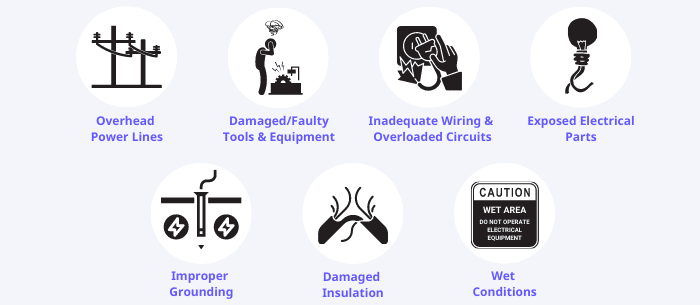
- Electric shock: When current passes through the human body, it can damage tissues, muscles, or even stop the heart.
- Overheating and fire: Too much current can cause wires or appliances to overheat, leading to burns or electrical fires.
- Short circuits: When live and neutral wires touch directly, causing a very large current that can damage appliances or ignite fires.
- Electrocution: Fatal electric shock due to contact with high voltages.
Safety Devices and Measures
- Insulation: Wires are coated with insulating material (like plastic or rubber) to prevent direct contact with electricity.
- Fuses: A fuse melts and breaks the circuit if the current exceeds a safe limit, protecting devices and people.
- Circuit Breakers (MCBs): Automatically switch off the current when it becomes too high, safer than fuses because they can be reset.
- Earth wire (Earthing): Provides a safe path for current to flow into the ground in case of a fault, preventing electric shock.
- Double insulation: Appliances with two layers of insulation (plastic casing + internal insulation) do not require an earth wire.
- RCD (Residual Current Device): Detects small leakage currents to earth and cuts off supply immediately to prevent shocks.
Safety Precautions in Everyday Life

- Never touch electrical appliances with wet hands.
- Do not overload sockets with too many devices.
- Use the correct rating of fuse for each appliance.
- Ensure proper earthing in homes and buildings.
- Switch off appliances before repairing or cleaning them.
Example:
An electric iron is rated at 230 V, 1000 W. What fuse rating should be used for safety?
▶️ Answer/Explanation
Step 1: Current = \( I = \dfrac{P}{V} = \dfrac{1000}{230} \approx 4.35 \, A \).
Step 2: Choose a fuse slightly higher than the operating current, e.g., 5 A.
Final Answer: A \(\boxed{5 \, A \, fuse}\) should be used.
Example:
A metal toaster develops a fault where the live wire touches its metal case. Explain how the earth wire prevents danger to the user.
▶️ Answer/Explanation
Step 1: The live wire touching the metal case makes the case live.
Step 2: The earth wire provides a low-resistance path for current to flow to the ground.
Step 3: This large current causes the fuse to blow or the circuit breaker to trip, disconnecting the supply.
Final Answer: The earth wire ensures safety by preventing electric shock and switching off the circuit.
Example:
A person accidentally touches a faulty washing machine, and a small leakage current of 30 mA flows through their body. How does the RCD prevent a fatal accident?
▶️ Answer/Explanation
Step 1: The RCD compares current in the live and neutral wires.
Step 2: If there is a difference (due to leakage through the person), the RCD detects it.
Step 3: The RCD cuts off power supply almost instantly (within 0.03 seconds).
Final Answer: The RCD disconnects the circuit, preventing a fatal electric shock.