
Galaxies
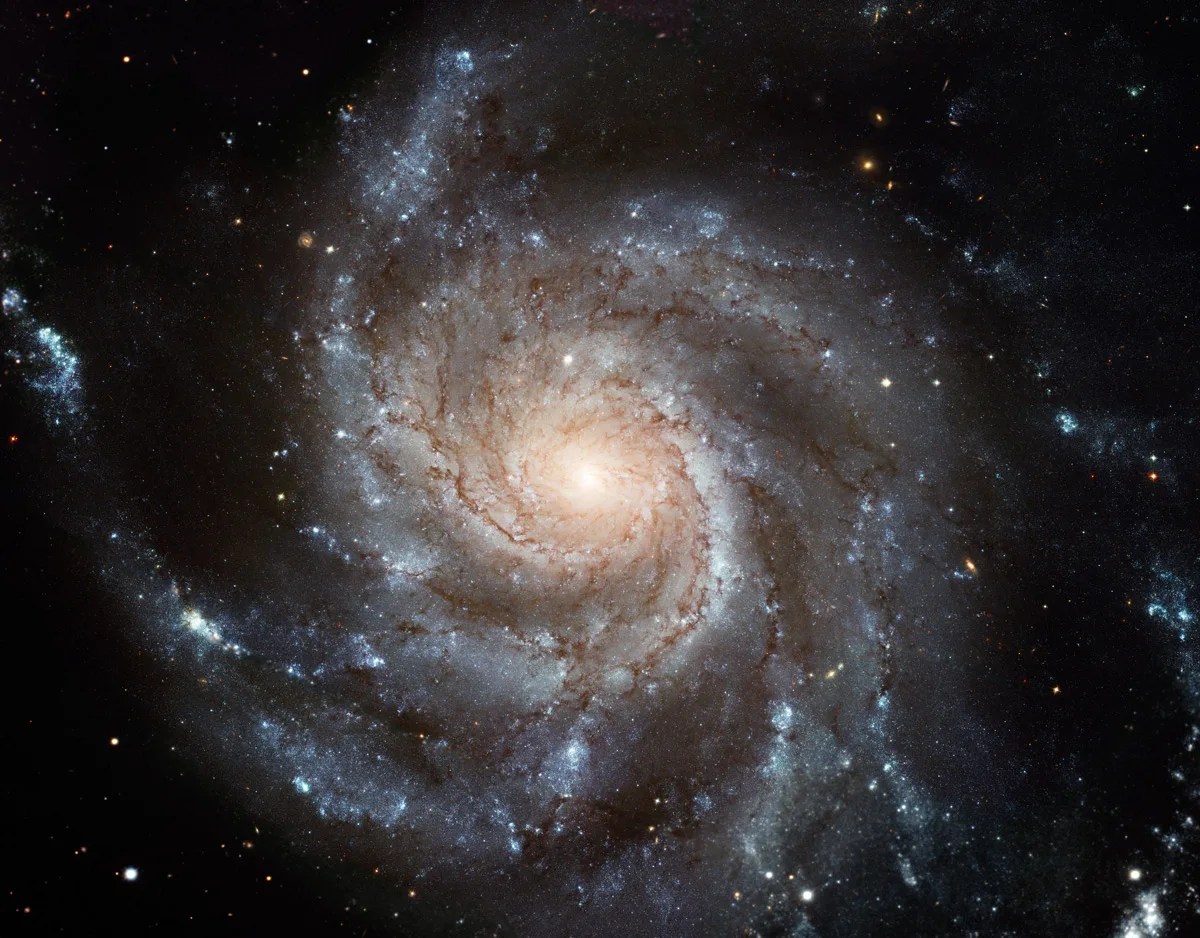
- Gigantic systems of stars, gas, dust, and dark matter bound together by gravity.
- Contain billions of stars and their solar systems.
- Galaxies are not stationary — they rotate and move through space.
- Classified into three main types:
- Spiral galaxies: Flat, disk-shaped with spiral arms (e.g., Milky Way).
- Elliptical galaxies: Round/oval shapes, mostly older stars, less gas.
- Irregular galaxies: No clear shape, often formed by collisions.
- The Milky Way is our home galaxy, about 100,000 light-years across.
Examples:
- Milky Way Galaxy – spiral galaxy that contains our Solar System.
- Andromeda Galaxy (M31) – nearest major galaxy to the Milky Way, about 2.5 million light-years away.
Stars
- Massive balls of hot gases (mainly hydrogen and helium).
- Shine by nuclear fusion: hydrogen nuclei fuse into helium, releasing energy.
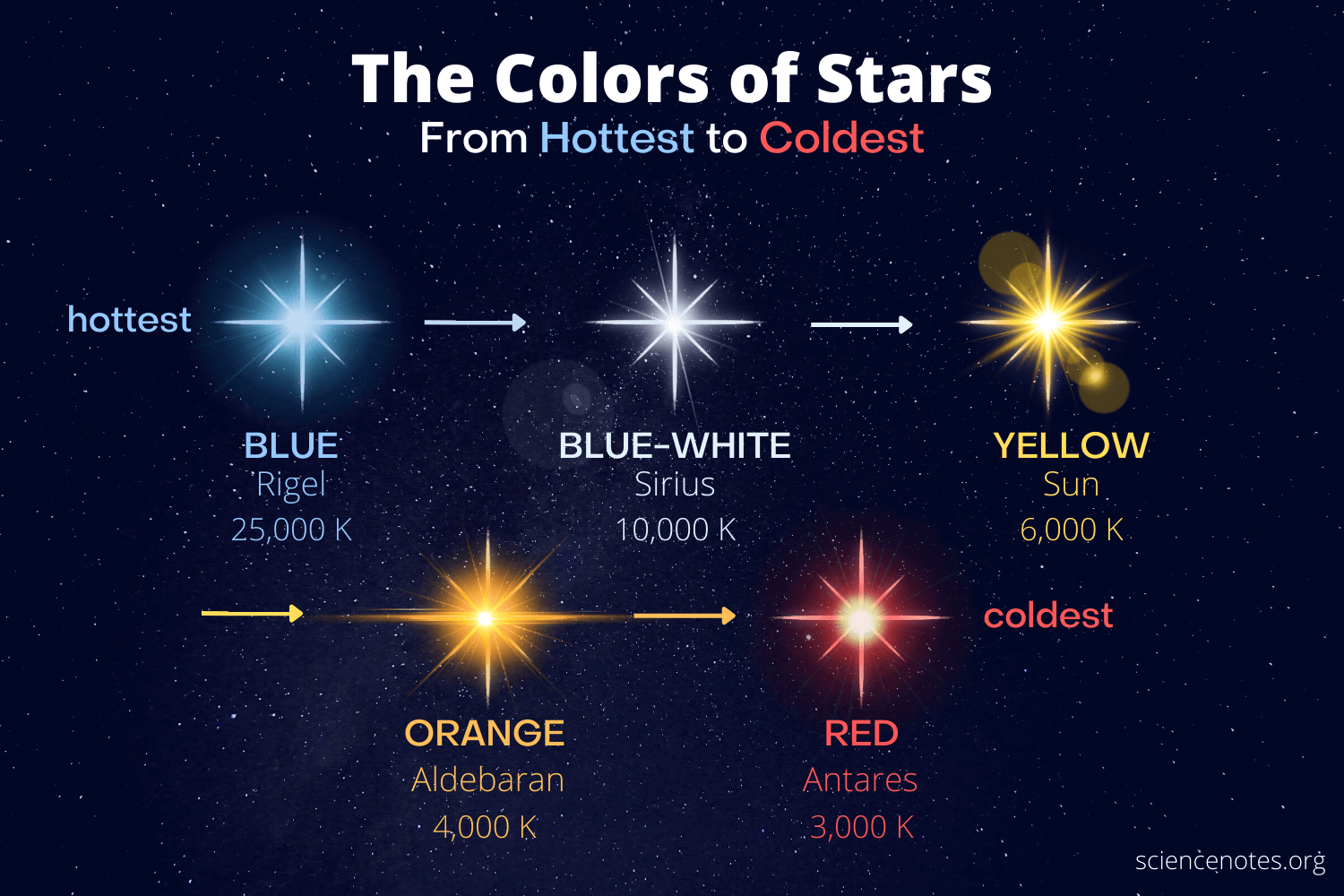
- Stars differ in temperature, color, mass, and brightness.
- Colors indicate surface temperature:
- Blue stars – hottest (above 10,000 K).
- Yellow stars – medium (like the Sun, ~5800 K).
- Red stars – coolest (~3000 K).
- Life cycle: nebula → protostar → main sequence → red giant/supergiant → white dwarf / neutron star / black hole.
Examples:
- The Sun – a medium-sized yellow star providing energy for life on Earth.
- Sirius – the brightest star in Earth’s night sky, located in the constellation Canis Major.
Planets
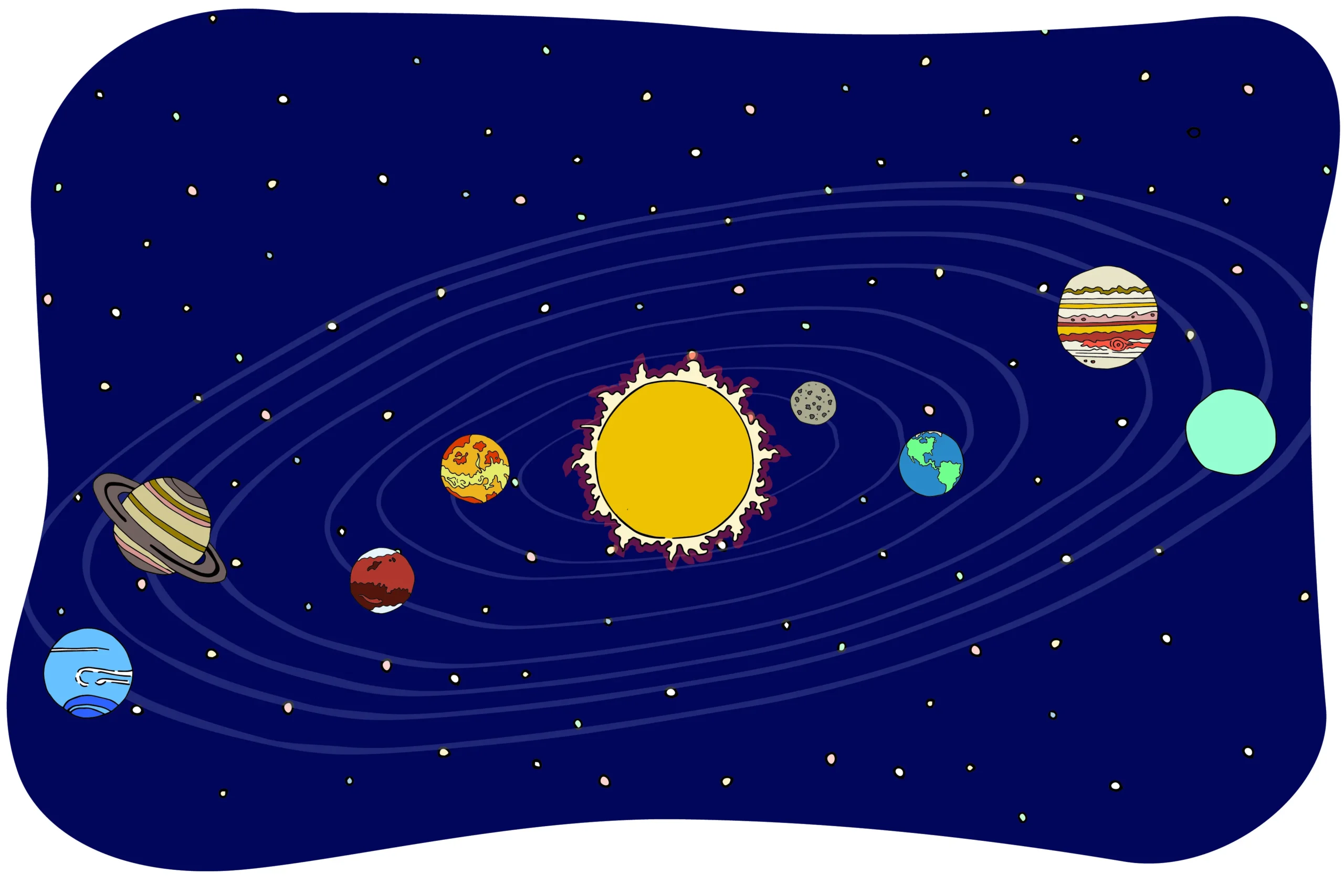
- Large spherical objects orbiting stars due to gravity.
- Do not produce light, only reflect starlight.
- Two types in our Solar System:
- Terrestrial (rocky) planets: small, dense, solid surfaces (Mercury, Venus, Earth, Mars).
- Gas giants/ice giants: very large, thick atmospheres, many moons (Jupiter, Saturn, Uranus, Neptune).
- Planets vary in temperature, mass, number of moons, and distance from the Sun.
Examples:
- Earth – the only known planet with life, has water and atmosphere.
- Jupiter – the largest planet, a gas giant with over 90 known moons.
Moons
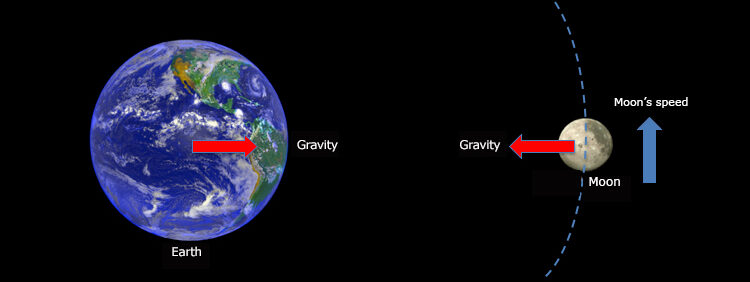
- Natural satellites that orbit planets.
- Stabilize the rotation of their planets and can affect tides (like Earth’s moon).
- Can be rocky or icy, some with atmospheres or subsurface oceans.
- Numbers vary: some planets have none (Mercury, Venus), while others have dozens (Jupiter, Saturn).
Examples:
- Earth’s Moon – stabilizes Earth’s tilt and causes tides.
- Europa (moon of Jupiter) – icy moon with a possible subsurface ocean that may support life.
Meteors
- Small pieces of rock or dust that enter Earth’s atmosphere.
- Friction with air makes them burn brightly – this is called a “shooting star.”
- If large enough, part of the rock can survive and hit Earth’s surface – then it’s called a meteorite.
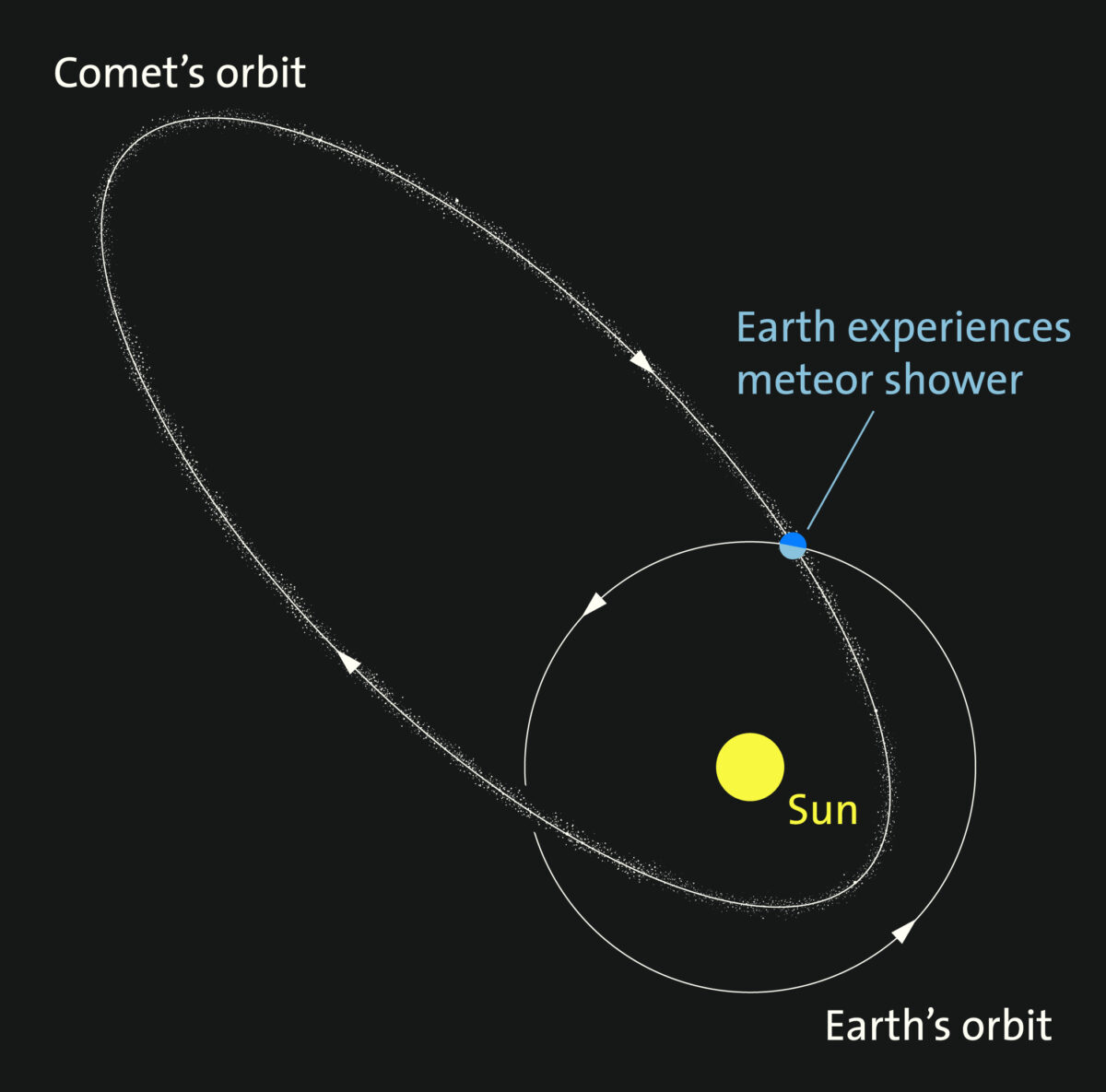
- Meteor showers occur when Earth passes through debris left by a comet.
Examples:
- Perseids Meteor Shower – occurs every August, from debris of Comet Swift-Tuttle.
- Chelyabinsk Meteor (2013) – exploded over Russia, causing damage and injuries.
Asteroids
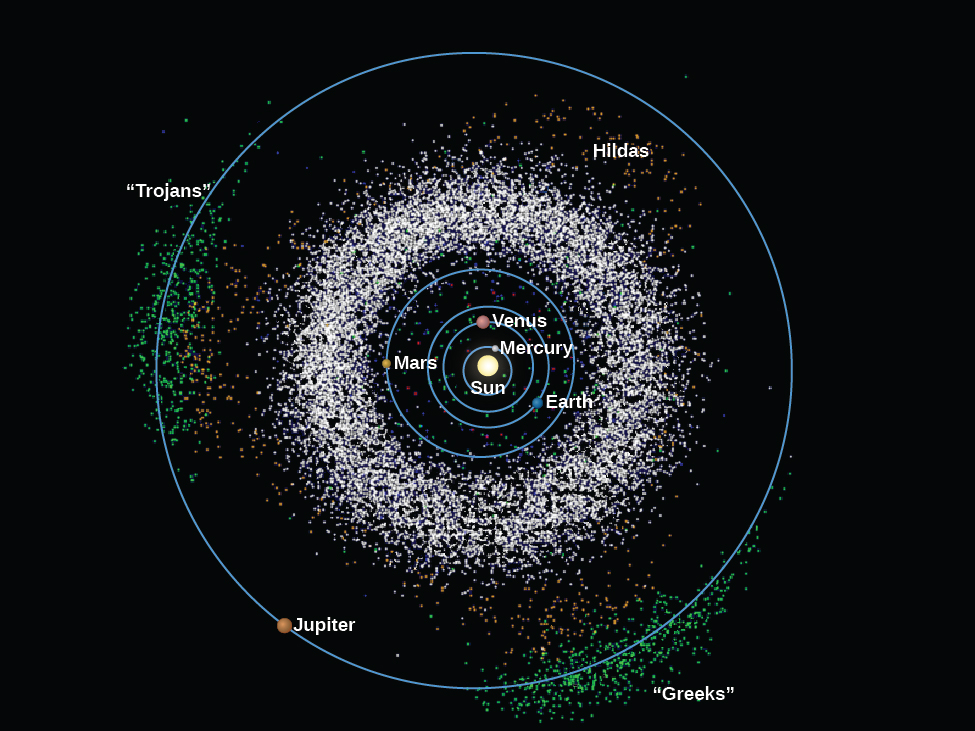
- Rocky objects orbiting the Sun, mostly between Mars and Jupiter in the asteroid belt.
- Much smaller than planets, irregular in shape.
- Thought to be leftover building blocks from the formation of the Solar System.
- Some asteroids cross Earth’s orbit, creating impact risks.
Examples:
- Ceres – the largest asteroid (dwarf planet) in the asteroid belt.
- Vesta – one of the brightest and largest asteroids, visited by NASA’s Dawn mission.
Example:
The Andromeda Galaxy is about 2.5 million light-years away. If light travels at \(3 \times 10^8 \, \text{m/s}\), calculate how long (in years) light takes to reach Earth from Andromeda.
▶️ Answer/Explanation
Step 1: Recall that 1 light-year is the distance light travels in 1 year.
Step 2: Andromeda is 2.5 million light-years away. This means it takes 2.5 million years for light to reach us.
\(\text{Time taken} = 2.5 \times 10^6 \, \text{years}\)
Final Answer: \(\boxed{2.5 \, \text{million years}}\)
Example:
If a star’s surface temperature is 10,000 K, what color will it appear to us? (Use the general rule that blue stars are above 10,000 K, yellow ~5800 K, red ~3000 K.)
▶️ Answer/Explanation
Step 1: Compare the star’s temperature with the color ranges.
\(\text{Blue:} > 10,000 K, \quad \text{Yellow:} \approx 5800 K, \quad \text{Red:} \approx 3000 K\)
Step 2: The star’s temperature is exactly 10,000 K, so it lies on the boundary of yellow-white and blue stars.
Final Answer: The star will appear \(\boxed{\text{blue-white}}\).
Example:
Earth takes 365 days to orbit the Sun. If Neptune takes about 165 years to complete one orbit, how many times slower does Neptune move around the Sun compared to Earth?
▶️ Answer/Explanation
Step 1: Express Earth’s orbital period in years.
\(\text{Earth’s orbit period} = 1 \, \text{year}\)
Step 2: Divide Neptune’s orbital time by Earth’s.
\(\dfrac{165}{1} = 165\)
Final Answer: Neptune moves around the Sun \(\boxed{165 \, \text{times slower}}\) than Earth.
Example:
The Moon orbits Earth once every 27.3 days. How many orbits does the Moon complete in one Earth year (365 days)?
▶️ Answer/Explanation
Step 1: Calculate the number of orbits per year.
\(\dfrac{365}{27.3} \approx 13.4\)
Step 2: Since orbits must be whole cycles, the Moon completes about 13 full orbits.
Final Answer: \(\boxed{13 \, \text{orbits per year}}\).
Example:
If a meteor enters Earth’s atmosphere at \(20 \, \text{km/s}\), how far does it travel in 5 seconds before burning up?
▶️ Answer/Explanation
Step 1: Use formula \(\text{distance} = \text{speed} \times \text{time}\).
\(d = 20{,}000 \, \text{m/s} \times 5 \, \text{s}\)
Step 2: Multiply values.
\(d = 100{,}000 \, \text{m} = 100 \, \text{km}\)
Final Answer: The meteor travels \(\boxed{100 \, \text{km}}\) before burning up.
Example:
An asteroid is orbiting the Sun at an average distance of 3 AU (astronomical units). If Earth is 1 AU from the Sun and takes 1 year to orbit, estimate the asteroid’s orbital period using Kepler’s law \(T^2 \propto R^3\).
▶️ Answer/Explanation
Step 1: Write Kepler’s law.
\(\dfrac{T_1^2}{R_1^3} = \dfrac{T_2^2}{R_2^3}\)
Step 2: Substitute Earth’s orbit \((T_1 = 1, R_1 = 1)\).
\(1^2 / 1^3 = T^2 / 3^3\)
Step 3: Simplify.
\(T^2 = 27\)
Step 4: Take square root.
\(T = \sqrt{27} \approx 5.2 \, \text{years}\)
Final Answer: The asteroid takes about \(\boxed{5.2 \, \text{years}}\) to orbit the Sun.
Relative Sizes of Stellar Bodies
Moons
- Moons are natural satellites that orbit planets.
- They are usually the smallest of the main stellar bodies considered.
- Size range:
- Small irregular moons can be less than 10 km across (e.g., Deimos of Mars ≈ 12 km).
- Larger moons like Earth’s Moon (3,474 km) or Jupiter’s Ganymede (5,268 km) rival small planets in size.
- Moons are generally smaller than planets but can be geologically active (like Io) or icy (like Europa).
Planets
- Planets are larger bodies that orbit stars.
- They are significantly bigger than moons, with diameters ranging from a few thousand kilometers to over 100,000 km.
- Examples of size variation:
- Mercury: 4,879 km (smallest planet).
- Jupiter: 139,820 km (largest planet, ~11 times Earth’s diameter).
- Gas giants (Jupiter, Saturn) are much larger than rocky planets (Mercury, Venus, Earth, Mars).
Stars
- Stars are massive balls of plasma undergoing nuclear fusion.
- The Sun is a medium-sized star with a diameter of about 1.39 million km (~109 times Earth’s diameter).
- Relative sizes:
- Small stars (red dwarfs): smaller than the Sun, but still many times larger than Earth.
- Supergiants (like Betelgeuse): can be more than 1,000 times the Sun’s diameter.
- This means stars can range from tens of thousands to billions of km across.
Solar Systems
- A solar system includes a star and all objects bound to it by gravity (planets, moons, asteroids, comets, etc.).
- Solar systems are vastly larger than individual stars or planets because they cover the entire region of orbiting bodies.
- Our Solar System:
- Extends well beyond Pluto (~6 billion km from the Sun).
- The Oort Cloud extends trillions of km, marking the far edge of the Sun’s gravitational influence.
Galaxies
- Galaxies are vast collections of stars, planets, gas, and dust held together by gravity.
- They contain billions of stars and solar systems.
- Size range:
- Dwarf galaxies: a few thousand light-years across.
- Large galaxies (like the Milky Way): about 100,000 light-years across.
- Supergiant galaxies: several million light-years across.
Universe
- The Universe is the largest scale known, containing billions of galaxies.
- The observable Universe is about 93 billion light-years in diameter.
- Beyond this, the Universe may be much larger, but it is beyond what we can currently observe.
- The scale difference between the smallest moons and the Universe is almost unimaginable, spanning over 20 orders of magnitude in size.
Example:
The Earth’s diameter is about 12,742 km. The Sun’s diameter is about 1,390,000 km. How many Earths could fit across the Sun’s diameter?
▶️ Answer/Explanation
Step 1: Compare the diameters.
\( \dfrac{1,390,000}{12,742} \approx 109 \)
Step 2: Interpretation → About 109 Earths could fit across the Sun’s diameter.
Final Answer: \(\boxed{109}\) Earths across the Sun.
Example:
Betelgeuse, a red supergiant star, has a diameter about 1,000 times that of the Sun. Estimate how many Earths could fit across Betelgeuse.
▶️ Answer/Explanation
Step 1: First find Betelgeuse’s diameter.
Sun’s diameter = \(1.39 \times 10^6 \, \text{km}\)
Betelgeuse = \(1000 \times 1.39 \times 10^6 = 1.39 \times 10^9 \, \text{km}\)
Step 2: Compare with Earth’s diameter (12,742 km).
\( \dfrac{1.39 \times 10^9}{12,742} \approx 109,000 \)
Final Answer: \(\boxed{109,000}\) Earths could fit across Betelgeuse.