
IBDP Economics 4.6 Balance of payments HL Paper 2- New Syllabus
Question
Read the extracts and answer the questions that follow.
Text A — India-United Kingdom trade agreement negotiations
India is a country located in South Asia. India’s government predicts 7 % annual economic growth and it is expected to become the third-largest global economy by 2030. To support growth, India is establishing trade agreements to diversify trade partners, and reduce the impact of global political and economic shocks. However, the annual inflation rate increased from 4 % in 2021 to 7.8 % in 2022 due to supply chain issues and oil price increases. In response, India’s government has reduced taxes on fuel while the central bank has tightened monetary policy.
The United Kingdom (UK), a country in Europe, needs trade agreements with countries in Asia as this area contains some of the world’s fastest-growing economies and represents over 40 % of global gross domestic product (GDP). It is currently negotiating a free trade agreement (FTA) with India, which aims to double trade between the two countries by 2030. The agreement is also expected to increase labour movement and job opportunities and protect intellectual property. The Indian government is negotiating easier access to UK work permits and student visas but is concerned that some of its citizens may not return home with their skills.
The India-UK FTA would reduce trade protection, including tariffs and quotas, and administrative barriers. India expects to increase its exports of textiles, leather goods, footwear, and pharmaceutical products, whereas the UK aims to boost its exports of British cars, wine, spirits and vinegar. Additionally, foreign direct investment (FDI) between the two countries is expected to increase. The FDI inflows could help to finance India’s large current account deficit, which has increased as worker remittances from abroad have fallen. However, the current account deficit may decrease anyway because of recent increases in portfolio investment outflows, which could also impact the value of the rupee (India’s currency).
Increased competition from UK imports may threaten the growth of infant industries in India. An example is the local wine industry in India, which has grown by 30-40 % in recent years. However, to protect infant industries, the reduction in tariffs will be gradual and business taxes will be lowered.
Another discussion area in India-UK trade negotiations is the possible privatization of essential services in India, such as healthcare, education, and water. There has been encouragement from the UK for India to open these markets to foreign investment and competition.
Increased trade and competition could lower prices, forcing firms to cut labour costs. Indian labour protection groups want the UK to stop trade talks until India changes a law restricting labour unions. They believe the trade agreement should include regulations to protect against poor working conditions and low pay, which impact gender inequality and child welfare.
Text B — India-UK trade negotiations and Sustainable Development Goals
India and the UK recognize the relationship between trade and sustainable development and are committed to supporting the sustainable development goals (SDG).
The India-UK FTA negotiations are encouraging collaborative research and development projects in the following areas:
- Clean energy and green technologies; decreasing the market failure associated with fossil fuel energy, developing electric vehicles, and waste management practices.
- Gender inequalities; improving access to credit and markets for women, improving education opportunities, and increasing labour participation rate of females in India.
- Human and labour rights; supporting programmes that create work opportunities and better working conditions.
- The agricultural sector and food security; addressing India’s low productivity rates, which are blamed on ineffective fertilizer subsidies, lack of infrastructure, and flooding and drought problems from climate change.
- The healthcare sector; developing pharmaceutical products.
Table 1: Development data for India
| 2021 | |
|---|---|
| Gender inequality index | 0.490 |
| Female labour force participation rate (% of female population ages 15+); World average = 46.2 % | 23 |
India-UK’s previous health sector collaboration resulted in global vaccine development and helped decrease the market failure in the industry. However, possible FTA intellectual property rules may limit India’s ability to produce low-price medication, resulting in reduced export opportunities and possibly creating monopolies. On the other hand, targeted research and development could lead to cheaper medication, and the UK’s insurance expertise may improve India’s health insurance programme.
Growth in India-UK trade may increase carbon emissions, deforestation, and air and water pollution. Experts estimate the FTA could increase trade-related transport emissions by up to 36 %. Environmental experts believe this is significant as the UK continues cutting solar panel subsidies, slowing the conversion to clean energy.
Table 2: India and UK SDG data in 2021
| India | UK | |
|---|---|---|
| Overall progress in all SDGs (100 = all achieved) | 59.98 | 80.53 |
| SDG progress – World ranking (out of 163 countries) | 121 | 11 |
Table 3: India’s SDG progress in 2021
| Selected SDGs | India |
|---|---|
| Goal 1: No poverty | Moderately improving |
| Goal 2: Zero hunger | Stagnating |
| Goal 3: Good health and well-being | Decreasing |
| Goal 4: Quality education | Stagnating |
| Goal 5: Gender equality | Stagnating |
| Goal 7: Affordable and clean energy | Moderately improving |
| Goal 8: Decent work and economic growth | Moderately improving |
| Goal 9: Industry, innovation and infrastructure | Moderately improving |
| Goal 13: Climate action | On track |
| Goal 17: Partnerships for the goals | Stagnating |
Table 4: Economic data for India
| 2017 | 2021 | |
|---|---|---|
| Real GDP (US$ trillion) | 2.43 | 2.73 |
| Population (billion) | 1.35 | 1.41 |
| Annual unemployment rate (%) | 7.7 | 7.9 |
| Labour force (million) | 476 | 508 |
| Current account balance (US$ billion) | −30.14 | −33.42 |
(a) (i) Define the term monetary policy indicated in bold (Text A, paragraph 1). [2]
Answer / Explanation
Monetary policy is a demand-side policy that involves changing the money supply and/or interest rates in order to influence aggregate demand and achieve macroeconomic objectives such as low inflation, economic growth and low unemployment.
(a) (ii) Define the term current account deficit indicated in bold (Text A, paragraph 3). [2]
Answer / Explanation
A current account deficit occurs when the sum of net exports of goods and services, net income and net current transfers is negative. In other words, the value of current-account debits exceeds current-account credits.
(b) (i) Using information from Table 4, calculate the percentage change in real GDP per capita between 2017 and 2021. [3]
Answer / Explanation
2017:
Real GDP per capita = 2.43 trillion ÷ 1.35 billion = US$1800
2021:
Real GDP per capita = 2.73 trillion ÷ 1.41 billion = US$1936.17
Percentage change:
= [(1936.17 − 1800) ÷ 1800] × 100
= 7.57 %
Therefore, real GDP per capita increased by approximately 7.57 % between 2017 and 2021.
(b) (ii) Sketch an AD/AS diagram to show the possible impact on India’s inflation rate of a tighter monetary policy (Text A, paragraph 1). [2]
Answer / Explanation
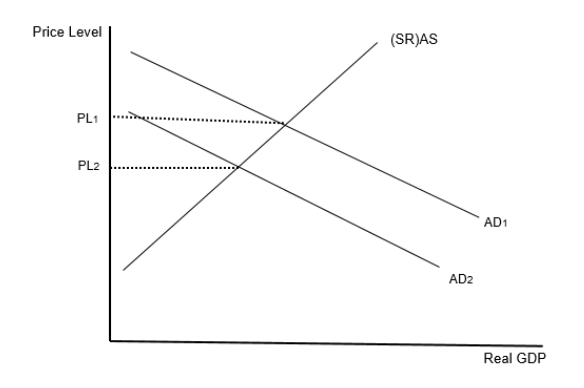
A tighter monetary policy, such as higher interest rates, reduces borrowing and consumption and investment. This reduces aggregate demand (AD), shifting AD to the left. As a result, the equilibrium average price level falls, reducing inflationary pressure.
(c) Using information from Text A, paragraph 3 and Table 4, explain the interdependence between the accounts in India’s balance of payments. [4]
Answer / Explanation
The balance of payments must balance overall because credits/inflows must be matched by debits/outflows. Therefore, a current account deficit must be matched by a corresponding surplus in the financial and/or capital accounts, apart from errors and omissions.
India had a current account deficit of US$30.14 billion in 2017 and US$33.42 billion in 2021. This deficit can be financed by financial account inflows such as foreign direct investment (FDI).
As stated in Text A, increased FDI inflows could help finance India’s current account deficit. Therefore, transactions recorded in one balance-of-payments account are interdependent with transactions in another account.
In addition, portfolio investment outflows can affect the current account in the future because investments made abroad may generate income inflows recorded in the current account.
(d) Using an international trade diagram for India, explain how lowering tariffs on British wine might impact UK wine producer revenue (Text A, paragraph 3). [4]
Answer / Explanation
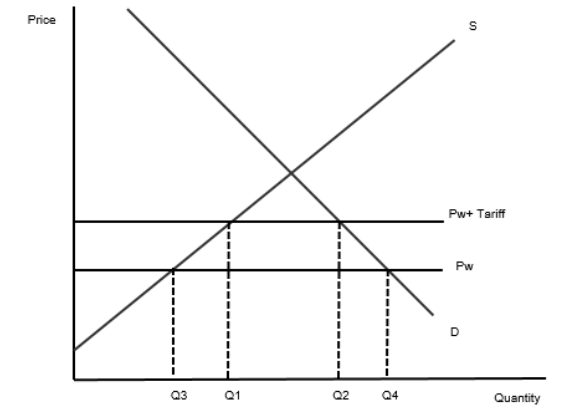
The tariff raises the domestic price of British wine above the world price. If India lowers the tariff, the domestic price of wine falls closer to the world price.
The lower price increases the quantity demanded of wine in India and reduces the quantity supplied by Indian domestic producers. Therefore, Indian imports of British wine increase.
Since British wine exports to India increase, UK wine producers sell a greater quantity of wine. Assuming the increase in quantity sold is sufficiently large, their total revenue increases.
(e) Using an externalities diagram, explain the market failure that could occur in the market for fossil fuel energy (Text B, paragraph 2). [4]
Answer / Explanation

Fossil fuel energy generates negative externalities, such as air pollution and greenhouse-gas emissions, which impose costs on third parties. These external costs are not fully reflected in the private market price.
Therefore, marginal social cost (MSC) is greater than marginal private cost (MPC). The market equilibrium occurs at a quantity Qₘ, which is greater than the socially optimal quantity Qₛₒ.
This results in an overallocation of resources to fossil fuel energy and a welfare loss, meaning the market outcome is not socially efficient.
(f) Using an AD/AS diagram, explain how increased female participation rates may impact India’s potential output (Text B, paragraph 2 and Table 1). [4]
Answer / Explanation

An increase in the female labour force participation rate increases the quantity of labour, which is a factor of production.
With more labour available, the productive capacity of the economy can increase. This shifts the long-run aggregate supply (LRAS) curve to the right.
Therefore, India’s potential output increases. This could contribute to higher long-term economic growth and, depending on the circumstances, may also reduce inflationary pressure.
This is particularly relevant because India’s female labour force participation rate was only 23 % in 2021, compared with a world average of 46.2 %.
(g) Using information from the text/data and your knowledge of economics, discuss the impact an India-UK trade agreement may have on India’s ability to achieve two sustainable development goals. [15]
Answer / Explanation
The India-UK free trade agreement (FTA) could have both positive and negative effects on India’s ability to achieve sustainable development goals (SDGs). The impact is likely to vary depending on the particular SDG and on how the agreement is implemented. Two particularly relevant goals are Goal 3: Good health and well-being and Goal 5: Gender equality.
Goal 3: Good health and well-being
The agreement could help India improve health outcomes through greater research and development (R&D) cooperation. Text B states that India and the UK are encouraging collaborative R&D, including in the healthcare sector. Previous India-UK cooperation contributed to global vaccine development and helped reduce market failure in the healthcare industry.
Targeted R&D could lead to cheaper medicines. Lower medicine prices would increase access to healthcare, particularly for lower-income households. Better health outcomes can also increase labour productivity because healthier workers are more able to participate effectively in production. This may therefore support both economic development and progress towards other SDGs.
The UK’s expertise in insurance could also improve India’s health insurance programme, potentially increasing access to healthcare and reducing the financial burden of medical treatment.
This is particularly important because India’s progress towards Goal 3 was decreasing in 2021. Therefore, collaboration with the UK could potentially provide significant benefits.
However, the FTA could also hinder progress towards Goal 3. Intellectual property rules may restrict India’s ability to produce low-cost generic medicines. This could reduce supply and increase prices. The creation of monopolies could further reduce consumer access to medicines.
In addition, the possible privatization of healthcare and water could increase prices and potentially create monopolistic outcomes. Therefore, the effect on health depends on whether the benefits from R&D and international cooperation outweigh the potential increase in prices caused by intellectual property protection and privatization.
Goal 5: Gender equality
The FTA could support Goal 5: Gender equality through greater access to credit and markets for women, improved education opportunities and increased female labour force participation. Text B specifically identifies these areas as part of the collaborative work between India and the UK.
Greater access to credit can allow women to establish or expand businesses, increasing their income and economic independence. Improved access to markets can increase the demand for goods and services produced by women. Similarly, better education can increase women’s human capital and improve their employment opportunities.
An increase in female labour force participation would also increase the quantity of labour available in India. This can increase productive capacity and shift LRAS to the right, raising potential output. Higher female employment and income may also reduce gender inequality and improve household living standards.
The potential benefit is significant because India’s female labour force participation rate was only 23 % in 2021, compared with the 46.2 % world average. In addition, India’s progress towards Goal 5 was described as stagnating, while the UK was on track towards achieving the goal. This suggests that cooperation with the UK could provide useful support.
Nevertheless, there are possible disadvantages. Text A states that increased competition may force firms to reduce labour costs. If labour protection remains weak, this could result in low wages and poor working conditions, potentially worsening inequality rather than improving gender equality.
Labour protection groups have also raised concerns about restrictions on labour unions. If workers, including women, have insufficient bargaining power, increased trade may not translate into better employment conditions. Therefore, the success of the FTA in improving gender equality would depend partly on effective labour protection.
Overall evaluation
Overall, the India-UK trade agreement has the potential to support India’s achievement of both Goal 3 and Goal 5, particularly through international cooperation, R&D, increased access to markets, improved education, healthcare and higher female participation in the labour force.
However, the benefits are not guaranteed. Intellectual property protection could increase medicine prices, privatization could reduce access to essential services, and weaker labour protection could limit the benefits to women and workers. The final impact will therefore depend on the policies accompanying the FTA and the extent to which India ensures that the gains from increased trade are distributed broadly and used to improve access to essential services and opportunities.
Given that India’s overall SDG progress was 59.98, compared with 80.53 for the UK, cooperation could provide substantial opportunities for India. However, the agreement is most likely to support sustainable development when trade liberalization is accompanied by appropriate regulation, labour protection, public investment and policies that address market failures.
Most-appropriate topic codes (CED):