
IBDP Economics 2.10 Market failure—asymmetric information (HL only) Paper 2- New Syllabus
Question
Read the extracts and answer the questions that follow.
Text D — Overview of Bhutan
Bhutan is a lower-middle income country in southern Asia. It is mountainous, water is plentiful, and 60 % of the territory is protected forest. Since 2008, Bhutan has measured its economic development by changes in its “Gross National Happiness” (GNH) index. The index considers factors such as income inequality, environmental conservation, sustainable development and gender equality, in addition to the components of the Human Development Index (HDI).
The pursuit of GNH has involved using government programmes to spread the benefits of economic growth across all social groups. An example of this is the construction of large hydropower plants, not only for the export of electricity but also to ensure that remote communities can buy power at low prices. Hydropower is a renewable method of producing electricity using the natural flow of water. With these new plants, all rural and urban areas had access to electricity by 2019.
Government intervention in the market for electricity has been necessary due to the high cost of resources. Both the production and distribution of electricity are therefore controlled by state-owned enterprises. Bhutan’s government has relied on India for grants and loans to finance hydropower projects.
Sales of surplus electricity to India, amounting to over 70 % of electricity generation in 2021, have increased the funds available to the government for investment in healthcare and education. These revenues have also helped to finance the expansion of essential infrastructure, particularly road networks. The government’s aim has been to reduce poverty and to improve well-being, especially in rural areas.
Hydropower has proved to be an important source of economic development. However, the private sector faces a lack of investment for multiple reasons, including high transport costs and a small domestic market. This has limited the creation of new private sector jobs. Furthermore, a sustainability tax of 100 USA dollars (USD) per night for tourists helps with Bhutan’s conservation efforts. The tax reduces Bhutan’s competitiveness as a tourist destination.
Agriculture is vital to Bhutan’s largely rural population. This sector employed 55 % of the workforce in 2021. However, most agricultural produce, such as rice, is consumed by farming households rather than sold in the market. By 2021, the country was importing about 50 % of its food. The growing food demands of urban areas could have negative consequences for the balance of payments.
Agricultural output is constrained by many factors, including a lack of machinery, irrigation and affordable credit. Bhutan’s partnership with the United Nations International Fund for Agricultural Development has provided funds for investment in the agricultural sector, such as irrigation systems, roads connecting farms to markets, and storage facilities. However, the GNH emphasis on sustainability could restrict growth in this sector. For example, to preserve biodiversity there are restrictions on the use of chemical fertilizers.
Text E — Youth unemployment in Bhutan
The youth unemployment rate for Bhutan in 2021 was 20.9 %. However, youth unemployment in towns was much higher than in rural areas. Approximately 60 % of the total unemployed youth were female.
There is a mismatch between the needs of employers and the skills of young people. Apart from this problem, the private sector requires government assistance in creating job opportunities so that young people can find employment outside of the public sector. Moreover, a lack of finance discourages the youth from entrepreneurship, further reducing their work prospects and the growth of Bhutan’s economy.
Text F — Bhutan’s trade relations with India
Bhutan has a free trade agreement with India, removing all tariffs between the two countries. In 2021–2022, about 80 % of Bhutan’s international trade was with India. India’s top imports from Bhutan include electricity, metals, and cement. Bhutan relies on India for goods such as fuel, cars, and rice. Transactions between the two countries are straightforward, as the central bank of Bhutan ensures the ngultrum (Bhutan’s currency, BTN) is fixed to the rupee (India’s currency, INR) at the exchange rate of 1 BTN = 1 INR.
Table 4: Economic data for Bhutan
| 2008 | 2021 | |
|---|---|---|
| Population (total) | 689737 | 782455 |
| Nominal gross domestic product (GDP) (USD million) | 1227.81 | 2539.55 |
| Real GDP (USD million) | 858.61 | 910.23 |
| GDP growth (annual %) | 4.8 | 4.1 |
| Current account balance (USD million) | −112.48 | −321.53 |
| Exchange rate (BTN per USD) | 43.51 | 73.94 |
Table 5: Development data for Bhutan
| 2007 | 2022 | |
|---|---|---|
| Life expectancy at birth (years) | 67 | 72 |
| Absolute poverty (% of population living on less than USD 2.15 (2017 PPP) per day) | 5.9 | 0 |
| Gini coefficient | 0.381 | 0.285 |
| People using safe sanitation services (% of population) | 44 | 51 |
(a) (i) Define the term infrastructure indicated in bold in the text (Text D, paragraph 4). [2]
Answer / Explanation
Infrastructure refers to large-scale public systems, services and facilities that are necessary for the functioning of an economy. It forms part of a country’s capital stock and is usually provided by the government. For example, road networks are infrastructure.
(a) (ii) Define the term private sector indicated in bold in the text (Text D, paragraph 5). [2]
Answer / Explanation
The private sector consists of economic activities, production and factors of production that are owned and controlled by private individuals or organizations rather than the government.
(b) (i) Using information from Table 4, calculate Bhutan’s GDP deflator in 2021. [2]
Answer / Explanation
GDP deflator = (Nominal GDP ÷ Real GDP) × 100
= (2539.55 ÷ 910.23) × 100
= 279.0009…
GDP deflator = 279
(b) (ii) Using information from Table 4, calculate Bhutan’s real GDP per capita in USD in 2008. [1]
Answer / Explanation
Real GDP per capita = 858.61 million ÷ 689737
= USD 1244.84 per person
Therefore, USD 1244.84 or USD 1245 is acceptable.
(b) (iii) A cement firm based in Bhutan contributed USD 800 000 to the nominal GDP of Bhutan in 2021. Using information from Table 4, calculate the firm’s contribution in BTN to Bhutan’s nominal GDP in 2021. [2]
Answer / Explanation
Exchange rate in 2021 = 73.94 BTN per USD
Contribution in BTN = 800 000 × 73.94
= BTN 59 152 000
(c) Using an AD/AS diagram, explain the likely effect on Bhutan’s real GDP of a large fall in sales of metals and cement to India (Text F). [4]
Answer / Explanation
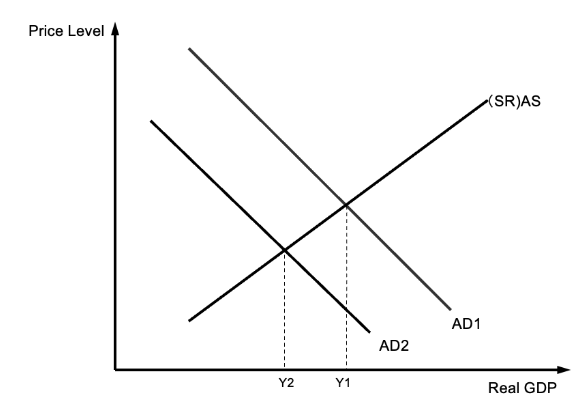
A large fall in sales of metals and cement to India represents a fall in Bhutan’s export revenue. Since exports are a component of aggregate demand, lower exports cause AD to decrease.
Therefore, the AD curve shifts left from AD1 to AD2. With SRAS unchanged, the equilibrium level of real GDP falls from Y1 to Y2.
(d) Using a demand and supply diagram, explain the likely effect of increased use of farm machinery on the price of agricultural goods, such as rice, in Bhutan (Text D, paragraph 7). [4]
Answer / Explanation
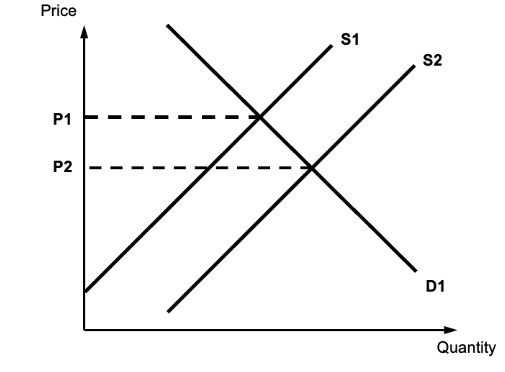
Increased use of farm machinery increases the quantity and/or quality of capital and can increase productivity and efficiency. It may also reduce farmers’ production costs.
As a result, the supply of agricultural goods such as rice increases, shifting the supply curve to the right. With demand unchanged, the equilibrium price falls and the quantity supplied increases.
(e) Using an exchange rate diagram, explain how the central bank of Bhutan could maintain its fixed exchange rate during a period of increasing demand from India for electricity produced in Bhutan (Text F). [4]
Answer / Explanation
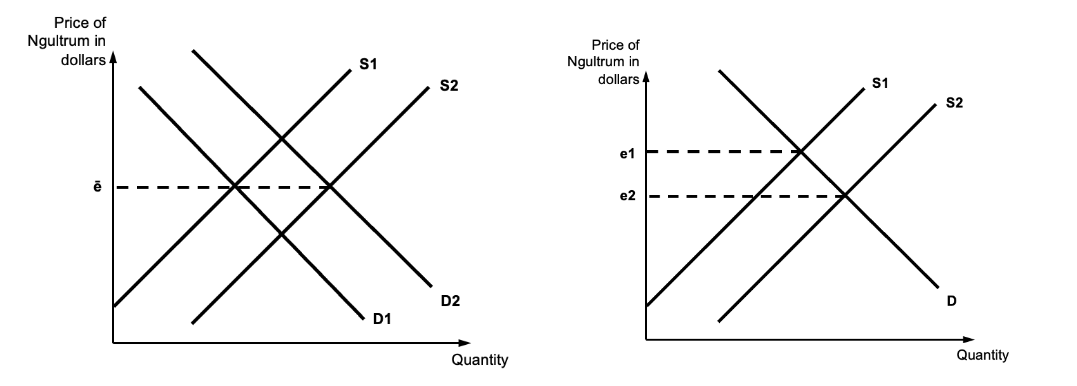
Increased demand from India for Bhutanese electricity increases Bhutan’s exports and creates upward pressure on the value of the ngultrum.
To prevent an appreciation of the ngultrum and maintain the fixed exchange rate, the central bank can sell ngultrums and purchase foreign currencies/assets. This increases the supply of ngultrums in the foreign exchange market, shifting the supply curve to the right.
The increased supply places downward pressure on the exchange rate and allows it to be maintained at the fixed rate. Alternatively, the central bank could lower the interest rate to put downward pressure on the exchange rate.
(f) Using an externalities diagram, explain how government subsidies to improve sanitation could achieve allocative efficiency in Bhutan’s sanitation services market (Table 5). [4]
Answer / Explanation
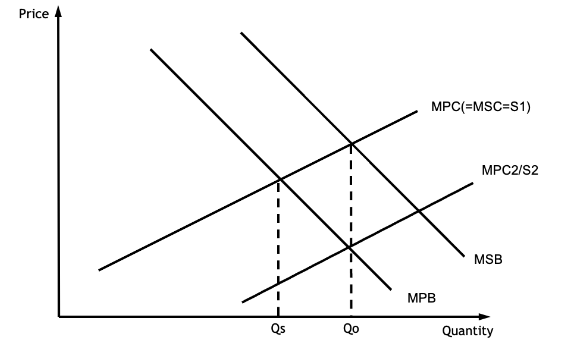
Sanitation services generate a positive externality of consumption because benefits such as improved public health and reduced spread of disease extend to third parties. Therefore, MSB is greater than MPB.
Without government intervention, the market produces less than the socially optimal quantity because consumers consider only their private benefits.
A government subsidy reduces the cost of providing sanitation services. This shifts the MPC/supply curve downwards (to the right), increasing the quantity of sanitation services towards the socially optimal output Q0.
This allocates more resources to the sanitation market and reduces the welfare loss. At the socially optimal equilibrium, MSB = MSC, achieving allocative efficiency.
(g) Using information from the text/data and your knowledge of economics, evaluate the strengths and limitations of Bhutan’s economic development strategy. [15]
Answer / Explanation
Bhutan’s economic development strategy is based on improving Gross National Happiness (GNH) rather than focusing only on economic growth. It combines policies aimed at economic growth, equity, poverty reduction, human development and environmental sustainability. The strategy includes trade liberalization, hydropower investment, infrastructure development, foreign aid, healthcare and education spending, agricultural investment, environmental protection and a fixed exchange rate.
One major strength is that the GNH approach has a broad definition of economic development. It considers income inequality, environmental conservation, sustainable development and gender equality in addition to HDI-related factors. This is wider than measures such as GDP per capita alone. There is evidence of improvement in several development indicators: life expectancy increased from 67 years in 2007 to 72 years in 2022, the Gini coefficient fell from 0.381 to 0.285, and absolute poverty fell from 5.9 % to 0 %. HDI also increased over the period shown in Figure 1.
Trade liberalization with India is another strength. Bhutan’s free trade agreement removes tariffs between the two countries. Increased exports, particularly electricity, can generate export revenue and contribute to economic growth. Sales of electricity to India also provide funds for government spending and can help finance imports.
However, the high degree of dependence on India is a significant limitation. Around 80 % of Bhutan’s international trade was with India in 2021–2022. This concentration makes Bhutan vulnerable to external shocks, such as a fall in Indian demand for Bhutanese exports. Greater export diversification would therefore make the economy more resilient. The removal of tariffs under the free trade agreement may also result in a significant loss of government tariff revenue.
Hydropower and infrastructure investment have also supported development. Hydropower provides electricity to rural communities at low prices, while sales to India generate revenue for state-owned enterprises and help finance healthcare and education. Improved infrastructure can improve the quantity and quality of resources and may encourage private-sector investment by reducing transport costs.
Nevertheless, Bhutan still faces high transport costs, suggesting that infrastructure remains inadequate. Government spending on infrastructure also has an opportunity cost. In addition, infrastructure construction may generate negative externalities, creating a conflict with Bhutan’s GNH and environmental objectives.
Foreign aid is another strength because it can fill a savings gap. Grants and loans from India allow the government to undertake investment expenditure that might otherwise be unaffordable. This can increase productive capacity and support development. However, loans must be repaid with interest. The growing reliance on foreign borrowing can therefore create future financial obligations and may have implications for the balance of payments and current account.
Investment in healthcare and education can improve human capital. Better education can increase workers’ skills and productivity, raising potential output. Better healthcare can improve worker productivity and life expectancy. Education may also help reduce Bhutan’s high youth unemployment. However, there remains a mismatch between the skills of young people and employers’ requirements, while lack of finance discourages youth entrepreneurship. Approximately 60 % of unemployed youth are female, so progress towards gender equality remains questionable. Government spending also has an opportunity cost.
Environmental sustainability is an important strength. Bhutan protects its forests and uses GNH to promote environmental conservation and sustainable development. A sustainability tax on tourists generates government revenue while supporting conservation. Regulations on chemical fertilizers also aim to make agriculture more sustainable. However, environmental policies can create trade-offs with economic growth. Restrictions on fertilizer use may limit agricultural productivity, while the USD 100 per night tourism tax may reduce Bhutan’s competitiveness and lower tourism-sector incomes.
Agricultural investment has potential to reduce rural poverty and inequality. The partnership with the UN agency provides investment in irrigation, roads and other agricultural infrastructure. Higher productivity could help farmers break the poverty cycle, improve food security and reduce the need for food imports. Better roads can also improve access to employment, schools and hospitals. However, dependence on foreign aid is a limitation, and much agricultural production is subsistence-based rather than marketed, which may restrict potential productivity gains.
The fixed exchange rate with the Indian rupee also has advantages because it facilitates trade with India and makes the cost of imported necessities such as fuel and rice less volatile. However, maintaining the fixed exchange rate requires central-bank intervention and restricts Bhutan’s freedom to conduct independent monetary policy.
Overall, Bhutan’s development strategy has achieved considerable progress in economic development. The reduction in absolute poverty and income inequality, increase in life expectancy, improvement in HDI and wider access to electricity indicate that the strategy has improved economic well-being. However, its effectiveness is constrained by dependence on India and foreign aid, limited private-sector investment, youth unemployment, high transport costs and trade-offs between environmental sustainability and economic growth.
Therefore, the strategy is strong in promoting inclusive and sustainable development, particularly because it considers objectives beyond GDP. However, for long-term development Bhutan would benefit from greater diversification of exports, stronger private-sector development and reduced dependence on external finance, while maintaining its environmental and social objectives.
Most-appropriate topic codes (CED):