The strong Thai baht
- Thailand’s currency, the Thai baht, ended 2019 at its highest value in more than six years. With a 7.8 % gain against the United States dollar (US$), it was the currency that appreciated the most among major Asian currencies.
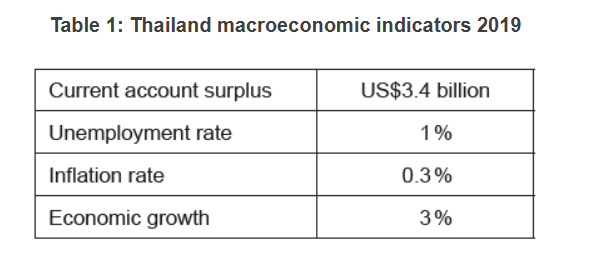
- The Thai baht’s appreciation was caused by several factors. Many foreign investors are attracted by Thailand’s economic stability, high levels of foreign reserves, low inflation rate and low unemployment (Table 1). However, the inflation rate is below the central bank’s target.
- Initially, the central bank of Thailand (BoT) was not too concerned, as the strong Thai baht was helping Thai importers and those who had foreign debts. Additionally, Thai producers could afford to import new technology and capital equipment. An appreciating currency could also help improve the country’s terms of trade.
- However, a strong currency can have severe consequences on an export-oriented country like Thailand. Exports account for 65 % of gross domestic product (GDP), and in 2019 exports declined by 7 %. Additionally, the tourism industry, which makes up approximately 20 % of GDP and accounts for 16 % of employment, started to express concern. Economic growth in 2019 was 3 %, down from 4.1 % in 2018.
- Therefore, towards the end of 2019, the BoT implemented measures to prevent further appreciation of the Thai baht. The BoT reduced controls on capital outflows to make it easier for Thai citizens to move money abroad. Additionally, restrictions were placed on the amount of money foreigners could hold in Thai bank accounts.
- The BoT is considering further measures including the use of foreign reserves, a decrease in the interest rate, and imposing controls on capital inflows, to prevent speculative inflows. However, these controls may impact the country’s credibility and financial markets. Expansionary monetary policy may also increase household debt which, at 78.6 % of GDP, is among the highest in Asia.
- The BoT is concerned about using foreign reserves, as this may result in Thailand being labelled a currency manipulator* by the US. Currently, Thailand’s overall large current account surplus is the only requirement it meets to be labelled a currency manipulator. However, Thailand’s bilateral trade surplus with the US is currently US$19 billion, which means it is close to meeting a second requirement. Thailand wants to avoid being labelled a currency manipulator as the US may use trade protection in retaliation.
Question
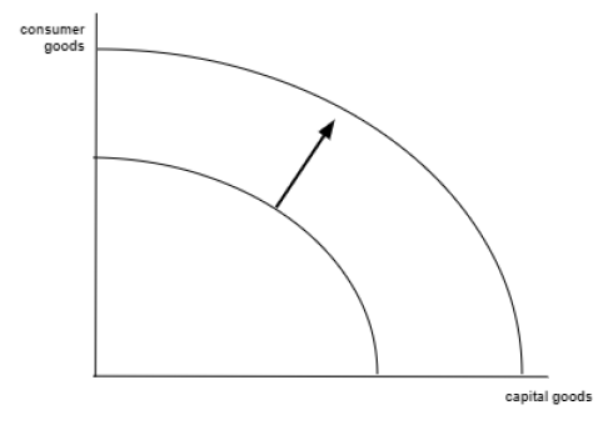
Using a production possibilities curve (PPC) diagram, explain how the importing of “new technology and capital equipment” might affect Thailand’s production possibilities (paragraph [3]).
▶️Answer/Explanation
For drawing a correctly labelled PPC diagram, showing an outward shift of the PPC
AND
For explaining that technology/capital equipment increases the quantity and/or quality/efficiency/productivity of resources/factors which will lead to outward shift the curve, therefore increasing potential output/production possibilities.
AND
For explaining that technology/capital equipment increases the quantity and/or quality/efficiency/productivity of resources/factors which will lead to outward shift the curve, therefore increasing potential output/production possibilities.